The Unusual Suspects: Shamgar
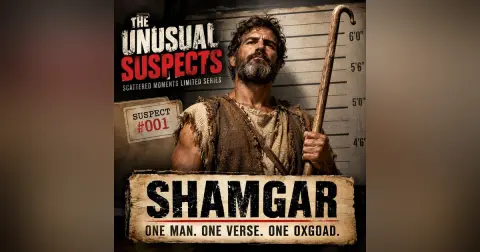
Some people in Scripture get entire books. Shamgar gets one verse. Judges 3:31 introduces him almost as quickly as it leaves him: “After Ehud came Shamgar son of Anath, who struck down six hundred Philistines with an oxgoad. He too saved Israel.”That's essentially his entire biography. No tribe is identified. No hometown is given. There is no calling narrative, no recorded prayer or speech, and no explanation of how the battle unfolded. Yet Scripture gives Shamgar one remarkable distinction: ...


Some people in Scripture get entire books. Shamgar gets one verse.
Judges 3:31 introduces him almost as quickly as it leaves him:
“After Ehud came Shamgar son of Anath, who struck down six hundred Philistines with an oxgoad. He too saved Israel.”
That's essentially his entire biography.
No tribe is identified. No hometown is given. There is no calling narrative, no recorded prayer or speech, and no explanation of how the battle unfolded. Yet Scripture gives Shamgar one remarkable distinction:
“He too saved Israel.”
Who was Shamgar?
We simply don't know very much.
Even his identity raises questions. The name Shamgar is unusual in the Hebrew Bible, and scholars have debated whether it reflects a non-Israelite background. His designation “son of Anath” is equally intriguing. Anath was the name of a prominent Canaanite warrior goddess, although the phrase does not necessarily mean Shamgar worshiped her. It could reflect a personal name, geographic association, or possibly some kind of military designation.
Whatever the explanation, the Bible does not provide Shamgar with the kind of clear Israelite genealogy we might expect from one of Israel's deliverers.
That makes the final statement even more striking:
God used him to save Israel.
Shamgar appears one other time
Shamgar's name appears again in Judges 5:6, in the Song of Deborah and Barak:
“In the days of Shamgar son of Anath, in the days of Jael, the highways were abandoned; travelers took to winding paths.”
It paints a picture of a frightened and unstable land. Normal travel had become dangerous. People avoided the main roads.
Whether Shamgar's exploits occurred immediately before Deborah's time or overlapped with it is difficult to determine precisely, but the picture is clear: these were dangerous days.
And Shamgar stood up in the middle of them.
And then there's the oxgoad.
An oxgoad was an agricultural implement rather than a conventional weapon of war. It was essentially a long wooden pole, often fitted or sharpened at one end, used for directing oxen.
Shamgar apparently took something associated with ordinary work and used it in an extraordinary confrontation.
Scripture says he struck down 600 Philistines with it.
The text doesn't tell us whether this happened in a single encounter, a series of encounters, or exactly how the fighting unfolded. We shouldn't fill in details Scripture doesn't give us.
But perhaps that's part of what makes Shamgar's story so compelling.
The Bible doesn't tell us everything about the battle. It tells us what Shamgar had in his hand—and what God accomplished through him.
What are your Philistines?
We don't face Shamgar's Philistines, but we certainly face enemies.
Some are within us: pride, greed, lust, bitterness, gossip, addiction.
Others come against us: disease, grief, poverty, loneliness, circumstances we never chose and cannot control.
They aren't all fought in the same way. Some things must be resisted. Others must be endured. Some can be overcome. Others require us to stand faithfully in circumstances we cannot change.
And that's where Shamgar leaves us with another question:
What's your oxgoad?
What has God already placed in your hand?
A skill.
A relationship.
A testimony.
A Scripture you know.
A friend you can call.
A church family.
Years of experience.
Perhaps simply enough courage to take the next faithful step.
We can become so preoccupied with the sword we don't possess that we overlook the oxgoad already in our hand.
Moses had a staff.
David had a sling.
A boy had bread and fish.
And Shamgar had an oxgoad.
One verse. One man. One oxgoad.
And four words that make quite a résumé:
“He too saved Israel.”
The Unusual Suspects is a limited series from Scattered Moments, exploring the overlooked, unexpected, and sometimes downright strange people God uses throughout Scripture.
Take heart. Notice the scattered moments. Share the grace.
There are some people in the Bible who get chapters. Abraham gets chapters, David gets books, Paul gets letters, Shamgar gets one verse. Welcome to the unusual suspects, the people nobody expected, barely noticed, and probably wouldn't have picked. And today's suspect is a man named Shamgar. Here's practically everything the Bible tells us about him. Judges 3, 31 says, After Ehud came Shamgar, son of Anath, who struck down 600 Philistines with an oxcope. He too saved Israel.
SPEAKER_00Shamgar, son of Anath, no known address, no tribe listed. Guy practically walks into the Bible without identification.
SPEAKER_01And that's the unusual suspect for this episode. Thank you for listening. Okay, maybe we should dig a little deeper. Because that one verse is absolutely loaded. We don't know where Shamgar lived. We're not given his tribe. We don't get his family history beyond the strange designation son of Anath. Even his name suggests that his background wasn't conventionally Hebrew.
SPEAKER_00Wasn't that the guy from Nabu with the faulty lightsaber who flunked out of Jedi training? Nope. You know anything about Star Wars?
SPEAKER_01Not enough to continue this conversation.
SPEAKER_00Moving on.
SPEAKER_01And move on, we shall. If Shamgar filled out an application for the position of deliverer of Israel, human resources would have had some questions. No resume, no military record that we know of. No famous lineage. No calling experience recorded in scripture. No speech, no army, just Shamgar. And then there's his weapon, an ox goat. Now I've done the research on this. I've gone through the Hebrew, considered the culture and the era, and apparently the ox goat is a stick used to goad an ox. Ox. Goad. My wife uses her words to goad me. That's her husband goad. And it's for another episode entirely. An oxgoad wasn't a sword. It wasn't a spear. It wasn't an ancient military superweapon. It was a farming implement, a long pole used to prod or direct oxen. Apparently, Shamgar looked around, saw Philistines, looked down at what he had in his hand, and thought, well, that'll do, stick. And so it did.
SPEAKER_00No sword, no spear, no military hardware, just farm equipment. This case keeps getting weirder.
SPEAKER_01Now I have a lot of questions about this verse. 600 Philistines at once, over time? Was Shamgar alone? Were there others fighting with him? The Bible doesn't tell us. But the Bible tells us what matters. He saved Israel. And maybe that's where this strange little story stops being about Shamgar and starts being about us. Because Shamgar had his Philistines. And so do we. Not an ancient kind with swords and shields, but there are a few things that invade our territory. Things that steal our peace, things that threaten the people we love, things that keep us from becoming the people God has called us to be. So what are your Philistines? Maybe they're within you. Lust, greed, bitterness, gossip, pride, and addiction you can't seem to shake, or maybe they're around you. Disease, poverty, grief, loneliness, a situation you didn't create and cannot control. Some Philistines need to be resisted, some need to be endured, some need to be overcome. And some require us to simply stand our ground and trust God. But here's where Shamgar's story gets interesting. Because when Shamgar faced his Philistines, apparently he didn't have a weapon you would expect. He had an ox goat, and maybe that's the question hiding inside the strange little verse. What's your oxgoat? What has God already put in your hand? Maybe it's a relationship, a skill, a scripture you've memorized, a friend you can call, a church family, a testimony, a little money, a lot of experience. Maybe it's simply enough courage to do the next right thing. We spend so much time thinking about what we don't have. I don't have enough experience. I don't have enough influence. I don't have enough connection. I don't have enough money. I don't have the right personality. I don't have what they have. There's always a they, isn't there? Maybe the question isn't what am I missing? Maybe it's what's already in my hand. Moses had a staff, David had a sling, a little boy had some bread and fish, and Shamgar had an ox goat. Shamgar didn't wait for somebody to hand him a sword. He used what was in his hand, where he was, and when the moment came, one verse, one man, one ox goat. Case closed. Not quite. Because the real mystery isn't how much we're told about Shamgar. The real mystery is how God keeps doing extraordinary things through ordinary people with ordinary things already in their hands. And tucked almost casually into the story are four words that may be the best resume anybody ever had. He too saved Israel. You don't have to occupy too many pages to make a difference. I truly believe that bit characters can save the world. You don't have to have an impressive background. You don't have to have the obvious weapon. You don't have to wait until you have everything that you need. Maybe today you just need to identify your Philistine. Look at what's already in your hand and trust God with both. One verse, one man, one oxcode, and one very unusual suspect.


