September 30 | Moments Almanac | Hours
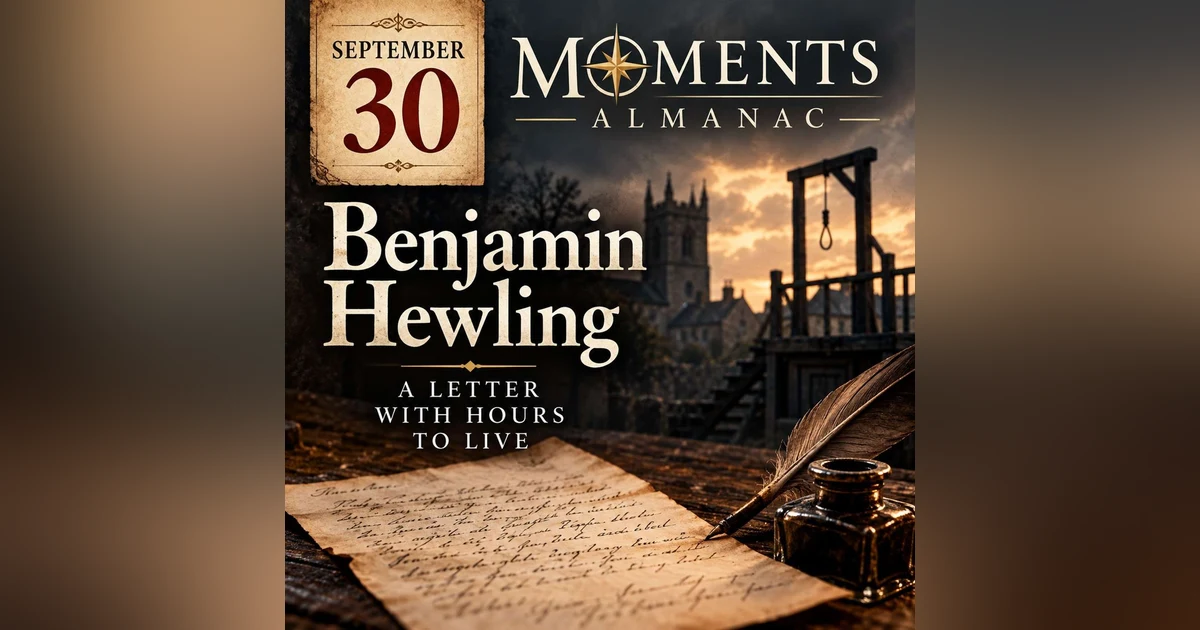


On September 30, 1685, twenty-two-year-old Benjamin Hewling sat down in Taunton, England, knowing he had only hours to live. Condemned for his part in the failed Monmouth Rebellion—and having already lost his younger brother to the executioner—Benjamin picked up a pen and wrote one final letter to his mother.
What he wrote was not filled with anger or despair, but with an extraordinary confidence in Christ.
In this episode of Moments Almanac, we remember a young man facing the end of his life and the remarkable words he left behind:
“Blessed be the Almighty God that gives comfort and support in such a day.”
Sometimes faith doesn't change what happens next. Sometimes faith changes the way we meet it.
Welcome to Moments Almanac for September 30th. And on this day in 1685, a 22-year-old man sat in Taunton, England, and wrote a letter to his mother. He knew it would be his last. His name was Benjamin Hewling. A few months earlier, England had erupted in rebellion. James II was on the throne, and the Duke of Monmouth had raised an army against him. Benjamin Hewling and his younger brother William joined Monmouth's forces. By their own account, they believed they were fighting for English liberties and the Protestant faith. They weren't merely spectators. Benjamin commanded cavalry, and William served as a lieutenant. And when Monmouth's rebellion collapsed, so did their hopes of returning quietly to ordinary life. The trials and executions that followed became known in history as the Bloody Azizens. And there was another layer to the Hewling story. Their grandfather was William Kiffin, a wealthy London merchant and one of the most prominent Baptist leaders in England. Kiffin had spent years advocating for religious liberty. He had influence, he had money, he had connections, but none of it could save his grandsons. William, not yet twenty years old, was executed in Lyme on september twelfth. Eighteen days later Benjamin received word that his turn had come. Imagine that morning. You're twenty two. Your younger brother is already dead. A warrant has arrived. And somewhere your mother is waiting, hoping that perhaps someone with influence would intervene. Perhaps there would be a pardon, perhaps the execution would be delayed, perhaps somehow her son would come home. Benjamin knew otherwise, so with only a few hours remaining he picked up a pen and he began writing Honored Mother And then he told her the news that she had dreaded. The warrant had arrived. Within hours he expected the sentence to be carried out. And here's what catches me. William doesn't spend the rest of the letter raging against the king. He doesn't write pages defending the rebellion. He doesn't curse the judge. He doesn't even spend much time defending himself. Instead, he writes about Christ. In one of the most remarkable lines in the letter, he says this Blessed be the Almighty God that gives comfort and support in such a day. Such a day not a good day. Not an easy day. Not a day he would have chosen, such a day. A day when the future had shrunk from years to hours, and yet he discovered that the grace of God did not disappear when the options did. Benjamin wrote about Christ being able to save those who come to him. You can almost hear Hebrews 7.25 behind his words. And then Benjamin did something remarkable. With his own death approaching, he began to worry about everybody else. Tell them, he wrote, how precious it is to belong to Christ when you come to die. And then he entrusted his family to God. Finally he signed the letter, your dying son, Ben Hewling. Hours later, Benjamin Hewling was executed, september thirtieth, sixteen eighty-five, Taunton, England. Now Benjamin's story is complicated. He participated in an armed rebellion. He was not simply dragged from his home and killed because he was a Christian. History deserves that distinction, but faith often reveals itself more clearly in complicated stories, because whatever mistakes, convictions, politics, dreams, and decisions had brought Benjamin to that room, there he was, twenty-two years old, hours from eternity. And suddenly most of the things that had seemed so large had become very small. The rebellion was over, the arguments were over, the ambition was over. The only question remaining was what can I hold on when everything else has been taken away? And Benjamin's answer was Christ. And that is the question September 30th leaves us. We spend so much time in our lives holding things we assume will always be there, our plans, our health, our influence, our families, our tomorrow. But eventually every hand has to open. And when it does, what remains? Benjamin Hewling discovered something at 22 that many of us spend a lifetime trying to learn. Faith is not merely a confidence that God will keep the difficult day from coming. Sometimes faith is discovering that when such a day comes, God is already there. Blessed be the Almighty God that gives us comfort and support in such a day. September 30th, a young man, a scaffold waiting, a mother receiving one final letter, and a reminder almost three and a half centuries later that sometimes faith doesn't change what happens next. Sometimes faith changes the way we need it. And that's Moments Almanac for the last day in September, September 30th. I'm Matt Tullis. I hope you'll join me tomorrow. Until then, take heart. Notice the scattered moments and share the grace.


