September 25 | Moments Almanac | Amendment
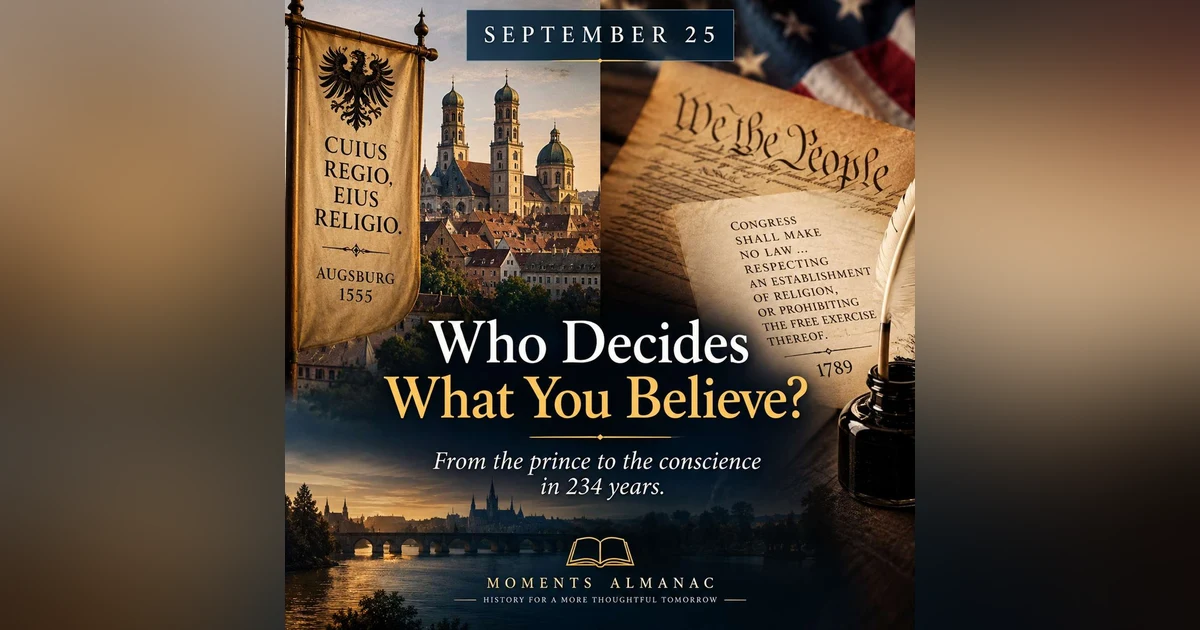
Who has the right to decide what you believe—your ruler, your government, or your conscience? On September 25, 1555, the Peace of Augsburg established a religious settlement in the Holy Roman Empire that allowed territorial rulers to choose between Catholicism and Lutheranism. For ordinary believers, religious freedom remained largely out of reach. Exactly 234 years later, on September 25, 1789, the United States Congress submitted proposed constitutional amendments to the states, including w...


Who has the right to decide what you believe—your ruler, your government, or your conscience?
On September 25, 1555, the Peace of Augsburg established a religious settlement in the Holy Roman Empire that allowed territorial rulers to choose between Catholicism and Lutheranism. For ordinary believers, religious freedom remained largely out of reach.
Exactly 234 years later, on September 25, 1789, the United States Congress submitted proposed constitutional amendments to the states, including what would become the First Amendment. Among those who helped secure these protections were Baptist preacher John Leland and the Virginia Baptists, who pressed James Madison to safeguard religious liberty.
In this episode of Moments Almanac, we explore two pivotal moments in history and the remarkable journey from the authority of the prince to the freedom of the conscience.
But this is more than a story about government and religious liberty. It's a reminder of a profound spiritual truth: You can compel religious conformity, but you cannot legislate a new heart.
Jesus declared, "My kingdom is not of this world" (John 18:36). His kingdom advances not through coercion, but through the transforming power of grace.
Join us as we remember the believers who helped secure religious freedom and consider why genuine faith must be freely given.
Because the conscience belongs neither to the prince nor to the president. It is accountable to God.
Moments Almanac is part of Scattered Moments with Matt Tullos. Take heart. Notice the scattered moments. Share the grace.
Welcome to Moments Almanac for September 25th. On this day in 1555, a remarkable agreement was signed in Augsburg, Germany. After years of religious conflict, the Holy Roman Empire recognized Lutheranism along with Roman Catholicism. It was called the Peace of Augsburg. But there was a catch. The agreement embraced a principle that would become famous. Surius regio is religio. Whose realm his religion. In other words, the prince decided what his people believed. If your ruler was Lutheran, your territory was Lutheran. If he was Catholic, your territory was Catholic, and if you disagreed you could leave. It was a significant step toward religious coexistence, but freedom of conscience remained largely out of reach. Now turn the calendar forward exactly, exactly two hundred and thirty four years. September twenty fifth, seventeen eighty nine, across the Atlantic in a young nation called the United States, Congress approved twelve proposed amendments to the Constitution and sent them to the states for ratification. Among them was a remarkable protection that would become the First Amendment. Congress could establish no national religion or prohibit its free exercise. And Baptists helped make it happen. For years, Virginia Baptists had suffered for preaching without government permission. Some had been fined and others imprisoned. Among their champions was a Baptist named John Leland. Leland believed that faith was a matter between God and the individual. He and other Baptists pressed James Madison to secure religious liberty in the Constitution, and Madison listened. The proposed amendments would eventually become the Bill of Rights in 1791. Two September twenty fifths, two radically different approaches to religious authority. In Augsburg, the ruler determined the religion of his territory, and in America, a constitutional protection was taking shape to keep the federal government from dictating the individual's faith. But here's what I find most remarkable. Long before Augsburg or America, Jesus stood before Pontius Pilate and declared, My kingdom is not of this world. Christ's kingdom does not advance through the coercive power of government. It advances through the transforming power of grace. You can force a man to attend a church, you cannot force him to worship. You can compel someone to recite a creed, you cannot compel him to believe it. You can legislate religious conformity, you cannot legislate a new heart. And that's why religious liberty is so precious. It recognizes that the conscience belongs neither to the prince nor the president. It is accountable to God. Today, thank God for the freedom to worship. I do. And remember those around the world who still pay a terrible price for exercising that freedom, because faith that is forced is not faith freely given. And the king who invites us to follow him is worthy of our willing hearts. Thanks for joining me for Moments Almanac. I hope you'll join me tomorrow. Until then, take heart. Notice the scattered moments and share the grace.


