Sleep Story: The Empty Table
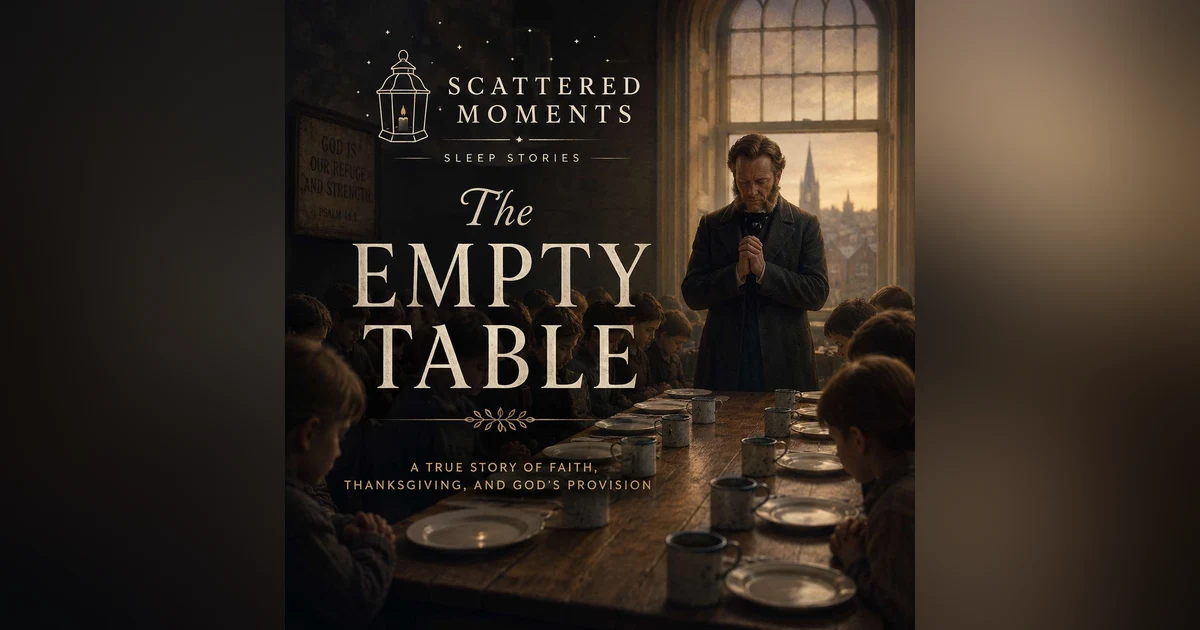


As dawn breaks over nineteenth-century Bristol, three hundred orphaned children gather around empty tables with nothing to eat. There is no bread, no milk, no money—only a prayer of thanksgiving spoken before the answer arrives.
In The Empty Table, journey into the remarkable true story of George Müller, whose unwavering trust in God's provision became a testimony that has inspired believers for generations. Told with gentle narration and peaceful pacing, this sleep story invites you to lay down your worries, release tomorrow into God's hands, and rest in the faithfulness of the One who knows every need before we ask.
Tonight, if your own table feels empty, may this story remind you that God's provision often begins in the quiet space between the prayer and the answer.
🌙 Scattered Moments Sleep Stories blend Scripture, history, and peaceful storytelling to help you end the day in God's presence and drift into restful sleep.
Welcome to Scattered Moments Sleep Stories. This time it's not meant to teach you something. It's meant to help you rest. Find somewhere comfortable. Tim the lights if you can. You don't need to remember any of this, and you don't need to stay awake for the ending. If you drift off partway, that's not a failure. That's the whole point. Tonight's sleep story is called The Empty Table, based on the life of George Mueller. It's early morning in Bristol, England. Sometime in the 1840s. The sky outside is the color of ash just before it lightens. Inside a long dining room at Ashley Down, 300 children are sitting at their places, hands folded, waiting for breakfast that has not arrived. There is nothing on the table, no bread, no milk. The plates are clean because there was nothing to put on them. In the kitchen there is no flour, no money, and no plan. Only a man named George Mueller standing at the head of the room, about to do the same thing he has done nearly every difficult morning for years. He was not always that kind of man. As a boy in Prussia, George Mueller lied without thinking twice. He stole from his own father. He gambled away money meant for his studies. And on the night his mother lay dying, he was out drinking with friends who didn't know and wouldn't have cared. If you had known him then, you would not have guessed what was coming. But something shifted in him at a small prayer meeting in 1825. Quiet, unremarkable. The kind of evening that doesn't announce itself as a turning point until years later, looking back. By the time he settled in Bristol, that belief became a discipline. He decided he would never ask another human being for money. Not from the pulpit, not in a letter, not with a hint, dropped right at the moment of need. If the work was God's, he reasoned, then God alone would be asked to supply it. He kept that promise for sixty-six years. It meant nights like this one. Empty plates, three hundred children too young to understand why their breakfast hadn't come. And one man old enough to know exactly how many times he stood in this spot before, with the same nothing in front of him. So he did what he always did. He lifted his hands over the empty plate, the same hands that had once picked pockets and lied to his father. And he said, Dear Father, we thank thee for the food thou art going to give us to eat. Not a plea, a thank you. For something that, as far as anyone in the room could see, did not exist. Before the children had even lifted their heads, there was a knock at the door. A baker stood there, flowers still on his sleeves, looking a little embarrassed. He hadn't been able to sleep the night before, he said. Something had kept nagging him that the orphanage wouldn't have bread in the morning. So at two o'clock, unable to shake the feeling, he had gotten up and baked three batches. And here he was. Mueller thanked him and turned back toward the children. He hadn't finished speaking when a second knock came. This time it was the milkman standing outside next to a cart with a broken wheel right in front of the orphanage. He couldn't fix it until the milk was unloaded, he explained. And it would spoil if it sat much longer. Would they take it off his hands? By the time the sun was fully up, there was bread on the table, and there was milk in the cups, and three hundred children were eating a breakfast that had not existed forty minutes earlier. Mueller did not act surprised. This was not the first time, and it would not be the last. Over the course of his life, he cared for more than 10,000 orphans this way. Never a fundraising letter, never a public appeal, never a debt. He kept meticulous records of every gift down to the last shilling, so that no one could ever say the money came from anywhere. But the quiet, unglamorous place he always said it came from. He was an old man by the time he finally slowed down. And even then he kept traveling, kept praying, kept trusting the same way he had at 30. When he died in 1898, the streets of Bristol were filled with people who had grown up inside the walls he built out of nothing. But that habit of thanks spoken before an answer arrived. This is something worth remembering tonight as you drift to sleep in all the needs and worries of the day. Not the bread, not the milk, the waiting. The plates set out before there was any reason to expect they'd be lifted. The willingness to say thank you first, and let the answer catch up whenever it was ready to you. Early, and you can rest the way three hundred children in Bristol learned to rest in the quiet space between the asking and the answer.


