July 14, 2026 | Moments | Almanac | Bastille
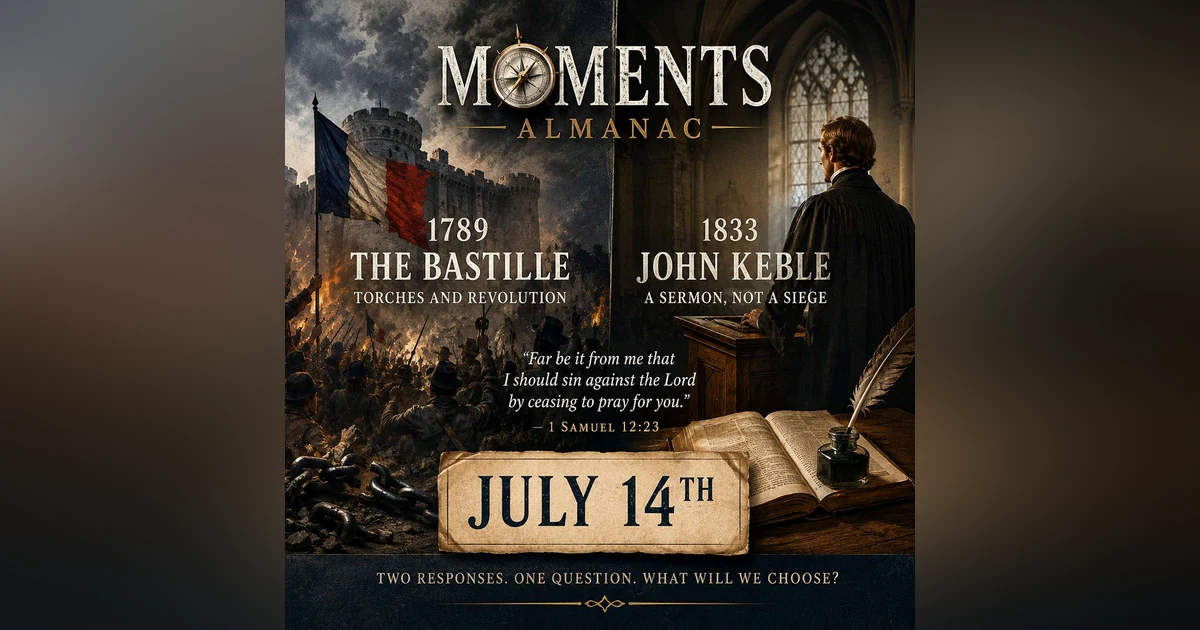
One date. Two revolutions. Two very different ways of changing the world. On July 14, 1789, the storming of the Bastille ignited the French Revolution, unleashing forces that would reshape Europe through violence and upheaval. Forty-four years later, on that same date, an English pastor named John Keble stepped into a pulpit with a different vision for renewal—one rooted not in rage, but in prayer. In this episode of Moments Almanac, we explore the surprising connection between the Bastille, ...


One date. Two revolutions. Two very different ways of changing the world.
On July 14, 1789, the storming of the Bastille ignited the French Revolution, unleashing forces that would reshape Europe through violence and upheaval. Forty-four years later, on that same date, an English pastor named John Keble stepped into a pulpit with a different vision for renewal—one rooted not in rage, but in prayer.
In this episode of Moments Almanac, we explore the surprising connection between the Bastille, the Oxford Movement, Victor Hugo, and the biblical call to overcome evil with good. What do we do when the institutions we love seem broken? Do we answer with clenched fists or folded hands?
History offers examples of both. Scripture points us toward a better way.
Join us as we remember two moments that ask one timeless question: How does lasting change really begin?
Welcome to Moments Almanac. Today is July 14th, 2026. And there is one thing stronger than all the armies of the world, Victor Hugo would write, and that is an idea whose time has come. July 14th reminds us that ideas can arrive carrying either a torch or a prayer. On July 14, 1789, a mob converged on the decaying fortress in Paris called the Bastille. They wanted gunpowder, and they wanted a symbol to burn. By the end of the day, seven prisoners had been freed, the fortress's governor had been dragged through the streets and killed, and a revolution that would shake Europe had begun. The people were not imagining abuses they observed. France had grown for generations beneath crushing inequality and an increasingly broken system, something that needed to change. History remembers the smoke, the broken stones, the severed head that was carried through the streets. It remembers july fourteenth because revolutions are loud. Forty four years later, on that very same day, a man believed his nation stood at a crisis. But almost no one remembers what happened that day because this revolution began with a sermon instead of a siege. John Kebel, an Oxford scholar and country pastor, climbed into the pulpit at St. Mary's Church in Oxford to preach before a gathering of judges. He believed England was drifting into what he called a national apostasy, that its leaders were beginning to treat the church as little more than a political institution rather than the body of Christ. But Kebel reached for no torch, he rallied no crowd, instead he opened his Bible to 1 Samuel twelve. There the prophet Samuel speaks to a nation that has rejected both his leadership and God's kingship. Yet Samuel tells them, Far be it from me that I should sin against the Lord by ceasing to pray for you. Imagine that. The very people who had rejected Samuel were the people he refused to stop praying for. Kebel's answer to national decline was simple, though anything but easy. Intercession first, then truthful speech offered with humility and love, prayer before protest, faithfulness before fury. Historians still debate how much that sermon mattered in the moment. There was no applause, no immediate victory, no headlines. But one young priest sitting in the congregation, John Henry Newman, never forgot it. Years later, he would look back on july fourteenth, eighteen thirty three as the true beginning of what became known as the Oxford movement, a quiet effort to renew the church from the inside out. Victor Hugo would spend much of his life reflecting on revolutions and the human heart. In Les Miserables, the greatest transformation doesn't happen on a barricade. It happens when a bishop answed with mercy, changing the life of a thief named Jean Valjean forever. Perhaps Hugo understood something scripture had declared long before. Ideas can change nations, but grace changes people. That leaves us with the uncomfortable question this date presses upon every generation. When we're convinced our nation, our church or our institutions have gone wrong, what do we do? The Bastille reminds us that righteous grievances can still produce unrighteous methods. Kibel reminds us that prayer is not passivity. It is one of the most courageous acts of faith a believer can offer. Neither story leaves us with heroes wearing spotless halos, both leave us with a choice. The Apostle Paul writes in Romans twelve, twenty one, do not be overcome with evil, but overcome evil with good. That's harder than throwing a stone, harder than joining a crowd, harder than winning the argument. It's easier to storm the fortress than to faithfully love people you've nearly given up on. July 14th asks us whether we'll answer a broken world with clenched fists or with folded hands. One may change a government, but the other has been changing hearts for thousands of years. And that is Moments Almanac for July 14th, 2026. Hope you'll join me tomorrow. Until then, take care, notice the scattered moments, and share the grace.


