July 9, 2026 | Moments Almanac | Disaster
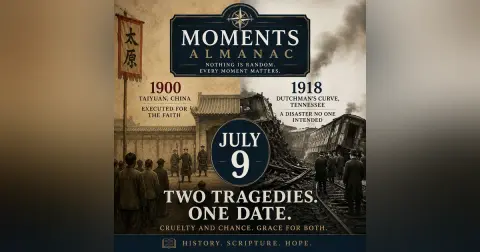
On July 9, history offers two very different tragedies. In 1900, during the Boxer Rebellion, a Chinese governor lured missionaries and Chinese Christians into a place that promised safety—only to order their execution. Among them was a fifteen-year-old believer who refused to deny Christ. Eighteen years later, on the same date, two passenger trains collided at Dutchman's Curve near Nashville, Tennessee, in one of the deadliest rail disasters in American history. This time, no one intended the...


On July 9, history offers two very different tragedies.
In 1900, during the Boxer Rebellion, a Chinese governor lured missionaries and Chinese Christians into a place that promised safety—only to order their execution. Among them was a fifteen-year-old believer who refused to deny Christ.
Eighteen years later, on the same date, two passenger trains collided at Dutchman's Curve near Nashville, Tennessee, in one of the deadliest rail disasters in American history. This time, no one intended the loss of life. A series of small mistakes became an irreversible catastrophe.
One tragedy was born of human cruelty. The other of human error.
Drawing from Ecclesiastes 9 and the hymn God Moves in a Mysterious Way, this episode explores the difficult reality that both deliberate evil and unexpected misfortune are part of life under the sun—and the greater hope that God's grace reaches into every kind of wreckage.
If you've ever wondered where God is when life turns suddenly, this episode is for you.
Scripture: Ecclesiastes 9:11–12
Featured Hymn: God Moves in a Mysterious Way by William Cowper
Welcome to Moments Almanac for July 9th, 2026. And on this day in 1900, Taiyen in the Shanxi province, China, the provincial governor, a man named Yu Xiang, invited a group of missionaries into his government compound. He promised them protection from the violence raging against its walls. It was a lie. That day, nearly 50 men, women, and children were led into his courtyard and executed. Chinese believers were forced to watch. Then they offered one final chance to save themselves by renouncing Christ. A fifteen-year-old boy named Chang Ung was among those who refused. I will not, he said. You may do as you please with me, but I will not deny the Lord. He was killed where he stood. This was no accident. Someone chose it. And then July 9th, 1918, 18 years later to the day, five miles outside Nashville, Tennessee, two passenger trains raced toward one another on a single track. No one intended this to happen. A signal was misunderstood. A whistle went unheard. A required stop at a junction was missed. Just after seven that morning, the trains met head on at a bend known as Dutchman's Curve. More than 100 people died. Many were black laborers riding in old wooden coaches near the front of the train on their way to new jobs at a wartime gunpowder plant. The wreckage fell hardest on the people with the least power to prevent it. No one chose this. It accumulated instead. One small failure laid upon another until disaster became inevitable. Two tragedies, eighteen years apart, one date on the calendar, one calculated and one careless. By evening both had left bodies in the road. Scripture has a name for this mystery and it refuses easy answers. The preacher in Ecclesiastes writes, The race is not to the swift, nor the battle to the strong, but time and chance happen to them all. Then he adds, like fish caught in a cruel net, people are trapped by evil times that fall unexpectedly upon them. Notice what he holds together in the same breath cruelty, chance, deliberate evil, sudden misfortune. The preacher does not divide suffering into neat categories of deserved and undeserved. He simply tells the truth. This is life under the sun, and it comes for all of us. That is a hard word. It is also an honest word, but Ecclesiastes is not the last word of Scripture. Behind time and chance, behind cruelty and human error, there is still a God who has not surrendered his throne. William Cooper understood that. After years of wrestling with despair, he wrote, God moves in mysterious ways his wonders to perform. He plants his footsteps in the sea and rides upon the storm. Faith is not the absence of catastrophe. Faith is trusting the one who walks into it. Yuzhan's court and Dutchman's Curve are not the same kind of tragedy. One was murder, one was mistake. But grace does not rank suffering before it reaches for it. It's comforting to know that no matter what the cause of evil and tragedy, that Christ is in our suffering. He keeps our tears in a bottle. He treasures them. Grace came for the boy who would not deny Christ, and now he is rejoicing in eternity. And grace came for the tears and the mourning over the workers who'd never reached their destination. And grace comes for us. However, our own wreckage arrived. That's today's Moments almanac for July 9th, 2026. I hope you'll join me tomorrow. Until then, take heart, notice the scattered moments, and share the grace.


