July 6, 2026 | Moments Almanac | Risk
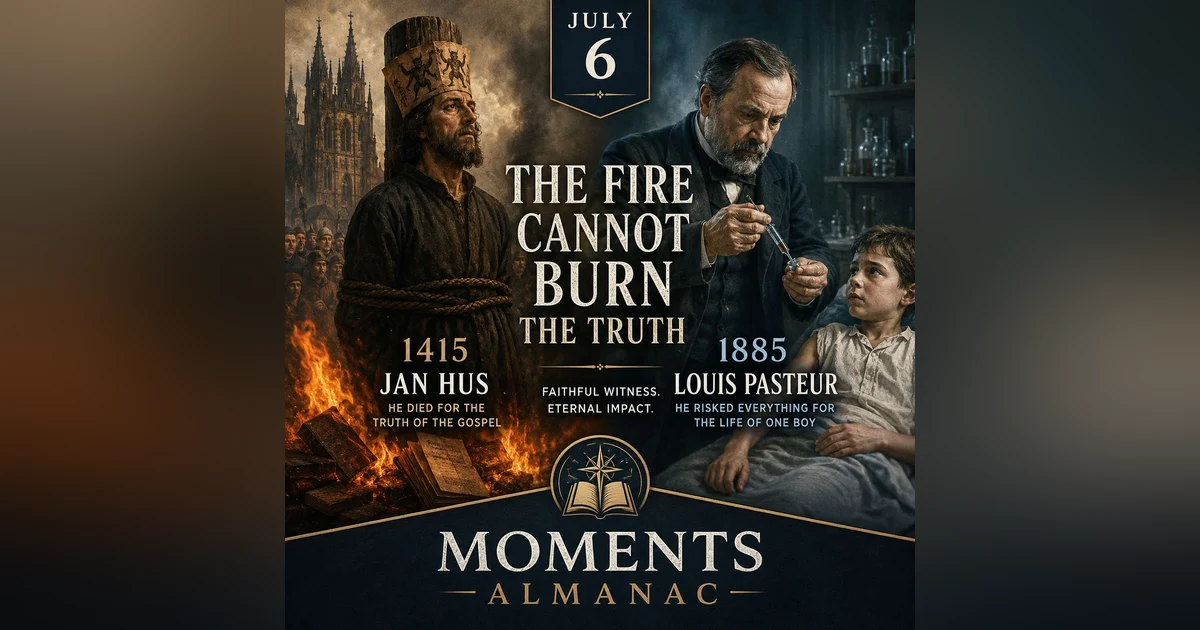


On July 6, 1415, Jan Hus was condemned and burned at the stake for insisting that Scripture — not church councils — held final authority, a conviction that would resurface a century later in Martin Luther. On July 6, 1885, Louis Pasteur risked his reputation to give an untested rabies vaccine to a dying boy. Two men, centuries apart, staked everything on a truth they couldn't yet prove — and both truths outlived them. Today's Moments Almanac looks at what it costs to hold to the truth, and why it's worth it.
Hello and welcome to Moments Almanac, a time for us to remember the people, places, and events that leave fingerprints on the soul. Today is July 6, 2026. Two men, 470 years apart, both wagered everything on what they believed was true. One faced a fire, the other faced a disease, no one survived. On July 6, 1415, in a cathedral at Constance, a Bohemian priest named Jan Hus stood before the leaders of the church and refused one final time to take back what he had preached. For years Hoos had insisted that scripture, not popes, not councils, not tradition, was the highest authority. He'd been promised safe passage to attend a council. Instead, he was arrested the moment he arrived. The verdict was read. His priestly garments were stripped away. A paper crown painted with devils was placed on his head. Then he was led outside, past a bonfire made from his own books, and chained to the stake. It's a story that has survived through centuries. As the fire struggled to catch, an elderly peasant woman hurried forward and tossed an armful of sticks onto the flames. Hus is said to have looked at her and quietly spoken the Latin words O sancta Simplicus, O holy Simplicity. Whether those words were exact ones no one knows, but the picture has endured. Sometimes sincere people can help destroy what they do not yet understand. As the flames rose, witnesses recorded Hoos praying, Christ, Son of the living God, have mercy on me. Until the smoke silenced his voice. His ashes were swept into the rhine, so no shrine could ever mark where he died. The council believed it had erased a heresy. Instead, it planted a seed. A century later, Martin Luther would read the writings of Jan Hus and recognize his own convictions staring back at him. The fire had not destroyed the truth. It had only spread. Almost four hundred and seventy years later, on that same date, another man stood before a very different kind of trial. July sixth, eighteen eighty five, Paris. A nine year old boy named Joseph Meister, who had been bitten fourteen times by a rabid dog, without treatment, rabies was essentially a death sentence. Louis Pasteur had spent years developing a vaccine, but it had only been tested on animals. He wasn't even a physician. If he treated the boy and failed, he could be blamed for his death. If he refused, the child would almost certainly die. Pasteur acted. Over the following days he administered a series of injections. Joseph Meister lived. He grew into adulthood and eventually became the gatekeeper at the Pasteur Institute, the very place where his life had been saved. Two men, one facing flames, one facing uncertainty. Neither could see how far the truth they held would travel. One could not imagine a reformation. The other could not imagine millions of lives preserved from a disease that had once meant certain death. That is often how faithfulness works. God rarely asks us to see the entire harvest. He simply asks us to stand where he has placed us and remain faithful to what he has revealed. Truth does not depend on our ability to defend it forever. It only asks us that we refuse to let go of it. And Jesus said, if you abide in my word, you are truly my disciple, and you will know the truth, and the truth will set you free. No matter where the day finds you today as we come out of a holiday weekend, I pray that you will have the courage and faith of Jan Hoos, and that you'll have the daring of Louis Pasteur. That's Moments Almanac. Until tomorrow, take care. Notice the scattered moments and share the grace.


