July 5, 2026 | Moments Almanac | Asterisk
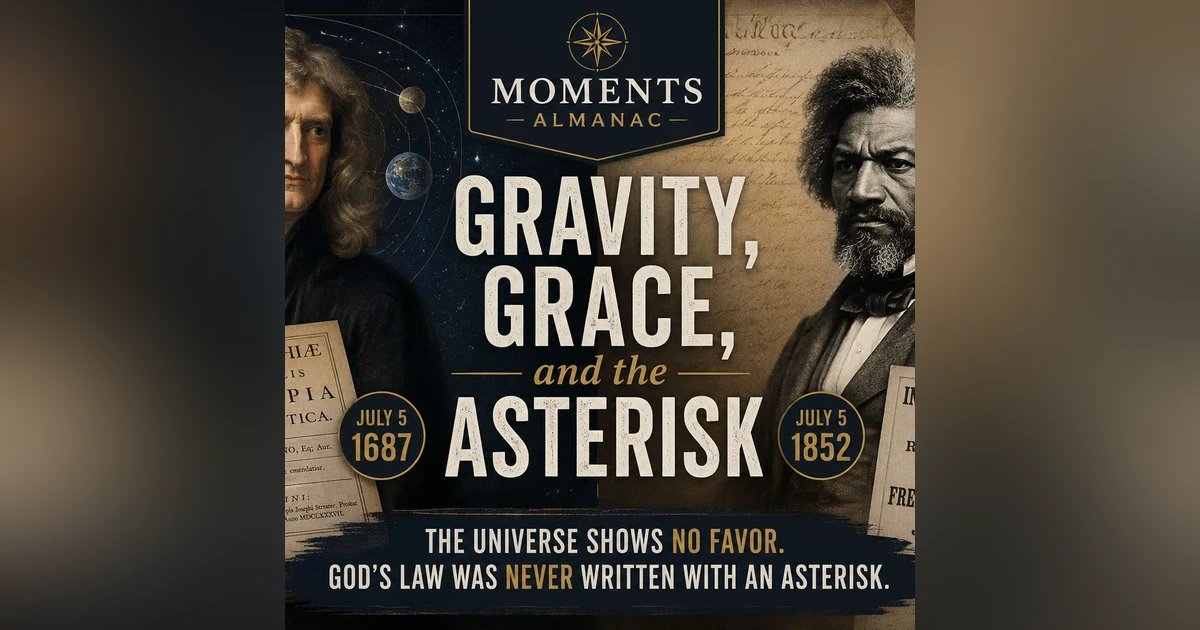
Some laws reveal the way the universe works. Others reveal the condition of the human heart. On July 5, 1687, Isaac Newton's Principia Mathematica introduced the laws of motion and gravity, describing an invisible force that acts with perfect impartiality. One hundred sixty-five years later, on July 5, 1852, Frederick Douglass stood before an Independence Day audience in Rochester, New York, and exposed a nation whose laws promised equality while denying it to millions. What do these two rema...


Some laws reveal the way the universe works. Others reveal the condition of the human heart.
On July 5, 1687, Isaac Newton's Principia Mathematica introduced the laws of motion and gravity, describing an invisible force that acts with perfect impartiality. One hundred sixty-five years later, on July 5, 1852, Frederick Douglass stood before an Independence Day audience in Rochester, New York, and exposed a nation whose laws promised equality while denying it to millions.
What do these two remarkable moments have in common?
In this episode of Moments Almanac, we explore the surprising connection between Newton's gravity, Douglass's unforgettable speech, and James 2:1, where Scripture calls believers to show no partiality. Along the way, we'll discover that while human beings often write laws with exceptions, God's law—and God's grace—never comes with an asterisk.
Join us for another journey through history, faith, and the scattered moments that still shape our lives today.
Scripture: James 2:1
Featured Voices: Isaac Newton, Frederick Douglass, Edwin Markham
Take heart. Notice the scattered moments. Share the grace.
Welcome to Moments Almanac for July 5th, 2026. Two moments. One reveals a law written into creation, the other exposes a law written with exceptions. On July 5th, 1687, in London, the Royal Society publishes a book that will reorder how humanity understands the universe. Isaac Newton's Principia Mathematica. Newton has just given the world its laws of motion and gravity, the invisible force that binds planets to their orbits and apples to the ground. Here's what makes gravity remarkable. It does not change. It pulls the king's carriage exactly as hard as it pulls the peasant's card. It does not check your bloodline, your bank account, or your citizenship papers before it acts. Whatever you are, wherever you stand, gravity treats you the same as everyone else standing on the same ground. It is, in its own strange way, perfectly impartial. One hundred and sixty five years later, july fifth, eighteen fifty two, Rochester, New York. Frederick Douglas has been invited to speak at an Independence Day celebration. He arrives a day late on purpose. Standing before a mostly white abolitionist audience, he asks the question they don't want to hear. What to the American slave is your fourth of July? Then he answers it himself. For you it is a celebration. For the enslaved it is a reminder of promises never kept. The law of the land, the one that was supposed to fall equally on every citizen, never quite reached him. It had been written with an asterisk. The room did not applaud. Some of history's most necessary truths arrive in silence. Put these two men side by side and you arrive at the uncomfortable question why does the universe manage impartiality better than we do? Gravity has never once made an exception for anyone. Human law makes exceptions constantly and calls it order. Scripture recognizes this problem long before Newton or Douglas. James writes to the church doing exactly what America was doing on paper and what Douglas was living underneath. My brothers, show no partiality as you hold the faith in our Lord Jesus Christ, the Lord of Glory. James 2.1. God's law, the real one, the first one, was never written with an asterisk. Ours keeps growing new ones. The poet Edwin Markham once wrote, He drew a circle that shut me out, heretic, rebel, and a thing to flout, but love and I had the wit to win. We drew a circle and took him in. That is the gospel. We spend enormous energy arguing about fairness while creation quietly practices it every second of every day. Gravity doesn't ask about your politics. It doesn't ask your race, it doesn't ask your income, it simply treats every person exactly the same. Grace goes one step further. It doesn't merely treat every person equally, it offers every person the same invitation. You don't have to invent justice from scratch. You simply have to stop making exceptions to what God has already shown us to be true. That's today's Moments Almanac. Take heart. Notice the scattered moments, and share the grace.


