July 8, 2026 | Moments Almanac | Walk
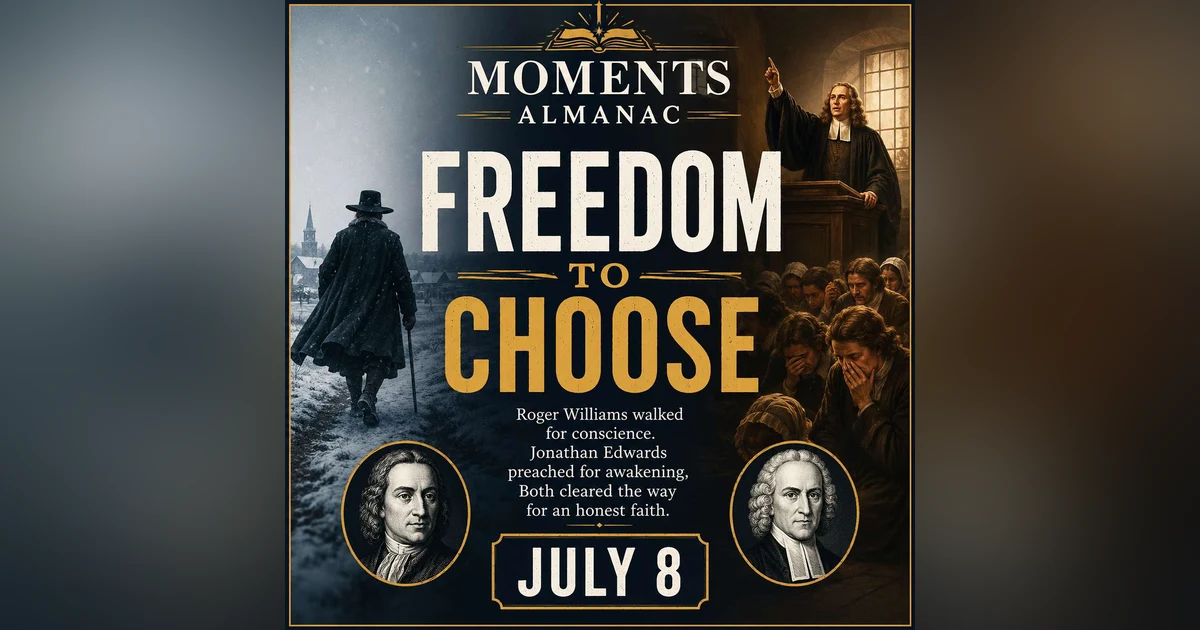


Same date, two New England moments, one hard question: can you force someone into real faith — or scare them into it? On July 8, 1663, Roger Williams's Rhode Island secured one of the first charters on earth guaranteeing full liberty of conscience. On July 8, 1741 — seventy-eight years later — Jonathan Edwards preached the most famous fire-and-brimstone sermon in American history at Enfield, Connecticut. Today's Scattered Moments Almanac holds these two side by side and asks what they actually have in common. Take heart. Notice the scattered moments. Share the grace.
Hello and welcome to Scattered Moments for July 8th, 2026. July 8th has given us two very different pictures of freedom. The first begins with a man walking through snow. In 1636, a young pastor named Roger Williams was banished from the Massachusetts Bay Colony. His crime was insisting that government had no business ruling the human conscience. Faith, he believed, cannot be forced. A compelled confession is only a performance. So, in the dead of winter, Williams walked south and founded a settlement he called Providence. Twenty-seven years later, on July 8, 1663, King Charles II granted Rhode Island a royal charter guaranteeing what it called full liberty in religious concerns. No established church, no religious test for public office, no government with a sword in one hand and a Bible in the other. For one of the first times in history, a government declared that conscience belongs to God. Seventy eight years later, on that same july eighth, another preacher stood before another congregation. His name was Jonathan Edwards. The town was Enfield, Connecticut. It had remained strangely untouched by the spiritual awakening that was happening around it, comfortable, complacent, confident. Edwards climbed into the pulpit and quietly read a sermon that history remembers as sinners in the hands of an angry God. Before he was finished, people were crying out, convinced that they stood before a holy God with nowhere left to hide. At first glance, these men seemed to stand at opposite ends of the Christian story. Roger Williams spent his life making sure that no one would be forced into faith, and Jonathan Edwards spent one unforgettable hour making sure no one could feel safe without it. But they were protecting the same truth. Williams opposed coercion because faith must be freely chosen to be real. Edwards shattered false security because people cannot freely choose Christ until they see their true need. One removed the state's hand from the scale, the other removed the false floor beneath people's feet. Both were clearing the way for an honest response to God. Williams would eventually leave every established church behind, calling himself simply a seeker. Edwards is largely remembered for his terrifying sermon, although his purpose was not fear itself, it was grace. He wanted hearts awakened so they could discover mercy. Together they remind us that liberty of conscience is not the enemy of the gospel. It's what makes faith genuine. And the gospel is not the enemy of freedom. It's what freedom is for. The Apostle Paul wrote, For freedom Christ has set us free. Stand firm then, and do not submit again to the yoke of slavery. Charles Wesley captured that freedom in the hymn, And can it be? My chains fell off, my heart was free, I rose, went forth, and followed thee. Perhaps that is the freedom we most need. Not merely freedom from coercion, but freedom for Christ. And so we pray, Father, give us the courage of Roger Williams, that we may never try to rule another person's conscience. Give us the liberty of Jonathan Edwards, that we would never hide behind a comfortable religion while avoiding the living God. Wake us up where we have grown sleepy. Free us from where we have become chained. And may faith be more than habit or performance. May we be willing to respond with our hearts captured by your grace. That's today's Moments Almanac for July 8th, 2026. I hope you'll join me tomorrow. Until then, take care. Notice the scattered moments and share the grace.


