July 10, 2026 | Moments Almanac | Calvin
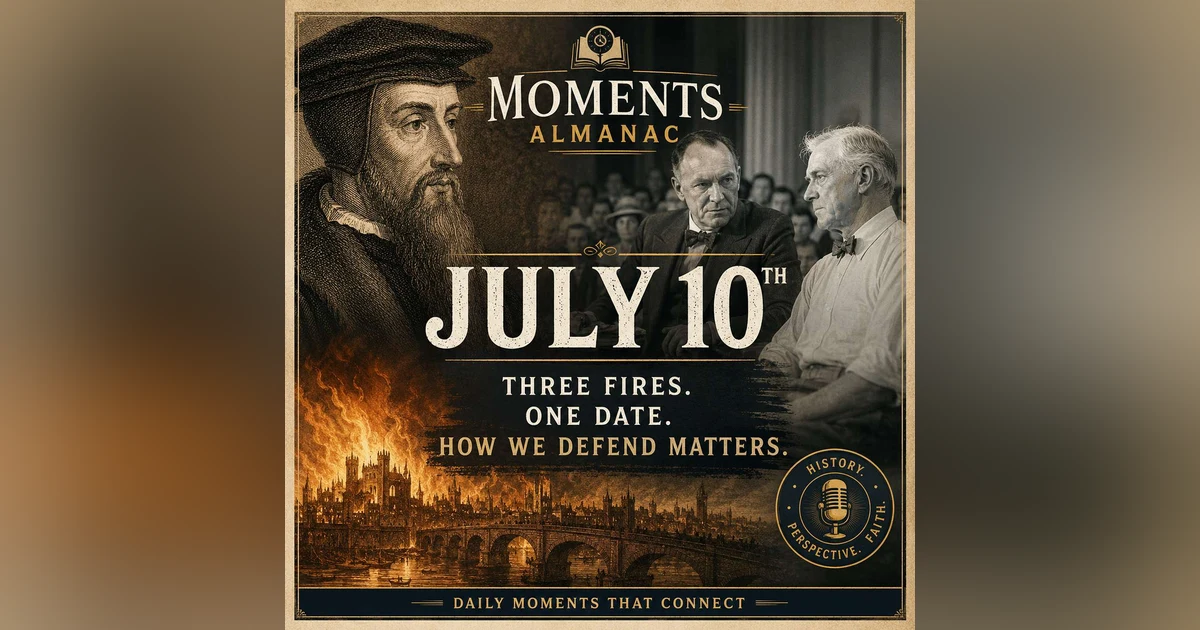


On this episode of Moments Almanac, we journey from Renaissance France to a Tennessee courtroom, with a stop at one of London's great fires, discovering what three very different events have to teach us about conviction, humility, and Christian witness.
Meet John Calvin, whose lifelong pursuit of Scripture and scholarship helped shape Protestant theology. Stand in Dayton, Tennessee, as the famous Scopes Trial turns questions of faith and science into a national spectacle. Then reflect on a fire that swept through medieval London, reminding us that while truth can bring light, controversy can also burn bridges.
Anchored in 1 Peter 3:15 and Proverbs 15:1, today's reflection explores how followers of Christ are called not only to defend the faith, but to do so with gentleness, respect, and hope.
History remembers the arguments.
Scripture reminds us to remember our spirit.
Scripture: 1 Peter 3:15; Proverbs 15:1
Moments Almanac is a daily journey through history, faith, and the people, places, and events that leave fingerprints on the soul.
Hey, welcome to Moments Almanac for July 10th, 2026. Some things deserve to be defended. Truth, the gospel, the authority of Scripture, but history has a way of asking another question. How do we defend them? July 10th remembers three very different fires. One was the fire of a brilliant theological mind, one was the fire of a public controversy, and one was an actual fire that consumed part of London. Together they remind us that convictions can illuminate or they can also burn. On July 10, 1509, a boy was born in Nyon, France, to a cathedral lawyer who wanted his son to become a priest. His name was Jean Cavon. You know him as John Calvin. Nobody in that household could have guessed that he would help reshape Protestant theology. Calvin's father changed his plans for him twice, first toward the priesthood and then toward law, so the boy trained in Paris and then Orleans, absorbing not only scripture but the full weight of Renaissance scholarship, Greek, Hebrew, Roman law, classical rhetoric. Calvin was not hiding from the life of the mind. He was driving straight into it, convinced that serious faith demanded serious thought. By 1536, that conviction produced the institutes of the Christian religion, a work built on patient argument, not bare assertion. Calvin kept revising and expanding it for the rest of his life. His legacy is not simple. Geneva, under his leadership, had moments of remarkable faithfulness and moments history still wrestles with. Brilliant theology does not excuse every decision, but neither do human failings erase genuine gifts to Christ Church. On july 10th, 1212, part of London burned after flames spread near London Bridge, and through crowded wooden buildings hundreds are believed to have died. Fire is a wonderful servant, but it's a terrible master. So are our convictions. William Jennings Bryant, a three-time presidential candidate, and a man of genuine conviction, came to prosecute. Clarence Darrow came to defend. And the newspapers came looking for a show. Reporters poured into Dayton. Vendors sold souvenirs on the courthouse lawn. At least one chimpanzee performed for the outside crowd. Before long, the courtroom had become a stage. Darrow called Brian himself to the witness stand, not as a legal necessity, but as public theater. The newspaper loved it. Crowds loved it. Careful conversation disappeared. Brian died just five days after the trial ended, worn down by most accounts by how the whole spectacle had unfolded. And here's what strikes me about those two men, separated by four centuries, Calvin and Brian, and one shared date on the calendar. Both cared enormously about truth. Both believed faith was worth defending in public. But July 10th also reminds us that truth can be defended in more than one spirit and attitude. Peter told the believers to always be ready to give an answer for the hope that is inside them, but he did not stop there. He wrote, Always be prepared to make a defense to anyone who asks him for a reason for the hope that is in you. And then he added these words we often skip. Yet do so with gentleness and respect. Proverbs says it another way. A gentle answer turns away wrath, but a strong word stirs up anger. Every generation has its arguments. Calvin had his, Brian had his. I hope you'll join me tomorrow. Until then, take care. Notice the scattered moments and share the grace.


