July 12, 2026 | Moments Almanac | Journal
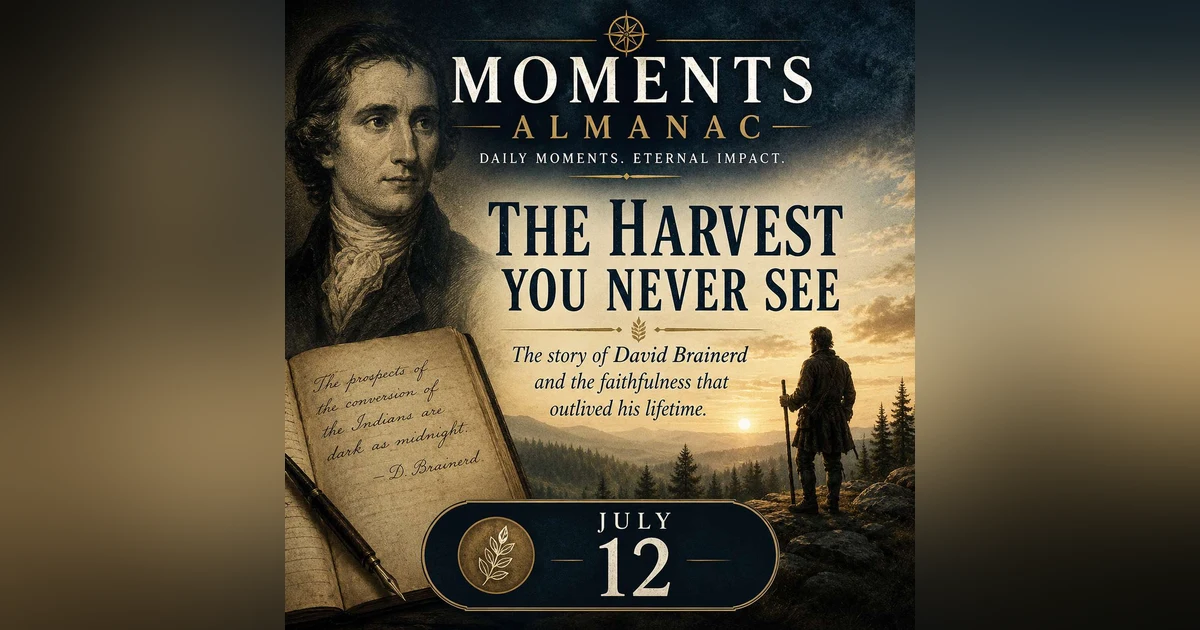


On July 12, 1739, a quiet young man in Connecticut encountered Christ. No one could have imagined that his life would one day inspire generations of missionaries around the world.
David Brainerd died believing he had accomplished very little. Expelled from Yale, weakened by tuberculosis, and burdened by deep melancholy, his ministry often seemed marked more by disappointment than success. Yet God was writing a story Brainerd himself would never live to read.
In today's Moments Almanac, we explore how one seemingly forgotten life became a catalyst for William Carey, David Livingstone, Jim Elliot, and countless others—and what Jesus meant when He said that a grain of wheat must fall into the earth before it can bear much fruit.
If you've ever wondered whether your quiet faithfulness matters, this episode is for you.
Scripture: John 12:24
"Notice the scattered moments. Share the grace."
SPEAKER_00
Hello and welcome to Moments Almanac is the time for us to remember the people, places, and events that leave fingerprints on the soul. My name is Matt Tullis. I'm so glad that you're here today on July 12th, 2026. I love today's story because it really deals with insignificance and true significance. Because on July 12, 1739, nothing remarkable happened that anyone would have noticed. A 21-year-old farmer's son from Connecticut bowed before God, and his life quietly changed forever. No crowds, no headlines, no great revival meetings, just a man, a young man named David Brainerd, who would later write that on this very day Christ became more beautiful to him than the whole world. It seems rather minor, rather insignificant, doesn't it? It's fitting that we remember July twelfth, though, not as the day that David Brainerd died, but as the day that he truly began to live. If anyone had tried to predict what God would do through him, they probably would have chosen somebody else. Brainerd was born in 1718 in Hayden, Connecticut, and orphaned before he turned fourteen. He entered Yale hoping to become a minister, but his future unraveled with one careless sentence. After remarking that a college tutor had no more grace than a chair, he was expelled. No degree, no respectable pulpit, no obvious future, so he turned to frontier missions almost because every other door had closed. For years he rode alone through the forest of Massachusetts, New York, and Pennsylvania, carrying the gospel to Native American communities. He battled tuberculosis, he battled crushing melancholy, what we would recognize today, of course, as clinical depression. In his journal, he described the prospects of native conversion as dark as midnight. By every measure he could see he was failing. Then, almost unexpectedly, in late 1745, at Crossweekson, New Jersey, hearts began to open. A small group of Delaware Indians listened with unusual attentiveness, and within months more than a hundred professed faith in Christ. It was the first real harvest of his ministry. He would only live about two more years. David Brainerd died in 1747 in the Northampton home of Jonathan Edwards. He was twenty nine years old. He believed he'd accomplished very little. But Jonathan Edwards had been quietly preserving Brainerd's diary. Two years later he published it. What Brainerd thought was little more than a record of his disappointments became one of the most influential books in Protestant history. John Wesley urged every preacher to read it. William Carey carried it toward India and called it almost second to the Bible. Henry Martin, Adeniram Judson, David Livingston, and generations later, Jim Elliot, they all traced this as a part of their missionary calling. Back to the pages of Brainerd that he never imagined anyone would read. The man who thought he had failed ended up shaping centuries of world missions. That's often the way God writes history. Jesus said, Truly, truly, I say to you, unless a grain of wheat falls into the earth and dies, it remains alone. But if it dies, it bears much fruit. In the first place, Jesus was speaking about himself. His death would look more like defeat, but it would become the salvation for the world. Then he immediately invited us, his followers, into that same pattern. The kingdom of God is full of seeds. Seeds disappear before they grow. Faithfulness often vanishes beneath the soil long before anyone sees a harvest. Brainerd thought his life was simply disappearing. God knew it was being planted. Frederick William Faber captured the mystery so well, for right is right, since God is God, and right the day must win. And perhaps no hymn says it better more tenderly than these familiar words, when peace like a river attendeth my way, when sorrows like sea billows roll. Not because suffering feels good. David would tell you that, but because God has an astonishing habit of turning what looks like loss into eternal gain. Your greatest act of faithfulness may not be the sermon that receives applause, the ministry everyone notices, the Sunday school lesson that you teach week after week, or the project that succeeds while everyone is watching. It may be the obedience whose harvest belongs to someone else. That's the message for me. I hope that's the message for you. God has never confused hiddenness with failure. And that's today's Moments almanac. I hope you'll join me tomorrow. Until then, take care. Notice the scattered moments and share the grace.


