July 11, 2026 | Moments Almanac | Rule
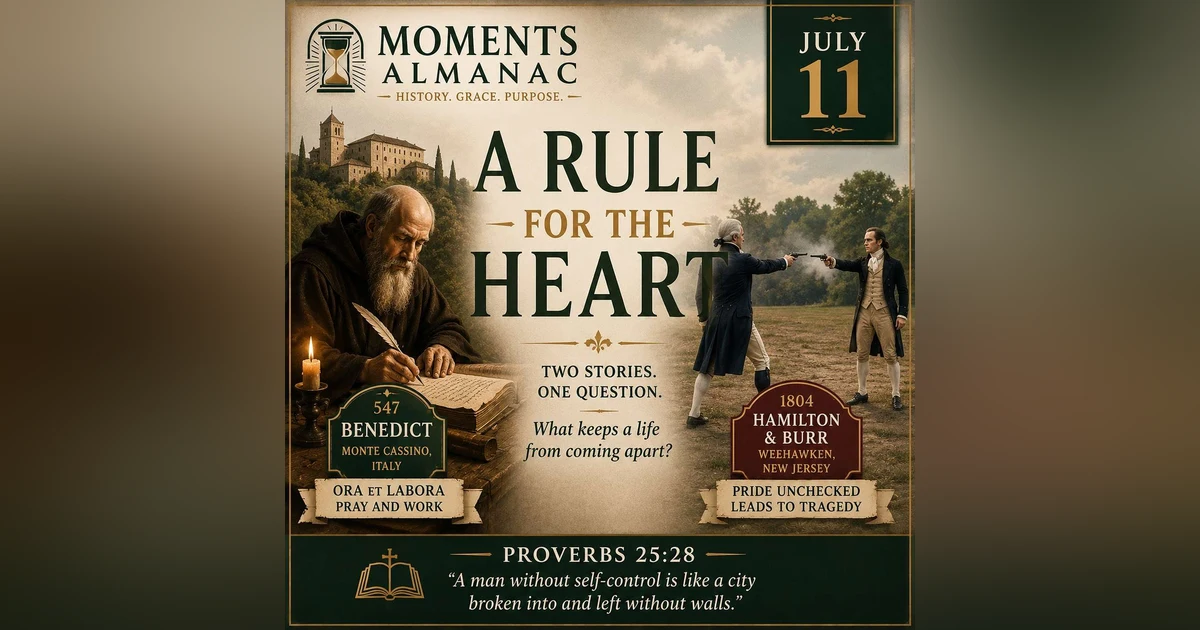
What keeps a life from coming apart? On this episode of Moments Almanac, we journey from the quiet monastery of Benedict of Nursia to the dueling grounds of Weehawken, where Alexander Hamilton and Aaron Burr settled a grievance with pistols at dawn. One man left behind a simple rhythm of prayer, work, and rest that has shaped Christian communities for fifteen centuries. The other two left a cautionary tale of what wounded pride can destroy in a single moment. Along the way, we reflect on Prov...


What keeps a life from coming apart?
On this episode of Moments Almanac, we journey from the quiet monastery of Benedict of Nursia to the dueling grounds of Weehawken, where Alexander Hamilton and Aaron Burr settled a grievance with pistols at dawn. One man left behind a simple rhythm of prayer, work, and rest that has shaped Christian communities for fifteen centuries. The other two left a cautionary tale of what wounded pride can destroy in a single moment.
Along the way, we reflect on Proverbs' warning that a life without self-control is like a city without walls, and discover why the habits of grace don't replace our need for Christ—they help keep our hearts returning to Him.
Sometimes the most ordinary rhythms become God's extraordinary means of shaping a faithful life.
Hello and welcome to Moments Almanac for July the 11th, 2026. This is a time to remember the people, places, and events that leave fingerprints on the soul. On July 11th, history gives us two very different answers to the same question. What keeps a human life from coming apart? In 6th century Italy, a quiet monk spent his life building a rhythm that would shape the Western civilization. And in 19th century America, two of the brightest political minds in the young republic met with pistols at dawn because neither could find a way to step away from wounded pride. The distance between those two stories is more than 1,200 years. The distance between their outcomes is even greater still. On July the 11th, in the year 547, a monk named Benedict died at Monte Cassino in Italy. He had spent much of his life writing a single document, not a great theological treatise or a sweeping manifesto, but a practical guide for how ordinary people could faithfully follow Christ together. It became known simply as the Rule of Saint Benedict. Its rhythm was beautifully ordinary. Eight hours of prayer, eight hours of work, eight hours of rest. Aura et labor pray and work. Benedict didn't invent monasticism. He gave it a backbone. His rule wasn't built on dramatic spiritual experiences, it was built on daily faithfulness, small acts of obedience repeated until they shaped the soul. As the Roman world crumbled around them, monasteries following Benedict's rule became places where scripture was copied, children were taught, the poor were cared for, travelers found shelter and learning survived the collapse of the empire. The rule outlived kingdoms because it understood something timeless. Freedom doesn't come from throwing off every restraint. It comes from choosing the right ones. Now, fast forward twelve hundred and fifty-seven years later, same date, different continent, different kind of man entirely. On July 11, 1804, Wehawken, New Jersey. Aaron Burr, the sitting vice president of the United States, faces Alexander Hamilton, the former Secretary of the Treasury, on a dueling ground overlooking the Hudson River. Two men had circled each other for years, rivals in law, politics, ambition, and reputation. The immediate spark was almost absurdly small. Reports that Hamilton had spoken contemptuously of Burr during a private dinner. Burr demanded satisfaction. Hamilton, bound by the code of honor expected of gentlemen of his day, believed he couldn't refuse. At dawn, the pistols fired. Hamilton fell. He died the next afternoon. Burr survived, but his public life never truly recovered. He spent the rest of his years as a man still breathing, yet politically hollow. Two brilliant minds, two gifted leaders, neither one had a habit strong enough to interrupt wounded pride before sunrise. One lost his life and the other lost almost everything else. That contrast is what keeps drawing me back to July eleventh today. Benedict wrote a rule because he understood how much damage an ungoverned heart can do not because rules save us, they don't. Grace is always the point, but grace was never meant to drift through our lives without form. It settles into our habits, into our prayer, into our worship, our confession, our faithful work. Without those things, grace has a way of leaking out of us. Scripture speaks honestly about that struggle. Proverbs says, A man without self-control is like a city broken into and left without walls. Jeremiah reminded us the heart is deceitful above all things and desperately sick. Who can understand it? Benedict took those warnings seriously enough to build his life around practices that turned the heart back toward God again and again. Burr and Hamilton, for all their brilliance, allowed a code of honor to become stronger than humility. One led to life, the other led to tragedy. Of course, Benedict himself would have been the first to tell us that the rules can save no one. Only Christ can do that. The rule simply gave grace somewhere to live. It helped ordinary believers keep turning their hearts back toward the Savior day after day. And so that's the question that July 11th leaves us. What daily rhythm keeps your heart returning to Jesus before pride carries it somewhere else? Maybe it's the beginning, the morning where Scripture dominates your life. Maybe it's kneeling in prayer before checking your phone. Maybe it's ending each day with a confession and with a gratitude. The habit itself isn't your hope. Christ is. But the habits of grace help us remember when our hearts are most likely to forget. As Francis Ridley Hoffergall prayed, take my moments and my days, let them flow in ceaseless praise. That's the prayer that I have in my heart, and so often I fail. And that's my prayer for you too. And that's Scattered Moments for July the 11th, 2026. Hope you'll join me tomorrow. Until then, take care. Notice the scattered moments and share the grace.


