July 15, 2026 | Moments Almanac | Canvas
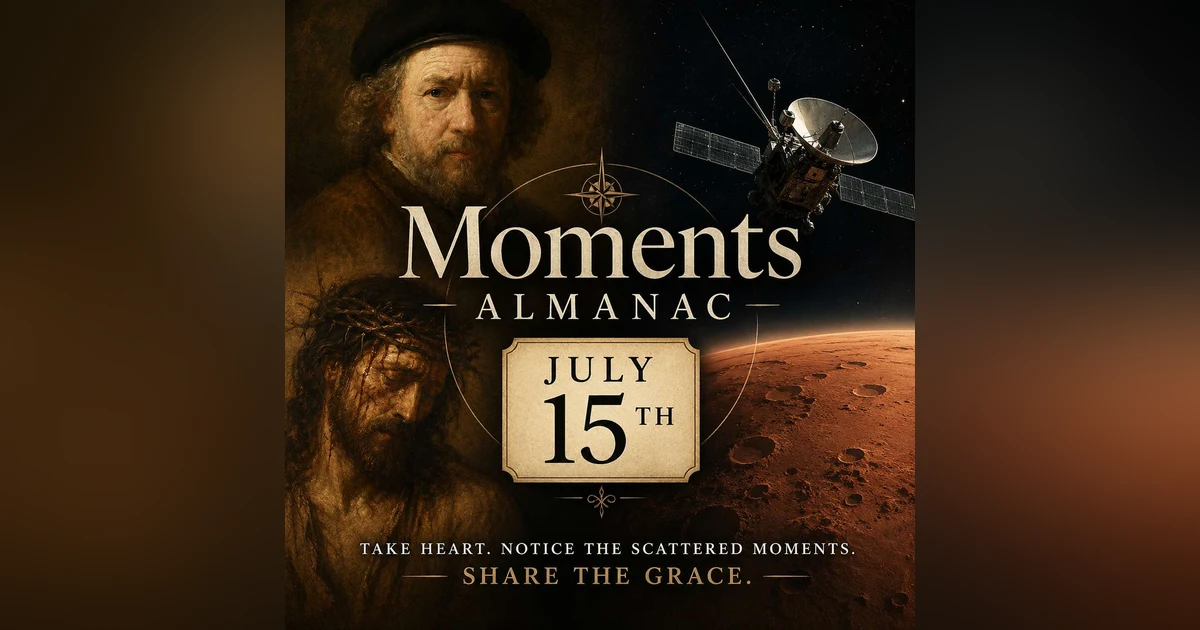


What does a grieving painter have in common with a lonely spacecraft crossing millions of miles of empty space?
On July 15, two remarkable stories converge.
In 1606, Rembrandt was born—a man whose deepest losses transformed not only his art but the way generations would see the suffering Christ.
More than three centuries later, Mariner 4 became the first spacecraft to reveal Mars as it truly was, replacing centuries of imagination with an unexpected reality.
Together, these stories remind us that truth often comes through hardship, and that suffering can sharpen our vision rather than obscure it.
Drawing from Paul's words that "now we see through a glass, darkly," this episode explores how God sometimes uses our deepest disappointments to clear away illusion and bring us closer to Himself.
History.
Faith.
Art.
Space exploration.
All pointing to the hope that one day we will see face to face.
Take heart. Notice the scattered moments. Share the grace.
It's July 15th, 2026, and I want to welcome you to Moments Almanac, a time for us to remember the people, places, and events that leave fingerprints on the soul. And on this day in 1606, a boy was born in Leiden Holland across the street from his father's mill. His name was Rembrandt. He would grow up to become one of the greatest painters in history, but greatness would not spare him of grief. He buried three children in infancy. He buried his wife, Saskia, when she was only thirty. He fell deeply into debt, surrendered his possession, sold his house, and watched his reputation decline within his own lifetime. And somewhere inside of all of this loss, his brush began to change. His early paintings were polished, dramatic, confident, sometimes almost showing off what he could do with the light, shadow, color, and human expression. But his latter paintings became quieter, darker, rougher, more honest. The faces looked older, the shadows grew deeper, the light seemed harsher. Throughout his life, Rembrandt returned again and again to the sufferings of Christ in paintings, drawings, and etchings, but his Christ did not hover safely above human pain. He was mocked, beaten, abandoned, crucified. Rembrandt painted a Savior who looked as though he actually bled. Grief did not push Rembrandt away from the cross. It brought him closer to it. Now let's travel through time 359 years later, on the night of July 14th and to July 15th, 1965, a small spacecraft called Mariner 4 was closing in on Mars. It had been traveling for 228 days alone and silent across more than 100 million miles of empty space. Shortly after 1 o'clock in the morning, Greenwich Time, on July 15th, it made its closest pass, flying just over 6,000 miles above the Martian surface. For about 25 minutes, Mariner 4 pointed its camera toward a planet no human being had ever seen up close. It captured 21 complete images and part of another. Then it turned away and began sending them home, one slow line at a time. For centuries, people on Earth had imagined what might be waiting there. Some believed they could see canals. Some dreamed of vegetation, others imagined cities, civilizations, and intelligent creatures staring back at us from another world. But what Mariner IV sent home was something else. A cratered landscape, a thin atmosphere, a silent, moonlike world, no canals, no cities, no signs of civilization, just craters upon craters, the scars of an ancient and battered planet. It was not the Mars people had hoped to see, but it was the real one. And so maybe that's what ties a grieving Dutch painter to a silent spacecraft. Both of them captured reality, one with a paintbrush and a lifetime of loss, and the other with an antenna and 228 days of empty space, and neither delivered the picture people expected. Rembrandt did not paint a Christ who made suffering look easy or ornamental. Mariner Ford did not send home a Mars decorated with canals and cities. They both stripped away illusion. They both showed us what was really there. The Apostle Paul wrote, For now I see through a glass darkly, but then face to face. For now our vision is incomplete. We strain to understand things we cannot yet fully bring into focus. And most of us assume that pain only makes the glass darker. We believe grief must be obscuring our view of God. We think loss is interfering with our own ability to see. But perhaps some forms of suffering do not fog the glass. Perhaps they wipe away the illusions we had painted upon it. Rembrandt lost much of what he loved. But in the darkness, he seemed to see the suffering of Christ more clearly. Mariner IV crossed the ocean of silence and returned with a world far different from the one humanity had imagined. Neither truth was easy. But both were honest. Perhaps the hard thing that you're walking through right now is not hiding God from you. Perhaps it is revealing the difference between the God you imagined and the God who actually is there. Not distant suffering, not untouched sorrow, but wounded, present, and standing with you inside it. One day, Paul says, the glass will be removed completely, the shadows will lift, the fragments will come together, we will no longer see dimly, we will see face to face. Until then, keep looking. Even through dark places. Especially through dark places. And as you do, take heart. Notice the scattered moments and share the grace.


