September 21 | Moments Almanac | Disguided
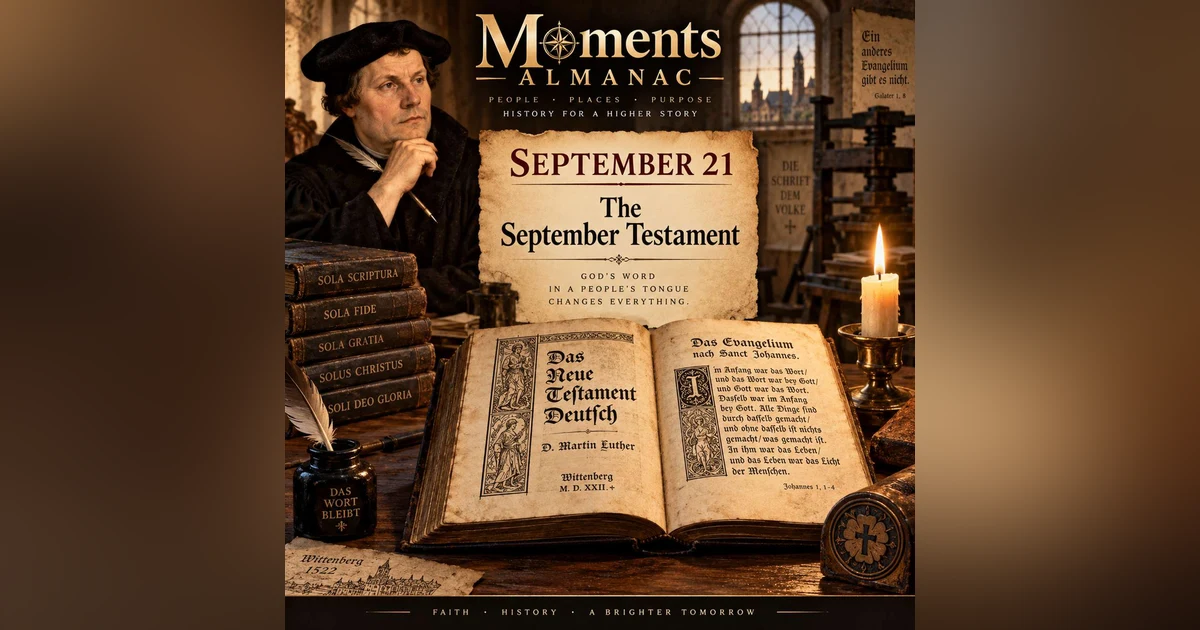


On September 21, 1522, Martin Luther’s German New Testament—known as the September Testament—was published, placing the words of Scripture into the hands of ordinary people in language they could understand.
Luther believed the Bible should not sound distant or academic, but like the language spoken in homes, marketplaces, workshops, and everyday life. His translation would help shape the German language and dramatically expand access to Scripture.
But five centuries later, the challenge has changed. For many of us, the Bible is no longer difficult to obtain—it is everywhere. The deeper question is whether we will open it, listen to it, and allow it to shape our lives.
In this episode of Moments Almanac, we remember the day the Bible began speaking German—and consider the enduring truth of Psalm 119:130: “The unfolding of your words gives light.”
Welcome to Moments Almanac on Scattered Moments for today, June 21st. Imagine holding a Bible you cannot read. You know it contains the words of Jesus. You know somewhere inside are the letters of Paul, the stories of Peter, and the promises of the resurrection and grace, but the words themselves are locked behind a language you do not understand. Then one day someone puts the New Testament in your hands, and it sounds like home. On September 21, 1522, Martin Luther's German translation of the New Testament appeared in print. It became known simply as the September Testament, and in many ways it changed the sound of Christianity. A year earlier, Luther had been declared an outlaw, following the Diet of Worms. Friends secretly carried him away to Wartburg Castle, where he disguised himself as a minor nobleman named George Knight. He grew his hair and his beard. And while much of Europe wondered where Martin Luther had gone, Luther sat in a room translating the New Testament from Greek into German. He completed his initial draft in roughly eleven weeks, but Luther wasn't interested in merely replacing one word with another. He wanted Scripture to sound like something ordinary German people would actually say. Years later, describing translation, Luther said that you should listen to the mother in the home and the common man in the marketplace. In other words, don't make the Bible sound like a textbook. Let people hear God speaking in the language of the kitchen table, the marketplace, the workshop, the farm. The September Testament was printed in Wittenberg, beautifully illustrated by Woodcuts by Lucas Cranich, and several thousand copies were produced, and although the book was expensive, demand was enormous. By December another edition was already needed. Anne Luther's influence went far beyond theology. His translation helped shape the development of the German written language itself. Think about that one man hiding in a castle who began translating words written fifteen centuries earlier, and generations of people began hearing them differently. Not because the gospel had changed, because suddenly they could understand it. Psalm 11930 says the unfolding of your words gives light. It gives understanding to the simple. That's the real story of September twenty first. The Word of God was never intended merely to be admired from a distance. It was meant to be opened, read, heard, understood, and obeyed. Five hundred years later, most of us can reach for a Bible in our own language within seconds. We have printed Bibles on shelves, Bible apps on phones, audio Bibles and earbuds, and more translations than Luther could possibly have imagined, which raises another question. The problem for us is no longer that we can't read the Bible, it's whether we will. Luther risked his life believing ordinary people deserve to hear the word of God, and perhaps today is a good day to open it. Because whenever God's word moves from the shelf to the heart, the September Testament is happening all over again. Thanks for listening to Moments Almanac. I hope you'll join me tomorrow. Until then, take heart. Notice the scattered moments, and share the grace.


