September 18 | Moments Almanac | Phantastes
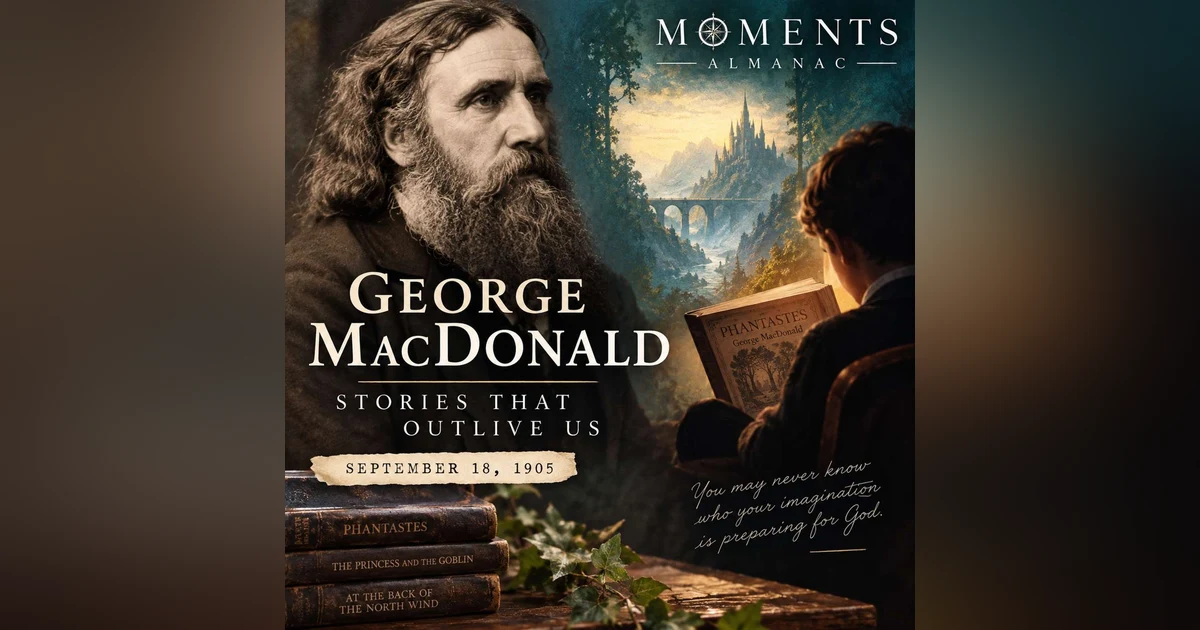


On September 18, 1905, Scottish minister, novelist, and fantasy writer George MacDonald died—never knowing how far his stories would travel. Years later, a young C. S. Lewis discovered MacDonald’s Phantastes and said it had “baptized my imagination.” That seed would eventually bear fruit in one of Christianity’s most influential writers.
Today on Moments Almanac, we explore the remarkable legacy of a man whose pulpit may have disappeared—but perhaps only because it got larger. It’s a reminder that we may never see the full reach of the stories we tell, the words we write, or the seeds we faithfully plant.
Sometimes you plant a tree knowing you’ll never sit beneath its shade.
Plant it anyway.
Welcome to Moments Almanac for September 18th. Sometimes the most important thing you do in your life happens after you're gone. On September 18th, 1905, an 80-year-old Scottish writer named George MacDonald died in England. He had been a minister, a poet, a novelist, a lecturer, and a writer of strange and wonderful fairy tales, but perhaps the most remarkable chapter of his story wouldn't be written until years after his death, because somewhere along the way, one of MacDonald's books would fall into the hands of a young man who had walked away from Christianity. His name was C. S. Lewis, and that's where we're headed today. George MacDonald was born in Scotland in 1824 and eventually trained for Christian ministry. He became a congregational pastor, but his ministry it was difficult and relatively brief. MacDonald held theological convictions that didn't always fit comfortably within the expectations of his congregation and denomination. Eventually the pulpit gave way to something else stories. Macdonald had a growing family to support, and he began writing and lecturing. He wrote novels, poetry, sermons, children's stories, fairy tales, and fantasy. And perhaps from the outside it might have looked like the life of a minister who had somehow wandered away from his calling. But maybe the pulpit didn't disappear. Maybe the pulpit just got larger. MacDonald believed imagination could carry truth into places an argument sometimes couldn't reach. Years later, a young C.S. Lewis discovered MacDonald's fantasy novel Fantastis. Lewis wasn't looking for Christianity. In fact, at that point he wasn't a Christian. But something happened. Lewis would later describe the experience by saying that MacDonald's book had baptized my imagination. That's an extraordinary phrase. His intellect wasn't there yet. His theology wasn't there yet. His faith wasn't there yet. But his imagination had begun moving towards something his mind would eventually recognize as true. Lewis later, as you know, became a Christian and went on to write mere Christianity, the screw tape letters, The Great Divorce, and of course the Chronicles of Narnia. And MacDonald was everywhere in Lewis's imagination. C.S. Lewis once wrote, I have never written a book in which I did not quote from him. Think about that. George MacDonald died before Lewis became a writer that the world would know. He never held the lion, the witch, and the wardrobe in his hands. He never met Lucy, Edmund, Susan, or Peter. He never read about Aslan. He never saw the millions of readers who would encounter echoes of Christian truth through the imagination of C.S. Lewis. MacDonald planted something. And then he died. But the seed kept growing. Jesus said in John 12, 24, unless a grain of wheat falls into the ground and dies, it remains alone. But if it dies, it produces much grain. And that's the strange mathematics of the kingdom. We don't always get to see what faithfulness becomes. The Sunday school lesson you teach, the poem you write, the child that you encourage, the sermon you preach, the story you tell, the kindness you offer. You may never know where it travels next. George MacDonald died on September 18, 1905, but some things created in faith refuse to be buried with us. Somewhere years later, someone opens the book, someone remembers the words, someone discovers the story, and something begins to grow. As we've often said, sometimes you plant a tree knowing you'll never sit beneath its shade. So we must plant it anyway. I hope you plant something today. And this is Moments Almanac. Thanks so much for joining me, and I hope you'll join me tomorrow. Until then, take care. Notice the scattered moments and share the grace.


