October 28 | Moments Almanac | Sword
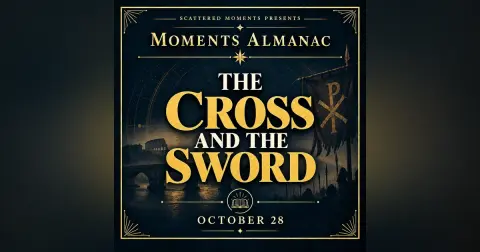
The Cross and the Sword | Moments Almanac — October 28 On October 28, AD 312, two Roman armies clashed at the Milvian Bridge in a battle that would forever change the history of Christianity. Emperor Constantine marched into battle beneath a symbol associated with Christ, believing divine power would grant him victory. By day's end, his rival was dead, and the course of the Roman Empire had changed. But Constantine's victory raises a question that still challenges the church today: What happe...


The Cross and the Sword | Moments Almanac — October 28
On October 28, AD 312, two Roman armies clashed at the Milvian Bridge in a battle that would forever change the history of Christianity. Emperor Constantine marched into battle beneath a symbol associated with Christ, believing divine power would grant him victory. By day's end, his rival was dead, and the course of the Roman Empire had changed.
But Constantine's victory raises a question that still challenges the church today: What happens when the cross becomes attached to the sword?
In this episode of Moments Almanac, we explore the dramatic battle, Constantine's mysterious vision, and the difference between earthly power and the kingdom of God.
Constantine conquered beneath the sign of the cross. Christ conquered upon it.
One victory changed an empire. The other changed eternity.
Take heart. Notice the scattered moments. Share the grace.
Welcome to Moments Almanag for October 28th. The prophecy was clear. On this day, an enemy of Rome would die. At least that's what the ancient oracles seemed to promise. And the Roman Emperor Maxentius was convinced he knew exactly who that enemy would be. He was wrong. It was October 28th in the year 312, and just outside the city of Rome, two armies were preparing for a battle that would change the course of Christian history. On one side stood Maxentius, the emperor who controlled Rome. On the other stood Constantine, a rival emperor determined to take the city. Between them lay the Tiber River and a crossing known as the Milvian Bridge. Maxentius had reason to be confident his forces were formidable, and he had something else in his favor, or so he thought. According to the early Christian writer Lactantius, Maxentius had consulted the Sabine Books, a collection of ancient Roman prophecies. They appeared to promise that on this very day an enemy of Rome would perish. It was the anniversary of Maxentius' rise to power, and surely the gods were on his side, but Constantine had his own remarkable story to tell. According to this early Christian writer, Constantine experienced a dream in which he was instructed to place a heavy sign upon the shields of the soldiers. It was the symbol associated with Christ. Another historian, Eusebius, writing years later, recorded an even more extraordinary account. Constantine, he said, had seen a cross of light in the sky, accompanied by the words that have echoed through history. In this sign, conquer. Historians still debate the details of Constantine's experience. The ancient accounts differ, and we can't know with certainty precisely what he saw. But we do know what happened next. On October 28, 312, Constantine's army met the forces of Maxentius near the Milvian Bridge. The battle was fierce. The forces of Maxentius collapsed, and in the confusion of their retreat, the emperor himself drowned in the Tiber River. The ancient prophecy had been fulfilled. An enemy of Rome had died. Just not the enemy Maxentius expected. Constantine entered Rome victorious, and the consequences reached far beyond the battlefield. For generations, Christians had endured periods of terrible persecution under Roman emperors. The churches had been destroyed, their scriptures confiscated. Many had been imprisoned or killed because of their faith. But the following year, Constantine and his fellow emperor Licinius established a policy of religious toleration that extended freedom of worship to Christians and others throughout the empire. Christianity, once persecuted by the imperial authority, now enjoyed imperial protection. It was a remarkable turning point, but it also introduced a question that Christians would wrestle with for centuries. What happens when the cross becomes attached to a sword? What happens when the symbol of a suffering savior becomes an emblem of an earthly empire? And what happens when the church, which once survived without political power, suddenly finds itself possessing it? Now we can be grateful that Constantine helped bring an end to persecution of Christians. Religious freedom is a precious gift, but there really is a difference between protecting the freedom to believe and possessing the power to make others believe. Because the kingdom of God has never depended on an emperor. It has never needed a Roman legion. And the gospel has never required the force of a sword to change the human heart. Centuries before Constantine, the prophet Zechariah recorded these words from the Lord, not by might nor by power, but by my spirit, said the Lord of hosts, Zechariah 4.6. And I think that's the most important thing to remember about that October day. Constantine looked to the cross as a sign of victory, but Jesus had already demonstrated what victory through the cross really meant. Not by taking the throne, but by surrendering his life, not by crushing his enemies, but by praying for them. Not by demanding that others die for him, but by willingly dying for others. Constantine conquered beneath the sign of the cross. Christ conquered upon it. And those are two very different kinds of victories. One changed the Roman Empire, the other changed eternity. One was secured by soldiers on a battlefield, and the other was accomplished by a Savior on a hill outside Jerusalem. And while Constantine's victory would eventually become a chapter in the history books, Christ's victory remains the living hope of every person who places their trust in Him. And there's a lesson here for the church in every generation. We can appreciate the freedoms we enjoy. We can give thanks for leaders who protect those freedoms, but we must never mistake earthly influence for spiritual power. We must never confuse winning an argument with winning a soul. And we must never forget that the cross is not a weapon to wield against our enemies. It is a place where Jesus gave his life to redeem them. And on October 28th, 312, a Roman emperor won a battle that changed history, but nearly three centuries earlier, on a hill called Calvary, the King of Kings had won a victory no empire could ever accomplish. And he did it without lifting a sword. It all just reminds me that the greatest victories in my life won't come through force, influence, or the ability to overpower someone else. They'll come through forgiveness, through humility, through laying something down instead of taking something up. Because sometimes the greatest demonstration of strength is the willingness to surrender. And that's Moments Almanac for October 28th. I hope you'll join me tomorrow. Until then, take heart. Notice the scattered moments and keep sharing the grace.


