September 28 | Moments Almanac | Mold
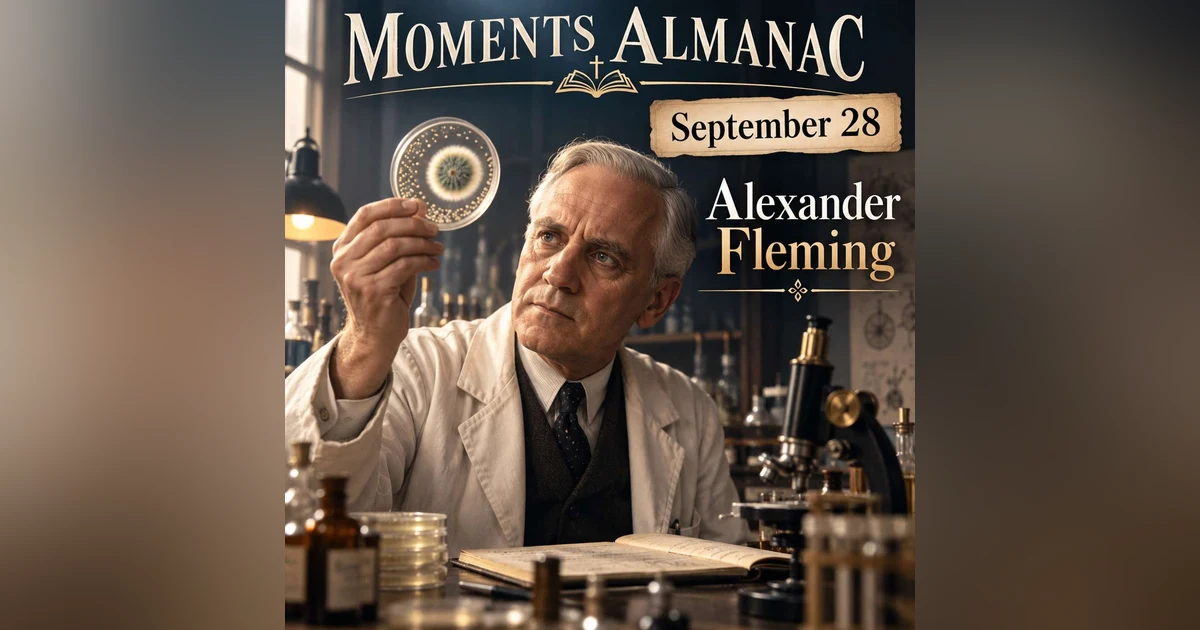


On September 28, 1928, Alexander Fleming noticed something strange in a contaminated culture dish: bacteria were dying around a patch of mold.
What looked like a ruined experiment became one of medicine’s most important discoveries.
In this episode of Moments Almanac, we look at the story of penicillin, the power of paying attention, and the possibility that what seems like an interruption may actually be an invitation to see something new.
Sometimes the interruption isn’t ruining the experiment.
Sometimes the interruption is the discovery.
Welcome to Scattered Moments for September 28th. And on this day in 1928, we learned that sometimes the most important thing in the room is the thing that wasn't supposed to be there. Alexander Fleming on this day made one of medicine's most famous accidental discoveries. He was working as a bacteriologist at St. Mary's Hospital in London. He'd been studying staphylococcus, the bacteria responsible for a number of dangerous infections. But today was different. Something went wrong. Or at least it looked like it did. One of Fleming's culture plates had been contaminated by mold. For a scientist, that usually meant one thing. The experiment was ruined. Throw it away, start over. But Fleming looked before he tossed it, and he noticed something strange. The bacteria were growing across the dish, except around the mold. There was a clear area surrounding it. Something in that mold was killing the bacteria. Fleming began experimenting with it and eventually called the antibacterial penicillin. But here's something we sometimes leave out in the story. Fleming didn't turn penicillin into a miracle drug himself. He couldn't successfully purify it in a form that could be widely used as medicine. For years his discovery largely sat there. Then, more than a decade later, Howard Florey, Ernest Chain, and a team of researchers at Oxford picked up the work and helped transform Fleming's observation into a practical treatment. In nineteen forty five, Fleming, Florey, and Chain shared the Nobel Prize in Medicine, but it all began with something that looked like a mistake a contaminated dish, an unwanted mold, an experiment that appeared to have gone bad. It reminds me of the words that Zechariah recorded. Who hath despised the day of small things? And maybe that's a good question for us this morning. How many things do we discard because they don't look like what we had planned? How many interruptions do we resent? How many detours do we label failures? How many small things do we overlook because we're waiting for something spectacular? Alexander Fleming didn't create the mold. He didn't intend for it to be there. He simply noticed what happened when it arrived. And sometimes faith looks like that. Paying attention, looking twice, leaving enough room in our plans for God to surprise us. I love that prayer. Lord, surprise me. You may not always understand why something has interrupted your life. You may even be looking for something right now that seems completely out of place. Don't be too quick to throw it away, because sometimes the interruption isn't ruining the experiment. Sometimes the interruption is the discovery. And that's scattered moments for today, September 28th. I hope you'll join me tomorrow. Until then, take heart. Notice the scattered moments and share the grace.


