September 26 | Moments Almanac | Appleseed
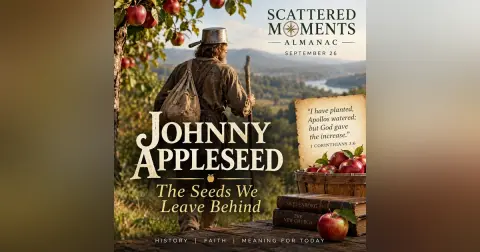


You probably know Johnny Appleseed as the barefoot wanderer with a cooking pot on his head, scattering apple seeds across the American frontier. But behind the beloved folk hero was John Chapman, a deeply religious man whose life was about much more than apples.
Born on September 26, 1774, Chapman traveled through the wilderness of early America, establishing orchards, sharing religious literature, and building relationships with frontier families. He planted trees whose fruit he might never taste, leaving behind a harvest for generations he would never meet.
In this episode of Moments Almanac, we explore the remarkable life of Johnny Appleseed and the spiritual lesson hidden in his legacy.
The apostle Paul wrote in 1 Corinthians 3:6, “I have planted, Apollos watered; but God gave the increase.”
What are you planting today that someone else may enjoy tomorrow? A word of encouragement, a prayer for a wandering child, a lesson taught to a young heart—God can bring an extraordinary harvest from seeds we may never see grow.
You don't have to see the harvest to have a hand in it.
Take heart. Notice the scattered moments. Share the grace.
Hey, thank you so much for joining me for Moments Almanac on September 26th. And on September 26th in 1774, a baby boy named John Chapman was born in Massachusetts. You probably know him by another name, Johnny Appleseed. If you grew up in America, you likely remember the pictures from elementary school. A barefoot boy wandering with a cooking pot on his head, scattering appleseeds across the frontier. But there's another side to Johnny Appleseed that you may not know. He was a missionary. As Chapman traveled through the wilderness of Pennsylvania, Ohio, and Indiana, he established apple nurseries, tended young trees, and sold and traded seedlings to settlers. He was also a deeply religious man who followed the teachings of Emmanuel Swedenborg. He carried religious literature with him, sharing it with families he encountered along the frontier. And here's something fascinating. Books were scarce in the frontier settlements, so Chapman sometimes divided his religious books into sections, leaving a portion with one family and exchanging it for another when he returned. Can you just imagine that? A traveling library, a missionary, and an apple orchard all rolled into one remarkable man. But also here's what strikes me about his story. Johnny Appleseed planted trees whose fruit he may never taste. He would clear a patch of ground, plant seeds, build a fence to protect the young trees, and move on. Years would pass before those trees ever produced a harvest and then Johnny would be hundreds of miles away. He understood something that we should never forget. The value of planting isn't determined by whether we get to enjoy the harvest. Scripture reminds us that I can do one thing and you can do another, and those two things might not be connected, or they may. But ultimately, God gave the increase. And that's a wonderful description of the Christian life. Some of us are called to plant, others are called to water, and sometimes we get to stand beneath the branches and enjoy the fruit. But the increase it really does belong to God. Think about the Sunday school teacher who faithfully teaches a room full of restless children, never knowing which child may become a missionary. Think about the parent who prays for a wandering son or daughter even when there seems to be no evidence that those prayers are making a difference at all. Think about the word of encouragement you offered someone years ago. You may have forgotten it entirely, but they haven't. You planted something. And God has a remarkable way of bringing life out of things we thought were buried. Johnny Applesed died in eighteen forty five, but the legend of the man who planted apple trees lives on. And his story leaves us with a question worth asking today. What are you planting? Because you don't have to see the harvest to have a hand in it. And sometimes the most important thing we can leave behind are the things we never live long enough to see. And that's Moments Almanac for September 26th. I hope you'll join me on the 27th tomorrow. Until then, take heart. Notice the scattered moments, and share the grace.


