September 29 | Moments Almanac | Restart
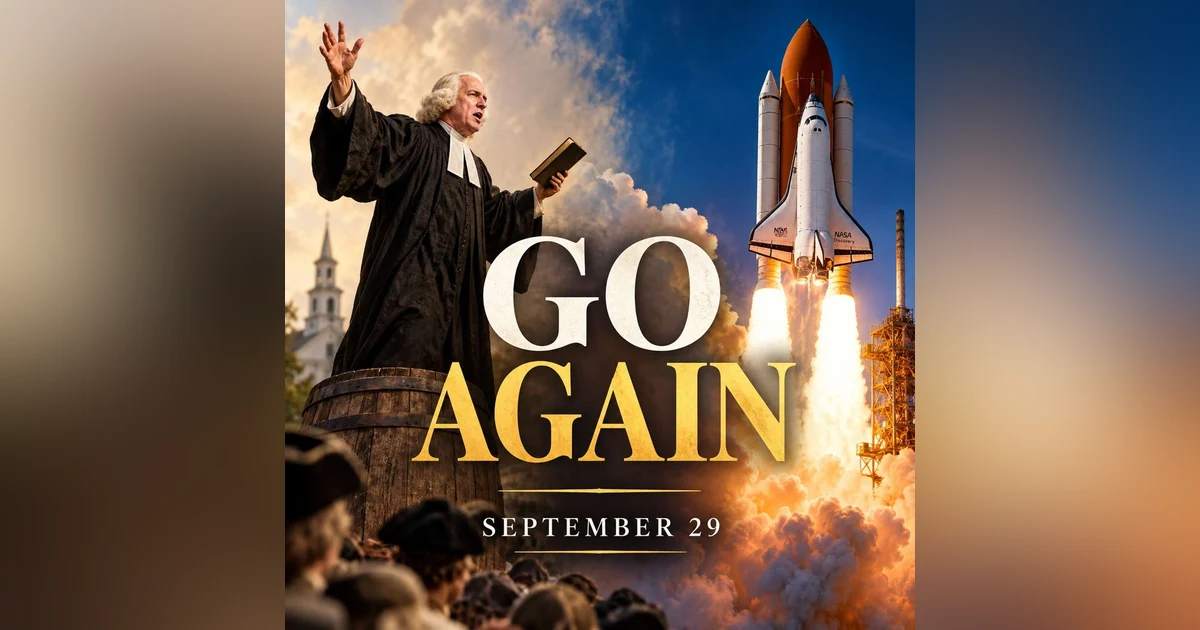


On September 29, 1770, George Whitefield climbed onto a barrel in Exeter, New Hampshire, and preached what would become his final sermon. His body was failing, his breathing was labored, but he believed that if God had given him one more opportunity to speak, he should take it.
Exactly 218 years later, on September 29, 1988, the space shuttle Discovery lifted off—the first shuttle flight since the Challenger disaster 975 days earlier. NASA had grieved, investigated, examined what had gone wrong, and prepared to fly again.
Two very different moments. One shared lesson.
Sometimes we need to stop and examine ourselves. Sometimes we need to learn from what has happened. But if the mission isn't finished, eventually we have to step back onto the barrel, climb back into the spacecraft, and go again.
In this episode of Moments Almanac, we remember George Whitefield's final sermon, Discovery's return to flight, and the courage to keep going when there is still work to do.
Welcome to Moments Almanac for September 29th. And on this day in 1770, George Whitfield was running out of breath. Literally. Whitfield had spent decades preaching across Britain and the American colonies, often outdoors, often to thousands, often until his voice was nearly gone. Now at fifty-five, his body was failing. That day during a stop in Exeter, New Hampshire, a friend looked at him and said, in essence, you belong in bed, not in a pulpit. Whitfield knew he was near the end. But he prayed that if his work was not yet finished, God would give him strength to preach once more. And so he did. That afternoon, Whitfield climbed onto a large barrel and preached to a crowd. His text was Second Corinthians, examine yourselves, whether ye be in the faith. At one point, speaking against the idea that we can somehow earn our salvation, Whitfield said trying to reach heaven by our own goodness was like trying to climb to the moon on a rope made of sand. That night his breathing would become worse. By six the next morning, George Whitfield was dead. Two hundred and eighteen years later, on september twenty ninth, nineteen eighty eight, another mission was preparing to go again. The space shuttle discovery lifted off from Kennedy Space Center. It had been nine hundred and seventy five days since the Challenger disaster. For nearly three years America had watched NASA examine itself what had gone wrong, what had been missing, what needed to change. Seven astronauts had died. The nation had mourned. The shuttle fleet had been grounded. And now came the question would they fly again? On September twenty-ninth, the answer was yes. Discovery rose from the launch pad and carried America back into space. The day before returning home, the crew paused to remember the seven astronauts who died aboard Challenger. They hadn't forgotten the cost, but the mission continued. There's something powerful about both of these events on September twenty ninth. Whitfield's final sermon began with an examination. Examine yourselves. NASA's return to space came only after years of examination. Because sometimes before you go again, you have to stop and look honestly at what's happening inside. What failed? What needs to change? What are we trusting? Where is our faith? But examination is not meant to leave us frozen forever. Eventually, if the mission remains, there comes a moment when you step back onto the barrel. You climb back into the spacecraft. You trust God with what comes next. And you go again. Let us run with endurance the race that lies before us, keeping our eyes on Jesus. Perhaps today, the question is not whether you have fallen, failed, grieved, or grown tired. Maybe the question is simply is God finished with you yet? If not, then go again.


