October 6 | Moments Almanac | Bar
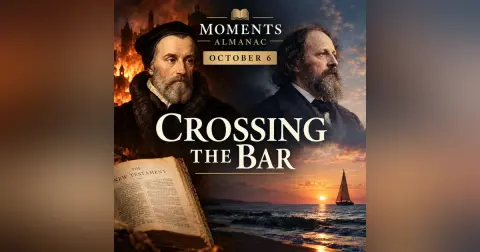
On October 6, two great English voices fell silent, 356 years apart. In 1536, Bible translator William Tyndale was executed at Vilvoorde, leaving behind a final prayer: “Lord, open the King of England’s eyes.” In 1892, Poet Laureate Alfred, Lord Tennyson died after a lifetime of words, including his haunting meditation on death, Crossing the Bar. In this episode of Moments Almanac, we bring their stories together—one man who gave his life to put Scripture into the language of ordinary people,...


On October 6, two great English voices fell silent, 356 years apart.
In 1536, Bible translator William Tyndale was executed at Vilvoorde, leaving behind a final prayer: “Lord, open the King of England’s eyes.” In 1892, Poet Laureate Alfred, Lord Tennyson died after a lifetime of words, including his haunting meditation on death, Crossing the Bar.
In this episode of Moments Almanac, we bring their stories together—one man who gave his life to put Scripture into the language of ordinary people, and another who imagined death as a voyage beyond the harbor, where he hoped to see his “Pilot face to face.”
Two lives. Two deaths. One October day.
And a reminder that eventually we all come to the bar—but for the Christian, beyond the horizon is not merely an unknown sea.
The Pilot is there.
Welcome to Moments Almanac for October 6th. And on this date, two Englishmen died, 356 years apart. One died with a prayer on his lips, and the other died behind a poem about what waits beyond the horizon. On October 6, 1536, William Tyndale was executed near Brussels. Tyndale had devoted much of his life to a dangerous conviction. Ordinary people should be able to read the Bible in their own language. At the time, translating scripture into English without authorization could cost you your life, but Tyndall pressed on, working from the original Greek and producing an English New Testament that could be read not merely by scholars and clergy, but by merchants, farmers, mothers, fathers, anyone who could get their hands on a copy. Those copies were smuggled into England, sometimes hidden among bales of cloth and other merchandise. Authorities hunted him. Eventually, Tyndale was betrayed, arrested, imprisoned for more than a year, and condemned as a heretic. According to John Fox, as Tyndale faced execution, he cried out, Lord, open the King of England's eyes, and then he was strangled and his body was burned. But his prayer would prove remarkably prophetic. Within just a few years, English Bibles were being placed in churches by royal authority, and Tyndale's language would echo through English translations for six generations. Three hundred and fifty-six years later, another great English words died on October 6th, Alfred Lord Tennyson. Tennyson had served as Britain's poet laureate for more than forty years. But one of the most enduring poems was only sixteen lines long. He called it Crossing the Bar. The image came from the sea. A bar as a ridge of sand or sediment near the mouth of a harbor. To cross the bar meant leaving the sheltered waters and moving into the vastness of the open sea. Tennyson turned that image into a metaphor for death. He begins, sunset and evening star, and one clear call for me. There is no panic in the poem, no desperate grasping for shoreline, only the sense that the voyage is beginning, and Tennyson knew where, or rather to whom, he hoped the voyage would lead. His poem concludes: I hope to see my pilot face to face when I have crossed the bar. When Tennyson died on October 6, 1892, he was buried in Westminster Abbey, where words of crossing the bar were set to music for his funeral. And that's where these two stories meet on October 6. William Tyndale stood before his executioners and prayed to the God whose word he had spent his life placing into the hands of ordinary people. And Alfred Tennyson looked toward the approaching horizon and imagined meeting his pilot face to face. One crossed through fire and the other crossed quietly from his home in Surrey. One left us words of scripture translated into the language of the people, and the other left us words of poetry describing the mystery that awaits every one of us. Because eventually we all come to the bar. The familiar shoreline begins to disappear, the evening stars rise, the water deepens, and faith reminds us that beyond the horizon there is not merely an unknown sea, there is someone waiting. The pilot is there. And that's Moments Almanac for October 6th. I hope you'll join me tomorrow. Until then, take heart. Notice the scattered moments, and share the grace.


