Psalm 25 | Psalms Reflections
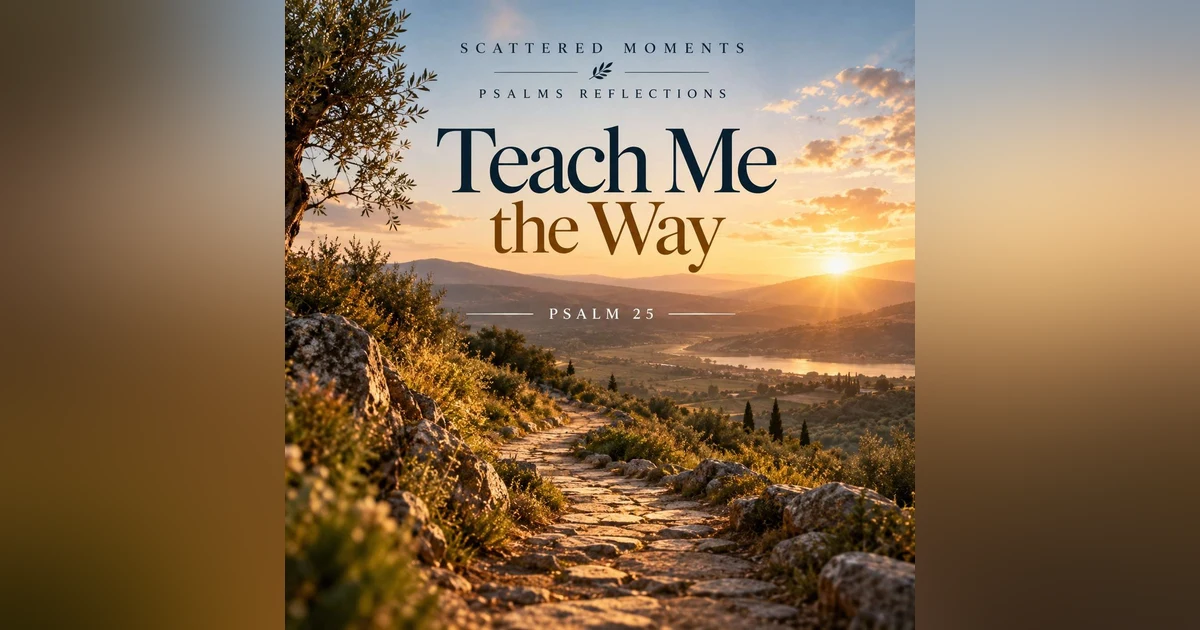


Some roads lead us to beautiful places. Others leave us carrying regrets. And some disappear around bends we cannot see, leaving us wondering what comes next.
In Psalm 25, David stands somewhere between the roads behind him and the uncertain path ahead. His prayer is remarkably honest. He remembers the sins of his youth, acknowledges the troubles surrounding him, and confesses his need for God's guidance. Yet instead of demanding answers, he offers a simple, profound prayer: "Make your ways known to me, LORD; teach me your paths."
In this deeply personal episode of Scattered Moments: Psalms Reflections, we explore what it means to trust God when the future is uncertain, when the past still troubles us, and when faith requires more waiting than walking.
Along the way, we discover the extraordinary beauty of God's steadfast love—the Hebrew concept of hesed—His faithful, covenant-keeping mercy that reaches beyond our failures. We reflect on David's remarkable request that God remember His compassion rather than the sins of David's youth, and we consider the invitation of Psalm 25:14 to enjoy the intimate counsel an
Welcome to Psalms Reflections on Scattered Moments, a time for us to slowly walk through and reflect on the words of the Psalms. Find a quiet place and join me. Psalm 25. There comes a time in life when you realize you've traveled a lot of roads. Some beautiful, some were difficult. Some led to places you never imagined you'd go. And some, well, some roads you had no business traveling in the first place. These are the turns you wish you could take again. Decisions you'd like to reconsider, words you'd like to retrieve, moments you'd like to revisit. Not because they are wonderful, but because you'd like another opportunity to get them right. And then there are the roads ahead. The ones you haven't traveled, the ones disappearing around the bend. You can see a little of the path, but not nearly enough to satisfy your curiosity or your anxiety. And that's where Psalm 25 finds us, standing somewhere between the road behind us and the roads ahead of us, carrying a few regrets, holding a few hopes, and whispering a prayer, Lord, teach me the way. Today we're spending some time in Psalm 25, a prayer of David, a man who knew something about taking the wrong road, finding the right one, and discovering that God's mercy was waiting for him along the way. David begins his prayer with these words, Lord, I appeal to you. My God, I trust in you. I love that he begins there, not with his problems, not with his enemies, not even with his regrets. He begins with trust. But as the psalm unfolds, we discover that David is anything but carefree. He has enemies, he has troubles, he has memories that still trouble him. He has questions about the future. In other words, he sounds remarkably like us. And then comes his request. Make your ways known to me, Lord. Teach me your paths, guide me in your truth, and teach me, for you are the God of my salvation. I wait for you all day long. Notice what David doesn't ask. He doesn't ask God to show him the next twenty years. He doesn't ask for a detailed itinerary. He doesn't ask for a guarantee that every road will be smooth and every destination pleasant. He simply asks to be taught. Teach me your paths. It's a different kind of prayer because most of us would prefer a map. A map gives us a sense of control. We want to know how long the journey will take. We want to know where the detours are. We want to know whether there's trouble ahead. We'd like God to give us a map with all the bad decisions conveniently marked in red. Don't turn here. Avoid this relationship. Don't say that. And whatever you do, don't send that email. Wouldn't that be wonderful? But God gives us something better than a map. He gives us himself. He teaches us to walk with him. And sometimes the lesson isn't about where we're going at all. It's about who we're becoming along the way. Now David turns his attention backward. And suddenly the prayer becomes deeply personal. Do not remember the sins of my youth or my acts of rebellion in keeping with your faithful love. Remember me because of your goodness, Lord. There is something about that prayer that becomes more meaningful with age. When we were young, we often imagined that our mistakes would eventually disappear into the distance, but some memories have a remarkable ability to stay with us. They show up unexpectedly. An open photograph, a familiar song, a name you haven't heard in years, a place you drive past, and suddenly you are there again, standing in a moment you wish you could change. I wonder what David was remembering. Was he thinking about his younger years? Was he remembering decisions that had hurt others? Was he thinking about the consequences of his rebellion? We don't know exactly what prompted these words. But we know enough about David's life to understand that he had plenty of reasons to ask for mercy. And what fascinates me is the way he prays. He asks God to remember something and to not remember something. Remember your compassion, remember your faithful love, but don't remember the sins of my youth. What a prayer. David isn't asking God to pretend that the past never happened. He's asking God to deal with him according to divine mercy rather than human failure. And this is where the gospel begins to shine through the ancient words of the psalmist. Because forgiveness isn't God deciding that sin doesn't matter. Forgiveness is God making a way for sinners to be reconciled to Him. And for us, that way leads to Jesus Christ. The cross tells us two things at once. Our sin is more serious than we often admit. And God's love is greater than we could possibly imagine. There are things in my life I wish I could go back and I could change. Perhaps you feel the same way. But I've learned something about grace. Grace doesn't give us the ability to rewrite yesterday. It gives us the freedom to live tomorrow without being imprisoned by yesterday. David knew that freedom could only come from God. And so he prayed. Not according to my worst moments. I've had plenty of those. Not according to my most foolish decision. Not according to the things I wish I'd never done. Remember me according to your goodness. And that is a prayer worth carrying into every new morning. As Psalm 25 continues, David makes a remarkable observation. He leads the humble in what is right and teaches them his way. The humble, not necessarily the brilliant, not the powerful, not the people who have everything figured out, the humble. I find that both comforting and challenging because there are times when I don't really want God to teach me. I want him to agree with me. I've already made my decision. I've already worked out the details. I've already determined the direction. And now I will I depreciate a little divine endorsement. Lord, here's my plan. Just sign at the bottom. But humility doesn't work that way. Humility says, Lord, I may be wrong. I may have misunderstood. I may have looked at this through the narrow window of my own preferences and fears. I may need to change, and I need you to teach me. There's a difference between asking God to bless the path we've chosen and allowing him to choose the path we take. Sometimes the most important spiritual growth happens when we stop trying to persuade God to follow us. And we begin following Him. And maybe that's why David repeats his request, teach me, guide me, show me. It's the prayer of a man who understands that spiritual maturity doesn't mean graduating from the need for guidance. It means becoming increasingly aware of how desperately we need him. And then tucked away in verse 14, we discover one of the most beautiful statements in the Psalms. And he reveals his covenant to them. The Hebrew word translated secret counsel comes from the idea of intimate conversation, the kind of conversation shared between trusted friends, not secret information about tomorrow's events, not some hidden code for predicting the future, but the privilege of fellowship with God. Meditate on that for a moment. The creator of the universe invites his people to know him, to walk with him, to listen to his word, to discover his character, to learn his ways. And the more we know him, the more we discover that guidance isn't merely about getting answers. It's about growing in relationship. Sometimes I become so obsessed with knowing God's will for my life that I overlook the greater invitation to know God Himself. We want to know what happens next. God invites us to know the one who holds what happens next. We want clarity. He offers companionship. We want certainty about the road. He calls us to trust the shepherd. And that's the greatest gift of divine guidance. It's not knowing where we're going, it's knowing who is going with us. Now here's something I don't want us to miss. Psalm 25 doesn't end with David announcing that all his troubles have disappeared. Quite the opposite. Near the end of the Psalm, he cries out, Turn to me and be gracious to me, for I am alone and afflicted. And then the distresses of my heart increase, bring me out of my sufferings. Notice his troubles haven't vanished, his enemies haven't necessarily surrendered, his circumstances haven't suddenly become pleasant, and yet, David, he's still praying, still trusting, still waiting, still looking toward God. I think that's important because somewhere along the way we begin to imagine that strong faith means having fewer struggles, that spiritual maturity means reaching a place where fear and uncertainty no longer trouble us. But Psalm 25 tells us a different story. Sometimes faith is trembling. Sometimes faith is waiting. Sometimes faith is sitting in the middle of circumstances you cannot change, whispering, Lord, my eyes are on you. Not because everything makes sense, not because the pain has disappeared. Not because the answers have arrived. But because God is still God. And his character has not changed. David says in verse 15, My eyes are always on the Lord, for he will pull my feet out of the net. What an image. Feet caught in a net, unable to move freely, trapped by circumstances beyond our control. And yet the eyes are lifted. The faith is there. Not pretending the net isn't there, but looking to the one who can deliver us. And then another turn. There's an interesting connection between Psalm 23 and Psalm 25. In Psalm 23, David confidently declares, The Lord is my shepherd. He speaks of green pastures, quiet waters, right paths, a shepherd who leads him. But in Psalm 25, we see this same David praying, Teach me your paths. In one Psalm he celebrates the shepherd's guidance, and in another he pleads for it. And isn't that the rhythm of our own lives? Some days we sing with confidence, He leads me. Other days we can barely whisper, Lord, please show me your way. Some days the path is obvious. Other days the fog settles in so thickly that we can barely see the next step. But the shepherd hasn't changed. The one who leads us beside still waters is the same one who walks with us through the valley. The one who restores our soul is the same one who hears us confess the sins of our youth. The one who prepares a table in the presence of our enemies is the same one who hears us cry out for deliverance. And whether we are celebrating his guidance or pleading for it, we are still his sheep. Still loved, still known, still held. And I don't know where you are, what path you are on, but maybe you're standing at a crossroads today. Maybe you're facing a decision. Maybe you're carrying a regret. Maybe the future seems uncertain. Maybe someone you've trusted has forsaken you. Or maybe you're simply tired of trying to figure everything out. Psalm 25 offers us a prayer, not a formula, not a guarantee for answers, a prayer. Lord, teach me your way. Teach me to trust when I cannot see. Teach me to wait when I want to run ahead. Teach me humility when I think I know everything. Teach me to remember your mercy more than I remember my failures. Teach me to listen. Teach me to follow. Teach me to rest in the knowledge that you are good. And when I cannot see the road ahead, remind me that you can. When I am troubled by the road behind, remind me that your grace is sufficient. When I become impatient with the road beneath my feet, remind me that walking with you is never wasted time. And when the path grows dark, remind me that I do not walk alone. You know, I've come to believe that the longer we walk with God, the more we understand how little we really know. We don't know what tomorrow holds. We don't know which unexpected turn will change our plans. We don't know how many miles remain. But we can know the one who walks with us. And that's enough. Actually, it's more than enough. Because the most faithful thing we can do is admit that we don't know where we're going. And then place our hand in the hand of the one who does. Teach me your path, Lord. Guide me in your truth. For you are the God of my salvation. And I will wait for you. So today, rest in the one who will teach you his path. He will guide you into truth today. He's the God of our salvation. And no matter what our adversity, no matter what we're weeping about or what we're celebrating, we can rest in the faithful love of our shepherd who will show us the path.


