Psalm 16 | Psalms Reflections
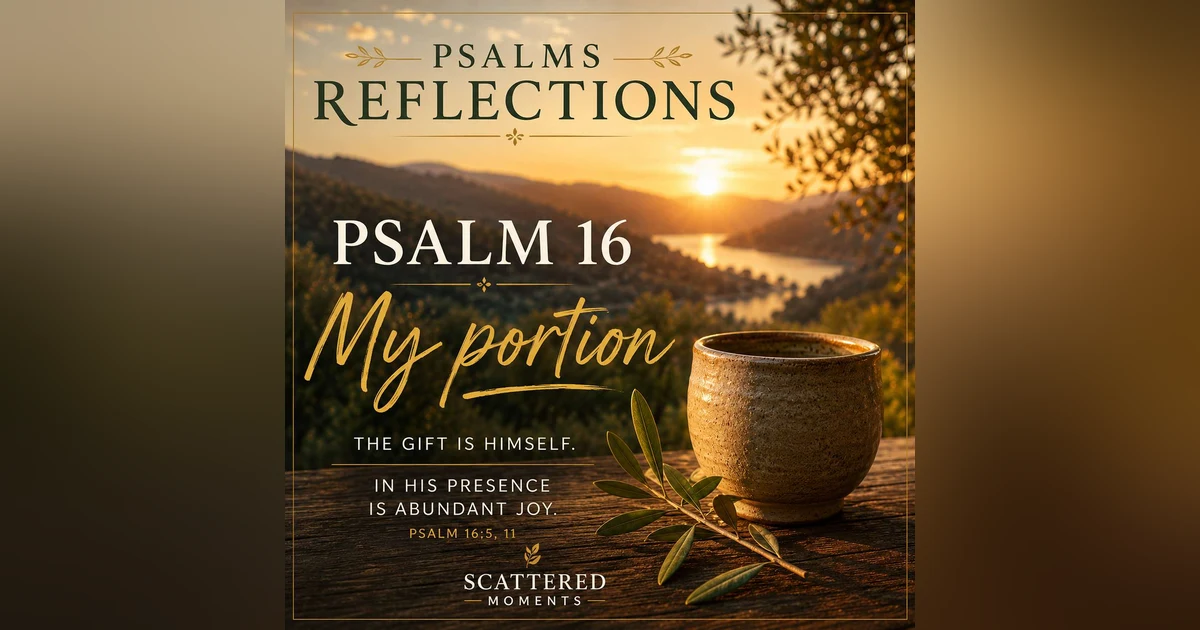
What if God answered your prayers today by giving you nothing but Himself? Would He be enough? Psalm 16 is a song of quiet confidence from David. Trouble seems to be somewhere in the background—he begins by praying, “Protect me, God, for I take refuge in you”—but David spends surprisingly little time describing what threatens him. Instead, he turns his attention toward what he possesses. And his greatest possession is God Himself. “LORD, you are my portion and my cup of blessing; you hold my ...


What if God answered your prayers today by giving you nothing but Himself? Would He be enough?
Psalm 16 is a song of quiet confidence from David. Trouble seems to be somewhere in the background—he begins by praying, “Protect me, God, for I take refuge in you”—but David spends surprisingly little time describing what threatens him. Instead, he turns his attention toward what he possesses.
And his greatest possession is God Himself.
“LORD, you are my portion and my cup of blessing; you hold my future.”
— Psalm 16:5 CSB
The Lord Is My Portion
The Hebrew word translated “portion” is חֵלֶק — cheleq (KHEH-lek). It can mean a share, portion, allotment, or inheritance—something assigned to someone as their possession.
That language would have carried special meaning in Israel.
When the Promised Land was divided among the tribes, families received their allotted portions of land. But the tribe of Levi was different. Deuteronomy 10:9 says that Levi received no territorial inheritance like the other tribes because “the LORD is his inheritance.”
Psalm 16 takes that beautiful idea and makes it personal.
David isn't merely saying, “God has given me a portion.”
He says:
God is my portion.
The gift is not simply what God places into our hands.
The gift is Himself.
We often measure God's goodness by the things surrounding us—our health, family, finances, opportunities, relationships, successes, and answered prayers. These are wonderful gifts. But they are not the ultimate gift.
Psalm 16 reminds us that even when circumstances change, the believer's greatest possession remains unchanged.
“You Hold My Future”
David also speaks of his “cup”—Hebrew כּוֹס — kos.
In Scripture, a cup can symbolize what has been appointed for someone to receive or experience. David is essentially looking at the life placed before him and declaring that God Himself is both his portion and the One who secures it.
The CSB beautifully renders the next phrase:
“You hold my future.”
Other translations speak of God maintaining or securing David's “lot.” The Hebrew idea comes from the ancient practice of casting lots to determine an allotted share.
David doesn't know everything his future contains.
But he knows Who holds it.
That is an important distinction.
Faith does not mean:
I know what is going to happen.
Faith says:
I know the One who holds what is going to happen.
The Boundary Lines
Then comes one of Psalm 16's most memorable images:
“The boundary lines have fallen for me in pleasant places; indeed, I have a beautiful inheritance.”
The Hebrew word חֶבֶל — chevel can refer to a cord or measuring line and, by extension, the territory measured out by that line.
Imagine land being surveyed and divided. The measuring cords fall, marking the portion that belongs to you.
David looks at his allotted life and calls his inheritance beautiful.
That doesn't mean David's life was easy.
His boundaries included conflict, betrayal, family heartbreak, enemies, personal failure, uncertainty, and grief.
So perhaps David isn't calling every circumstance pleasant.
He is recognizing the goodness of the God who occupies the territory with him.
Some of our boundary lines fall in places we would never have chosen.
A door closes.
A season ends.
Our bodies change.
Someone leaves.
A dream never materializes.
Life becomes smaller or simply different from what we imagined.
Psalm 16 asks us whether God's presence can make even an unexpected portion sacred ground.
God in the Night
David writes:
“I will bless the LORD who counsels me—even at night when my thoughts trouble me.”
Nighttime has a peculiar ability to magnify our fears.
Questions become louder.
Regrets become sharper.
Tomorrow becomes more intimidating.
Yet David discovers that God inhabits the night as surely as He inhabits the morning.
He continues:
“I always let the LORD guide me. Because he is at my right hand, I will not be shaken.”
His confidence isn't rooted in having solved his problems.
It is rooted in presence.
God is near.
Psalm 16 and the Resurrection
Then Psalm 16 suddenly reaches beyond David's immediate circumstances:
“For you will not abandon me to Sheol; you will not allow your faithful one to see decay.”
Sheol — שְׁאוֹל (she'ol) is the Hebrew term commonly used in the Old Testament for the realm of the dead or the grave.
These verses became enormously important to the early church.
On the day of Pentecost, Peter quotes Psalm 16 in Acts 2:25–32 and explains that David ultimately pointed beyond himself to Jesus Christ. David died and was buried, Peter argues, but Jesus entered the grave and rose again.
Paul makes the same connection in Acts 13:35–37.
That transforms the idea of God as our portion.
If Christ is our portion, even death cannot take our inheritance from us.
Everything else we possess will eventually leave our hands.
Possessions.
Accomplishments.
Titles.
Money.
Even our bodies.
But Christ remains.
The Path of Life
Psalm 16 concludes:
“You reveal the path of life to me; in your presence is abundant joy; at your right hand are eternal pleasures.”
The Hebrew word for “path” — אֹרַח (orach) describes a way, road, or course of life.
And look where David's road ultimately leads:
Presence.
Not merely success.
Not perfect circumstances.
Not answers to every question.
The path leads to God.
And there David finds “abundant joy.”
The Hebrew word שִׂמְחָה — simchah carries the idea of joy, gladness, rejoicing, and celebration.
Psalm 16 begins with David seeking refuge in God and ends with David discovering eternal joy in God's presence.
Perhaps that's the journey of the entire psalm.
We begin by asking God to protect the life we have.
And eventually we discover that God Himself is our life.
We ask Him for gifts.
He gives us Himself.
We ask for answers.
He gives us His presence.
We ask for certainty.
He gives us Himself.
We ask Him to secure our future.
And through the risen Christ, He tells us that our future ultimately ends in His presence.
The Lord is my portion.
And if He is my portion, I am never truly empty.
Scriptures for further reflection: Psalm 16; Numbers 18:20; Deuteronomy 10:9; Lamentations 3:24; Psalm 73:25–26; Acts 2:25–32; Acts 13:35–37; 1 Peter 1:3–4.
Psalms Reflections is part of Scattered Moments — taking time to slow down, listen to Scripture, and notice the presence of God in the ordinary places of life.
Welcome to Psalm's Reflections on Scattered Moments. Today we come to Psalm 16. We begin with a question. What if God answers your prayers today by giving you nothing but Himself? No change in circumstances. No sudden solution. No explanation for the thing you cannot understand. No guarantee that tomorrow will unfold exactly as you hope. Trust God. Would He be enough? David begins Psalm 16 with a prayer. Protect me, God, for I take refuge in you. There is trouble somewhere beyond these words. David needs protection. Something is uncertain. Something has driven him into the refuge of God. But David doesn't spend much time describing the danger. Instead, he begins describing his treasure. He says, Lord, you are my portion and my cup of blessing. You hold my future. You are my portion. It's an unusual way to speak about God. A portion is what has been allotted to you. It's what is placed on your plate. It's what you receive as your share. And David looks at everything that could be given to him and says, God, you are my share. The gift is not simply what God gives. The gift is God himself. We spend so much time, so many moments of our lives asking for other portions. Give me wealth. Give me strength. Give me enough time. Give me enough success. Give me enough health. Give me enough security to know that everything is going to be alright. And those aren't necessarily bad things. But Jesus taught us to pray for our daily bread. Psalm 16 invites us to something even deeper. What if we looked into the cup God has placed before us and discovered that the greatest blessing in the cup was his presence. Lord, you are my portion. When I don't have the answers I want, you are my portion. When the future seems uncertain, you are my portion. When something I treasured has slipped through my fingers, you are my portion. When I look around and wonder why someone else seems to have received more. David continues. Indeed, I have a beautiful inheritance. Maybe you've read those words and thought. Some boundaries are painful. There are places we cannot go anymore. Things we cannot do anymore. People we cannot bring back. Dreams that didn't happen. Doors that closed. Bodies that changed. Seasons that ended before we were ready. David certainly knew something about difficult boundaries. So perhaps his joy isn't found in having the perfect boundaries. Perhaps his joy comes from knowing who is inside them with him. I have a beautiful inheritance, he says. Why? Because God is there. David says that even in the night God counsels him. I will bless the Lord who counsels me even at night when my thoughts trouble me. I love that honesty, because nighttime has a way of making everything louder. A question you manage to avoid all day suddenly sits beside you. In the darkness, the worry becomes larger. The regret becomes sharper. The future becomes more uncertain. But David says that even there, even at night, God is present. I always let the Lord guide me. Because he is at my right hand. I will not be shaken. Not because David has figured everything out. Not because every enemy has disappeared. Not because every prayer has been answered. But because God is near. You are my portion. And then this psalm begins looking beyond today. David says, My heart is glad, and my whole being rejoices. My body also rests securely. For you will not abandon me. You will not allow your faithful one to see decay. Centuries later, Peter would stand in Jerusalem on that day of Pentecost and quote these words. He would say that David was looking beyond himself, beyond his own grave, beyond death itself. He was pointing us toward Jesus, the one who entered the grave and walked out. And suddenly those words, You're my portion, become even more beautiful. Because if Christ is our portion, death cannot take our inheritance. Everything else we possess eventually leaves our hands, our accomplishments, our possessions, our titles. Even these bodies we inhabit, but Jesus remains. The risen Christ is our portion, and because he lives, our inheritance cannot perish. David ends. You reveal the path of life to me. In your presence is abundant joy. At your right hand are eternal pleasures. Notice where the path leads. Not merely to better circumstances, not merely to answered questions, not merely to a longer life. And to his presence. Maybe that's what the whole psalm has been teaching us. God is not merely the one who gives us treasure. God is the treasure. He is our portion in the morning. He is our portion when the boundary lines confuse us. He is our portion in the middle of the night. He is our portion when tomorrow frightens us. And when our final tomorrow comes, he will still be our portion. So now perhaps we can loosen our grip on all the things we think we must have in order to be content and simply say, Lord, you are my portion. If you give me blessing, you are my portion. If you ask me to wait, you are my portion. If you lead me somewhere I did not expect, you are my portion. And when this path finally leads me home, you will still be my portion. Because the greatest gift you could give me is yourself. And in your presence there is abundant joy.
SPEAKER_01While others run to falsehood. I choose to seek your face.


