October 9 | Moments Almanac | Banished
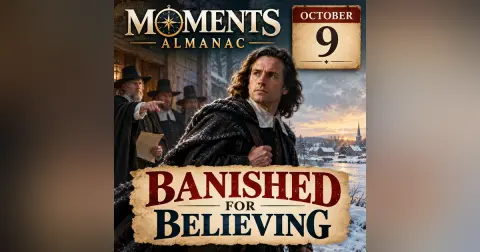


On October 9, 1635, Roger Williams was banished from the Massachusetts Bay Colony for spreading what authorities called “new and dangerous opinions.” His radical ideas? That government should not control religious belief, that worship should never be forced, and that Native Americans had legitimate rights to their land.
The Puritans had crossed an ocean seeking religious freedom, yet Williams dared to ask whether that freedom should extend to those who disagreed with them.
His convictions cost him his home and nearly his life. Escaping into the bitter New England winter, Williams found refuge with Native Americans before establishing Providence, Rhode Island, a community built upon freedom of conscience. He would later help establish what is widely recognized as America's first Baptist church.
In today's Moments Almanac, we revisit the remarkable story of a man whose banishment helped lay the groundwork for religious liberty in America.
It's a reminder that genuine faith cannot be manufactured by force, that conscience cannot be commanded, and that sometimes the convictions that get us thrown out of one place become the foundation of something extraordinary in another.
Because faith isn't something we can force upon another person. It must be freely chosen.
Moments Almanac is part of Scattered Moments with Matt Tullos, where history, faith, and the extraordinary lessons of ordinary days come together.
Welcome to Moments Almanac for October 9th. And on this day in 1635, a preacher named Roger Williams was ordered to leave Massachusetts Bay Colony. His crime? Well, he didn't rob a bank. There weren't any banks to rob. He hadn't committed a murder or stolen anyone's livestock. He had simply been expressing some rather dangerous ideas. Ideas like the government shouldn't tell people what to believe about God or people shouldn't be forced to attend church. And the land belonging to the Native Americans shouldn't simply be taken because an English king said it could. Now, those ideas might sound reasonable to us today, but in Puritan, Massachusetts, they were revolutionary. You see, Puritans had crossed an ocean seeking religious freedom, but once they established their own colony, they weren't particularly interested in extending that freedom to people who disagreed with them. Roger Williams saw the contradiction. He believed that genuine faith could never be manufactured by government decrees. You could force someone into a church building. You could even punish them for refusing to participate, but you couldn't make them believe. And Williams was willing to lose everything over that conviction. The authorities accused him of spreading what they called new and dangerous opinions. On October ninth, they ordered him banished, but there was a problem. Winter was coming. And a New England winter was no small inconvenience. The authorities initially allowed Williams to arrange his own departure, but when he continued sharing his beliefs, they decided to send him back to England. But before they could arrest him, Williams escaped. He fled into the wilderness during the bitter winter of 1636, and for weeks he wandered through the snow and cold, surviving in part through the kindness of Native Americans, including people whose rights he had defended. Eventually he established a settlement called Providence, and there something remarkable happened. Williams helped create a community where people could worship according to their conscience without government coercion. A few years later he established what is generally recognized as the first Baptist church in America. Now, Williams was not a perfect man, and his religious journey was complicated, but his conviction about freedom of conscience helped shape a principle that would become the central part of American understanding of religious liberty. And of course, there's something deeply biblical about that conviction. In Joshua 24, 15, Joshua tells the people, choose for yourselves today which will you worship. Notice the word choose, because genuine faith requires more than outward compliance. God desires our hearts, not merely the appearance of religion. And here's what strikes me about Roger Williams. The people who banished him believed that they were protecting their religious community. But the man they sent away helped establish a place where freedom of conscience could flourish. They thought they were getting rid of a troublesome preacher. Instead, they helped set in motion something far greater than they imagined. And on October 9th, 1635, Roger Williams lost his place in Massachusetts, but he refused to surrender his convictions. And sometimes the very thing that gets you thrown out of a place becomes the foundation of something extraordinary in another. And that's Moments Almanac for today, October 9th. It's a reminder that faith cannot be forced, conscience cannot be commanded, and sometimes the courage to stand alone opens the door for generations to come. I hope you'll join me tomorrow. Until then, take heart. Notice the scattered moments and share the grace.


