Psalm 15 | Psalms Refelctions
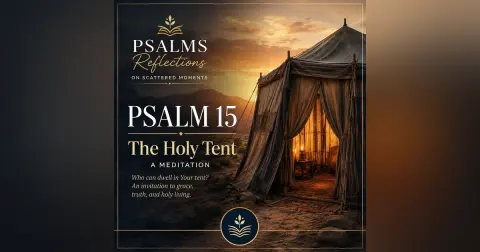
Who can dwell in the presence of a holy God? Psalm 15 begins with one of Scripture’s most searching questions: “LORD, who can dwell in your tent? Who can live on your holy mountain?” — Psalm 15:1David answers with a portrait of integrity: a person who practices righteousness, speaks truth from the heart, refuses to use words to harm others, keeps promises even when they hurt, protects the vulnerable, and lives justly. This short psalm reads almost like a collection of proverbs, but beneath it...


Who can dwell in the presence of a holy God?
Psalm 15 begins with one of Scripture’s most searching questions:
“LORD, who can dwell in your tent? Who can live on your holy mountain?” — Psalm 15:1
David answers with a portrait of integrity: a person who practices righteousness, speaks truth from the heart, refuses to use words to harm others, keeps promises even when they hurt, protects the vulnerable, and lives justly.
This short psalm reads almost like a collection of proverbs, but beneath its practical wisdom is a much deeper question: How can imperfect people ever enter the presence of a perfect and holy God?
The Hebrew word translated tent, ’ohel, recalls the dwelling place of God among His people. Psalm 15 invites us to imagine ourselves approaching that holy place and asking, Am I worthy to enter?
If our entrance depends upon perfectly fulfilling the requirements of Psalm 15, none of us can stand.
But the gospel gives us another answer.
Jesus Christ is the truly righteous One—the One who perfectly embodies the life Psalm 15 describes. And through Him, we are invited near.
Hebrews 10:19–22 tells us that we have confidence to enter the holy place through the blood of Jesus and therefore may “draw near with a true heart in full assurance of faith.”
Our holiness is not something we manufacture in order to gain entrance into God's presence. Christ makes us holy by grace and then begins forming His holiness within us.
As Hebrews 10:10 says:
“By this will, we have been sanctified through the offering of the body of Jesus Christ once for all.”
And 2 Corinthians 5:21 reminds us of the remarkable exchange at the heart of the gospel: Christ, who knew no sin, became sin for us “so that in him we might become the righteousness of God.”
Psalm 15 therefore becomes more than a checklist. It becomes both a mirror and an invitation. It shows us the life God desires, reveals how desperately we need grace, and points us toward the One who makes it possible for sinners to come home.
In this Psalms Reflection, we slowly approach the holy tent, consider the kind of life that flourishes in God's presence, and hear again the invitation made possible through Christ:
Come near.
Come by grace.
Come and dwell in the holy place.
Psalm 15 — The Holy Tent
A Psalms Reflection from Scattered Moments.
Song written by Matt Tullos
Music and vocals created with Sunos
Welcome to Psalm's Reflections on Scattered Moments. Today, let us pause and meditate on the words of Psalm 15. David begins with a question. Not a question about enemies. Not a question about suffering. Not even a question about himself. He asks a question about home. Lord, who can dwell in your tent? Who can live on your holy mountain? Imagine the tent for a moment. A holy tent. The dwelling place of God among his people. Perhaps you can see it in the distance. Perhaps you can imagine yourself walking toward it. And as you draw near, one question begins to rise within you. Can I come in? Lord, who can dwell in your tent? Who can live near you? Who can remain in the presence of a holy God. David answers. The one who lives blamelessly. The one who practices righteousness. The one who acknowledges truth in his heart. The one who does not slander with his tongue. The one who does not harm his friend. The one who keeps his word. Even when it costs him something. The one who does not exploit the vulnerable. But perhaps David isn't simply giving us a list of words. Perhaps he is describing what happens to a person who wants to live near God. Because the closer we come to the Holy Tent, the less comfortable we become with a divided life. We cannot worship God with our lips while using the same lips to destroy another person. We cannot celebrate God's mercy while refusing mercy to our neighbor. We cannot speak of God's faithfulness while treating our own promises as disposable. And perhaps that's the most searching phrase in this poem. He speaks truth in his heart. Not simply truth from his mouth. Truth in his heart. In that secret place where no one else can hear. Where excuses are manufactured. Resentment grows where pride hides. Where fear whispers. God desires truth even there. His heart. And suddenly I find myself standing outside the tent again. And David's question becomes my question. Lord, who can dwell in your tent? If this is the standard, how could I possibly enter? Because I haven't always spoken the truth. I haven't always kept my promises. My words haven't always brought life. My motives haven't always been pure. I failed the requirements of this song. And that is where this ancient song creates within me a longing for grace. I need someone who is righteous. Someone who is completely true. Someone completely faithful. Someone whose words never deceive. Someone whose promise never fails. And I find him in Jesus. And because of Jesus, the imitation of God is not merely stand outside and try harder. Because of Jesus. It is. Come near. Come into the presence of God. Come into the holy tent. Come with your failures. Come with your divided heart. Come with the words you wished you could take back. Come with the promises you failed to keep. Come and allow the grace of Christ to begin to reshape you into the kind of person Psalm 15 describes. Because grace does not simply forgive us. Grace changes the way we talk. The way we speak. The way we treat our neighbor. The way we keep our word. The way we tell ourselves the truth. And then David gives one final promise. The one who does these things will never be shaken. What a beautiful way to end this psalm. It begins with a tent. It ends with solid ground. To dwell with God is to discover a place where the soul can finally stand. So today, wherever you are, walking, driving, sitting quietly, or simply trying to make it through another complicated day. Imagine the holy tent. Imagine the presence of God and hear the invitation of Christ.
SPEAKER_01Come near who can dwell in your holy place? How can we approach the whole only by Christ? Through God, it could be a good idea.


