July 18, 2026 | Moments Almanac | Lines
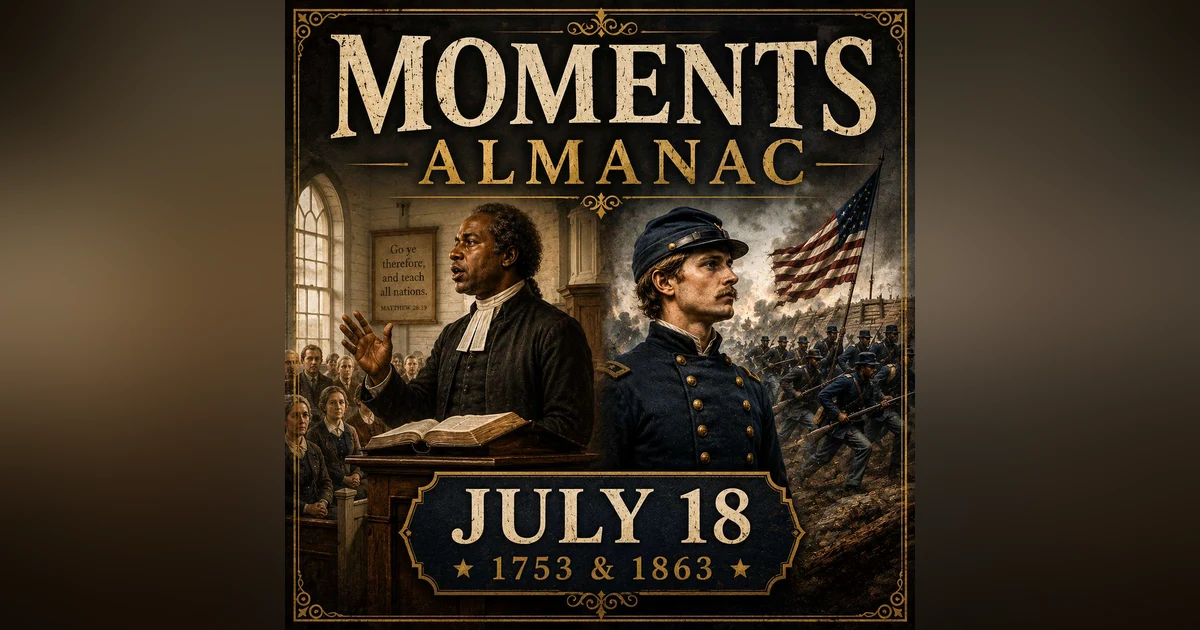


On July 18, two remarkable stories unfold more than a century apart, bound together by a common thread: the courage to cross the lines others refused to cross.
In 1753, Lemuel Haynes was born into a world that doubted a Black man could shepherd a congregation. Yet through decades of faithful ministry, he transformed suspicion into trust and became one of America's pioneering pastors.
Then, on July 18, 1863, Colonel Robert Gould Shaw led the famed 54th Massachusetts into the deadly assault on Fort Wagner, choosing to stand—and ultimately fall—beside the soldiers entrusted to his care. Alongside him, Sergeant William Carney's extraordinary courage would become a landmark moment in American history.
What do a pastor, a battlefield, and an old hymn have in common?
This episode explores the power of costly proximity—the Christlike choice to remain with the people God has called us to love, even when that love demands sacrifice.
Scripture: John 15:13; Hebrews 2:11
Take heart. Notice the scattered moments. Share the grace.
SPEAKER_00
Welcome to Moments Almanac. This is a time to remember the people, places, and events that leave fingerprints on the soul. Today is July 18th, 2026. You know, some victories are won by crossing a battlefield, others are won by crossing a room. On July 18th, history remembers two men who crossed lines that much of America insisted should never be crossed. On July 18th, 1753, a baby boy is born in West Hartford, Connecticut. His father is black, his mother is white. Before he is five months old, both parents have given him away. His name is Lemuel Haines. A farming family takes him in as an indentured servant, and somewhere between the plough and the pulpit he teaches himself Latin, Greek, theology, and how to preach the gospel. By 1785, he's ordained, the first black man ordained by a mainstream Protestant denomination in America. The very church that ordains him still can't quite bring itself to call him as its own pastor. One man is so offended by the sight of a black preacher that, according to an earlier account, he wears his hat through the entire ordination service as an act of protest. Haines preached anyway. By the time the sermon ends, the man quietly removed his hat. Three years later, Haynes accepts a call to the West Parish Church in Rutland, Vermont, an all-white congregation at a time almost no one expects such a ministry to survive. It doesn't survive, it flourishes. For 30 years he faithfully shepherds that church. Membership grows from 42 to more than 350. The congregation that many assumed would never receive him becomes people who cannot imagine another pastor. Okay, now let's fast forward 110 years. The calendar still reads July 18th, but now the setting is no country church. It's a narrow strip of sand outside Charleston, South Carolina. Colonel Robert Gould Shaw, only 25 years old, leads the 54th, Massachusetts, one of the Union Army's first black regiments, into the assault on Fort Wagner. Nearly 600 men charge. Shaw reaches the top of the parapet. Forward 54th, he shouts. Moments later, he is shot dead. Nearly half his regiment falls beside him. The Confederates bury Shaw in a mass grave with his black soldiers, intending it to be an insult, as though being laid to rest beside the men he would lead would somehow disgrace him. When Shaw's father heard the news, he answers with remarkable grace. He writes that he could wish for no better company for his son, no holier ground, and asked that the body never be moved. That same day, Sergeant William Carney, wounded four times while protecting the regiment's colors, carries the flag safely from the battlefield. Years later, he becomes the first African American to receive the Medal of Honor. Two men, one date, a century apart. One carried a Bible, one carried a sword. Both stepped into places where hostility waited for them. Both refused to abandon the people God had entrusted to their care. Haynes' battlefield was not lined with cannons, it was lined with suspicion. His sacrifice wasn't measured in bloodshed, but in the decades of patient love for his church. Shaw's sacrifice came in a single violent afternoon. Two different costs, the same principle. Neither man healed America's oldest wound. One sermon could not do it. One battle could not do it. But both refused to let fear decide who belonged beside them. Faithfulness often begins there, not by changing the whole world overnight, but by refusing to leave the people God has called us to love. Jesus said greater love has no man than this, that someone laid down his life for his friends. Shaw lived those words on the battlefield. Haines, he lived them in quiet persistence, and in a lifetime spent loving a congregation that many believe would never love him back. Jesus crossed a far wider divide than race, nation, or class. He entered our humanity. He bore our shame. And Hebrews tells us something astonishing. He is not ashamed to call them brothers. The gospel has always crossed the lines that sin draws. It always moves toward people rather than away from them. In seventeen eighty two a Baptist pastor named John Fawcett accepted a prestigious call to London. His family belongings were already loaded onto wagons when he looked back and saw his little country congregation weeping in the road. He unpacked the wagons, he stayed. Out of that decision came the hymn Blessed be the tithe that binds our hearts in Christian love. Haines stayed with a congregation that doubted him. Shaw stayed with soldiers, the world underestimated. Fawcett stayed with a church that loved him, and Christ stayed with us all the way to the cross. Perhaps that is one of the clearest sparks of Christian love, not simply loving people from a distance, but refusing to leave when love becomes costly. And that's today's Moments Almanac. I hope you'll join me tomorrow. Until then, take care. Notice the scattered moments and share the grace.


