August 29 | Moments Almanac | Truth
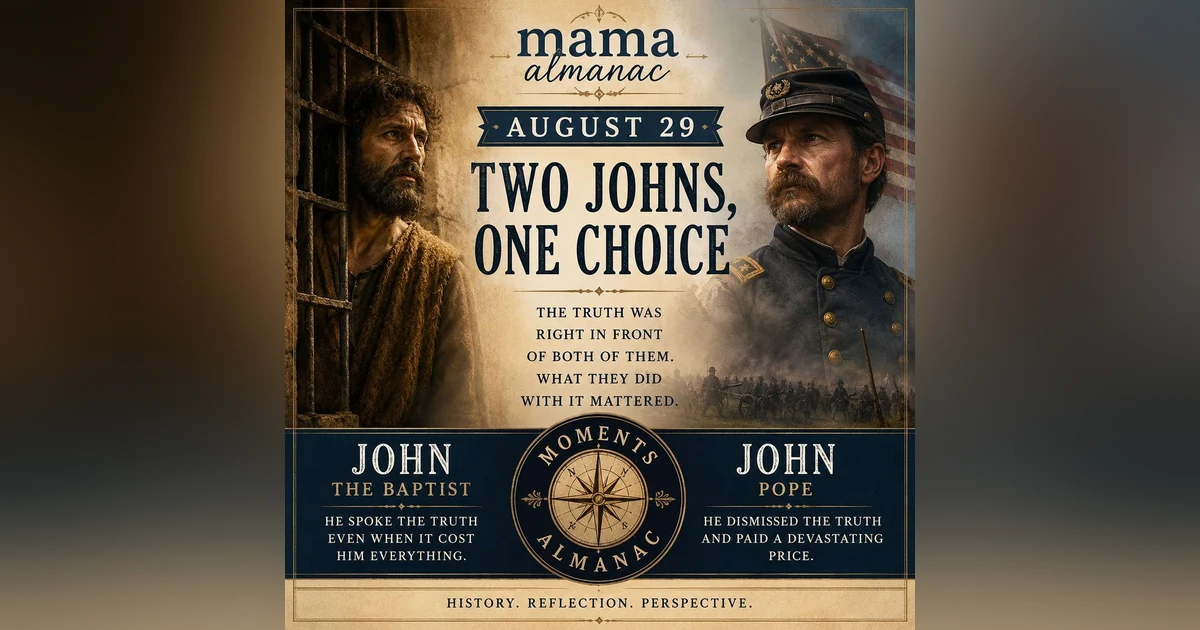
August 29 — Two Johns, One Choice What do you do when the truth costs you something? On August 29, we remember two very different moments in history. The church has long observed this date as the martyrdom of John the Baptist, who confronted Herod Antipas with a truth the ruler did not want to obey. Eighteen centuries later, during the Second Battle of Manassas, Union General John Pope received reports that Confederate reinforcements under James Longstreet were arriving — and refused to belie...


August 29 — Two Johns, One Choice
What do you do when the truth costs you something?
On August 29, we remember two very different moments in history. The church has long observed this date as the martyrdom of John the Baptist, who confronted Herod Antipas with a truth the ruler did not want to obey. Eighteen centuries later, during the Second Battle of Manassas, Union General John Pope received reports that Confederate reinforcements under James Longstreet were arriving — and refused to believe them.
Herod heard the truth but valued his reputation more. Pope was given the truth but trusted his own certainty more. John the Baptist chose another way: he spoke the truth even when it cost him everything.
In this episode of Moments Almanac, we explore pride, certainty, courage, humility, and the dangerous distance between hearing the truth and surrendering to it.
Because the question isn't simply whether we know the truth.
What does truth have permission to cost us?
Welcome to Moins Almanac for July 29th. Two men named John. They never met. They were separated by 18 centuries and a couple thousand miles and nearly every difference imaginable. One a wilderness prophet sitting in a Judean prison, and the other a Union general commanding an army on Virginia soil. But August 29th holds them together around one uncomfortable question. What do you do when the truth costs you something? Since at least the fifth century, the Western Church is remembered August 29th as the day John the Baptist was beheaded. The Gospel gives no date of his death, of course, so we hold the date loosely. But the story itself is unmistakable. John was the wilderness preacher who called Israel to repentance and baptized Jesus in the Jordan. He understood the role clearly. He must increase, but I must decrease. And John was willing to decrease. Herod Antipas had married Herodias, his brother's wife, in violation of Jewish law. John told him plainly that it was wrong. And Herod, well, he had John arrested. But Mark gives us a fascinating detail. Herod feared John, knew he was righteous and holy, and even liked listening to him. Think about that. Herod enjoyed hearing the truth. He just wasn't always willing to obey it. Then came Herod's birthday banquet. Herodias' daughter danced for the guests, and Herod rashly promised to give her whatever she asked. Prompted by her mother, she asked for the head of John the Baptist, and Herod was deeply grieved. He knew what was right, but his guests were watching. His reputation was on the line. So Herod chose his pride over the truth. John was beheaded in prison. Now move forward 18 centuries to August 29, 1862, and another man named John, Union General John Pope. He believed he had General Stonewall Jackson, the Confederate general, cornered in Manassas, Virginia, the day before Jackson had attacked a Union column at Brawners Farm. Pope became convinced that Jackson was trapped and vulnerable, so on August 29th, Pope sent his troops again and again against Jackson's position along an unfinished railroad grade. The attacks failed. And while Pope concentrated on Jackson, Confederate General James Longstreet was arriving with tens of thousands of additional troops, taking position on Jackson's right. Pope received word that Longstreet was there. He dismissed them. He was too certain of the battle he thought he was fighting to recognize the battle actually forming in front of him. The next day Pope attacked Jackson again. Then Longstreet unleashed a massive counterattack against the Union left. The result was a devastating Union defeat at Second Manassas. And there it is. Herod heard the truth, but couldn't bear the embarrassment of obeying it. Pope received the truth, but couldn't imagine that his own judgment might be wrong. John the Baptist did something entirely different. He spoke the truth, knowing exactly what it might cost him. And perhaps that's the question for august twenty ninth. That's what it leaves us with. Not simply do I know the truth? Herod knew. Pope had been told. The harder question is, what am I willing to let the truth change? My reputation? My assumptions, my plans, my certainty, even my life? Jesus said, You will know the truth and the truth will set you free. But sometimes before the truth sets us free, it first asks us to surrender, something we desperately want to keep. John did. Herod didn't. Pope wouldn't. And perhaps wisdom begins when we stop asking whether the truth is comfortable and start asking whether we are willing to follow it wherever it leads. And that's Moments Almanac for August 29th. I hope you'll join me tomorrow. Until then, take heart. Notice the scattered moments and share the grace.


