August 28 | Moments Almanac | Dream
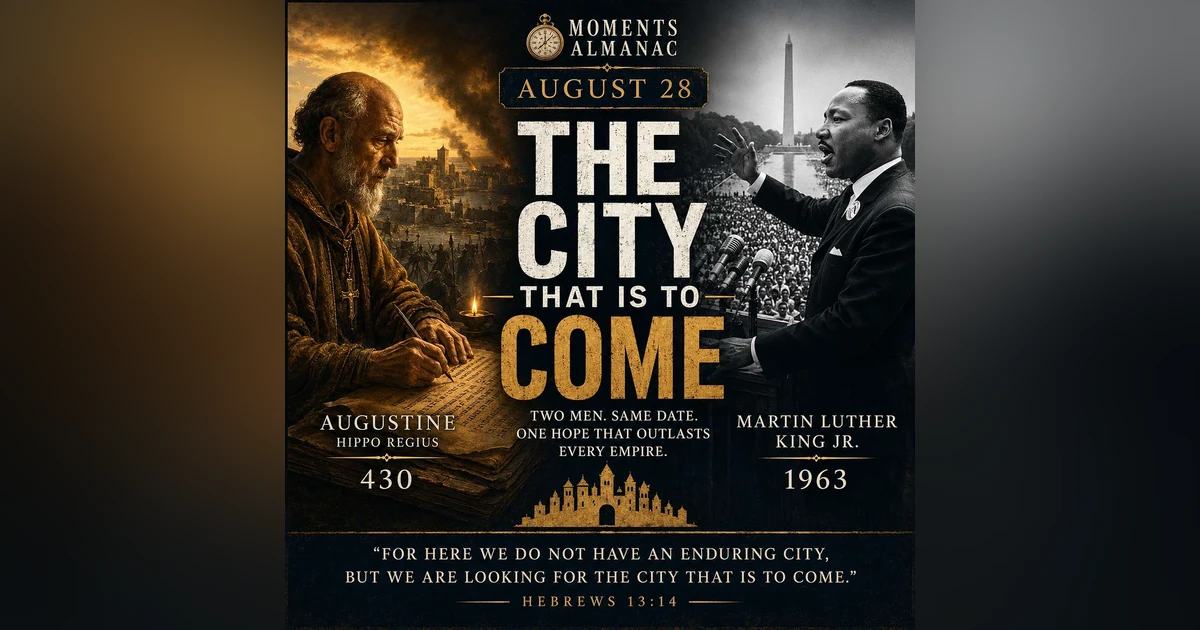


On August 28, 430, Augustine died as the Vandals besieged Hippo, convinced that no earthly empire—not even Rome—could ever be the Christian’s final home. Fifteen centuries later, on August 28, 1963, Baptist preacher Martin Luther King Jr. stood at the Lincoln Memorial and called a divided nation toward a dream of justice and human dignity.
Two preachers. Two troubled cities. Two visions of something beyond the brokenness they could see.
In this Moments Almanac, we consider Augustine’s City of God, King’s “I Have a Dream” speech, and the enduring promise of Hebrews 13:14: “For here we do not have an enduring city, but we are looking for the city that is to come.”
We work for the city in front of us because we belong to the City still coming.
Take heart. Notice the scattered moments. Share the grace.
Two men, fifteen centuries apart, spoke into a world that had run out of certainty, and both of them talked about a city. On this date, in the year 430, an old bishop lay dying in a North African town while an invading army camped outside its walls, the only world he had ever known coming apart around him. And on the same date, in 1963, a Baptist preacher stood on the steps of a monument to a slain president and told a quarter of a million people about a dream, a city not yet built, where every one of God's children would finally belong. One buried Rome and pointed past it. The other stood in the wreckage of a nation's broken promises and pointed past those two. Same day, centuries apart, same conviction, the city we can see was never meant to be the last word. Welcome to Moments Almanac. On August 28th, in the year 430, an old bishop lay dying in a North African city of Hippo Regius, while a Vandal army besieged it. His name was Augustine. He was seventy five years old and had served as bishop of Hippo for more than three decades. By then he had become one of the most influential theologians the Christian Church had yet produced. And he was watching his world come apart. Sixteen years earlier, in 410, Rome had been sacked by the Visigoths. For people who had grown up believing in Rome's preeminence, the psychological shock was difficult to overstate. Rome was more than a city. It represented civilization, security. For some Christians, the conversation of the empire had even blurred the distinction between the success of Rome and the success of Christianity itself, and then Rome fell. So Augustine began writing. The result was enormous, twenty-two books written over more than a decade, under the title City of God. At the heart of the work was a simple but unsettling idea. There are two cities, not two places you can locate on a map, but two ways of belonging. Augustine described one as built upon the love of self, even to the contempt of God, and the other was built upon the love of God, even to the point of setting self aside. And throughout history, those two cities are tangled together. No earthly empire is entirely one or the other. No nation is the kingdom of God. No government, culture, civilization, political movement, or human institution can bear the weight of our ultimate hope. Rome could fall, the city of God could not. By 430, Augustine was no longer writing about collapse from a safe distance. The Vandals had crossed into North Africa and were sweeping through the region. Refugees poured into Hippo. Then the Vandals surrounded the city itself. During the siege, Augustine became ill. His friend and biographer Posidius was there. He tells us that Augustine had the penitential psalms written out and placed where he could see them from his bed. He read them, he prayed, he wept, and on august twenty eighth, four hundred thirty, Augustine died. The vandals were still outside the walls. The empire Augustine had known was disappearing. Hippo itself would not remain untouched, but Augustine died convinced that none of those things had ever been his final home anyway. He belonged to another city, a city no army could besiege, no fire could consume, no empire could outlive. Now let's fast forward fifteen centuries later. On that same date, another preacher stood before another troubled nation, august twenty eighth, nineteen sixty three, Washington, D.C. Roughly a quarter of a million people gathered before the Lincoln Memorial for the march on Washington for jobs and freedom. Near the end of a long, hot day of speeches and music, the final speaker approached the microphones. He was 34 years old. A Baptist minister from Atlanta, Martin Luther King, Jr. King had prepared his speech carefully. One of its central images was financial. America, he said, had written a promissory note in its founding documents, a promise of liberty and equality, but for its black citizens, that check had repeatedly come back marked insufficient funds. King demanded that the nation make good on the promise it had already made. And then the speech changed. Gospel singer Mahalia Jackson, standing nearby, reportedly called out, tell them about the dream, Martin. Martin moved away from his prepared manuscript. The preacher took over. He began talking about a world that did not yet exist, a world in which former slaves and former slave owners could sit together, a world in which justice would be transformed, a world in which his children would not be judged by the color of their skin, but by the content of their character. And then the Baptist preacher, reaching instinctively for the language that had formed him, King reached backward into scripture to Isaiah, to Amos, to the prophets who had dreamed about God's justice long before America existed. Let justice roll down like waters and righteousness like a mighty stream. King wasn't describing heaven as an excuse for ignoring earth. Quite the opposite. His Christian hope demanded something of the present. If every human being bears the dignity bestowed by God, then injustice cannot simply be accepted as the way things are. The city we have must be called toward the city that ought to be. Augustine and King, we're not saying exactly the same thing, and we shouldn't make them. Augustine warned Christians never to confuse an earthly civilization with an eternal city of God. King called the earthly nation to live up to its own promises of justice and human dignity, but underneath both voices was a stubborn Christian refusal to believe that the broken world in front of us gets to define the limits of hope. Augustine watched Rome collapse and he said, This cannot be our ultimate city. King looked at segregation and racial injustice and said, This cannot be our final city either. And somewhere between them stands a single line from the book of Hebrews. For here we do not have an enduring city, but we are looking for the city that is to come. Hebrews 13, 14. That verse could have been hanging beside Augustine's bed. It could have been echoing from the steps of the Lincoln Memorial. And maybe it needs to echo through us too, because we have a peculiar responsibility as followers of Jesus. We must never expect this world to become the kingdom of God. And we must never use that fact as an excuse to stop making this world more just, more merciful, more truthful, more loving. We don't worship our cities, we serve them. We don't confuse our nations, we we bless them. We seek their good. We don't place our ultimate hope in institutions, governments, for goodness sake, movements, economies, or cultures, but neither do we shrug our shoulders when they fail our neighbors. We work for the city in front of us precisely because we belong to the city still to come. Augustine's Hippophel, King did not live to see the full realization of his dream. Neither man saw everything he hoped for. Neither will we. But faith has never required us to see the finished city, only to know which direction is home. For we do not have an enduring city, but we are looking forward to that city that is to come. So build what you can, repair what's broken, stand against what is unjust. Love your neighbor, seek the good of the place where God has put you. And when the walls shake, when institutions disappoint you, promises are broken, and the world you thought was permanent suddenly doesn't feel permanent at all. Remember Augustine in Hippo. Remember King in Washington and lift your eyes beyond the city you can see. There is another city coming, and its foundations can't be shaken. And that's Molen's almanac for today, August the 28th. I hope you'll join me tomorrow. Until then, take heart. Notice the scattered moments and share the grace.


