August 27 | Moments Almanac | Plume
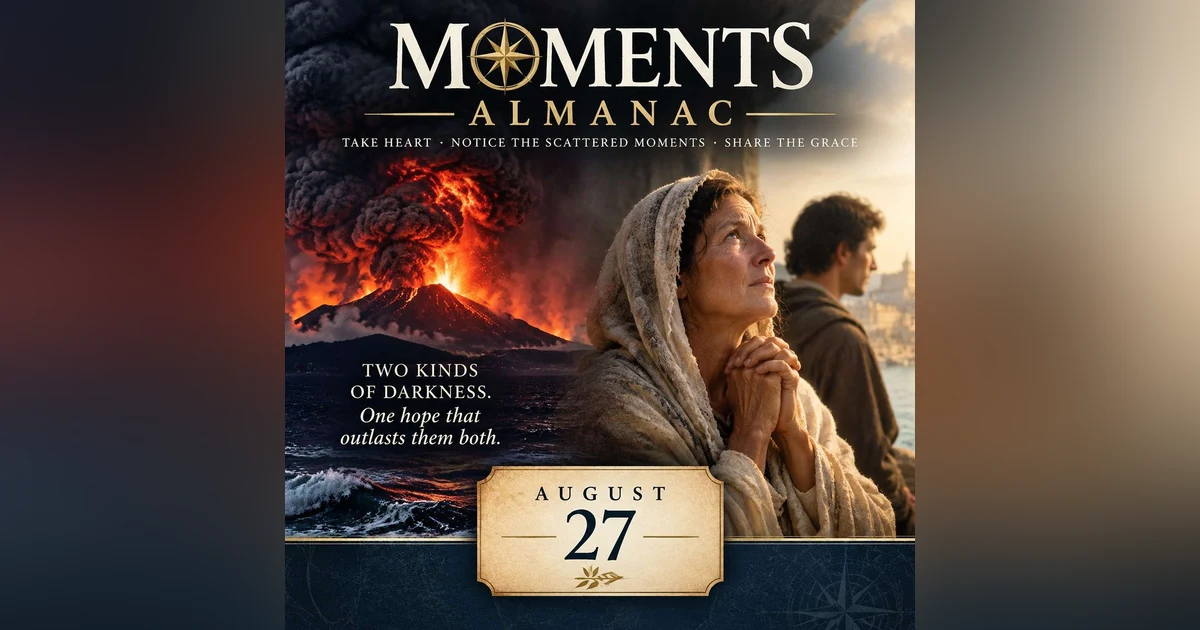


On August 27, 1883, Krakatoa erupted with a force heard nearly 3,000 miles away, sending deadly tsunamis across the Sunda Strait and changing skies around the world. Centuries earlier, another kind of darkness surrounded Monica of Hippo as she prayed year after year for her wandering son, Augustine.
Today’s Moments Almanac brings together a volcano that shook the world and a mother whose persistent prayers helped shape one of Christianity’s greatest theologians. It’s a story for anyone enduring a long night, waiting for an answer, or wondering whether the darkness will ever lift.
The night may be long. But the dark does not get the last word.
Take heart. Notice the scattered moments. Share the grace.
On the morning of August 27, 1883, the sky over the Sunda Strait tore itself apart. A volcanic island named Krakatoa exploded with a force that was heard nearly 3,000 miles away. Fifteen centuries earlier, in a very different kind of darkness, a mother had spent years weeping and praying over a son who seemed determined to lose himself for good. The church remembers her today too. Two kinds of darkness. Two very different mornings. And then the same question waiting underneath both of them. Does the dark get the last word? This is Moments almanac for August 27th. Krakatoa had been quiet for 200 years before it wasn't. On May 20th, 1883, the volcano stirred, sending ashes miles into the sky above the Sunda Strait, between the Indonesian islands of Java and Sumatra. For three months the mountain rumbled. Then on August 26th, the rumbling became explosions. And on the morning of August 27th came the climax. Four enormous explosions erupted within a matter of hours. The third at 10.02 that morning produced one of the loudest sounds in recorded history. Nearly 3,000 miles away, people heard it and thought a ship was firing distress cannons. Ash and debris were thrown high into the atmosphere. Tsunamis more than a hundred feet tall crashed into coastal towns of Java and Sumatra. More than 36,000 people died. Most of them not from the eruption itself, but from the walls of water that crashed into the shore. And then Krakatoa changed the sky. Fine volcanic material spread the upper atmosphere and circled the earth, producing brilliant red sunsets around the world. For months people looked upward and saw the sky they did not recognize, and no one could tell them exactly when it would clear. Fifteen centuries earlier, a woman named Monica knew something about waiting for the sky to clear. Her darkness did not arrive in one deafening explosion. It came slowly, one disappointment at a time. Monica was a Christian living in Roman North Africa and married to a pagan husband named Patricius, a man known for his temper. But her greatest heartache became her brilliant, relentless son Augustine. He rejected the Christian faith she loved. He took a mistress and fathered a son outside of marriage. He embraced false religion, and she prayed and prayed and prayed. Years passed. Augustine did not change. At one point Monica pleaded so persistently with a bishop to intervene that he finally sent her away with words she never forgot. It cannot be that a son of so many tears should perish. And still Augustine ran. When he decided to leave North Africa for Rome, Monica intended to go with him. Augustine tricked her. He left her while she was praying in a chapel near the harbor while he secretly sailed away. Imagine that morning. She walked back toward the docks, and the ship was gone. So was her son. Her prayers must have seemed unanswered, but Monica kept following. Eventually she arrived in Milan, where Augustine had come under the influence of another bishop, Ambrose, and slowly, almost imperceptibly at first, something began to change. The arguments Augustine had used against Christianity from a distance began to collapse. He listened, he wrestled, he surrendered. And then during an Easter vigil in the year three hundred eighty seven, Ambrose baptized Augustine, the son of so many tears, had come home. Mother and son eventually began their journey back to North Africa, but they never made it. While waiting at the port of Ostia, Augustine and Monica sat together at a window and talked about heaven. Years later, Augustine will remember that conversation in his confessions as one of the most beautiful moments of his life. Soon after Monica became ill. She told her son that there was nothing more she wanted from this world. The prayer that had carried her through years of disappointment had been answered. And there, far from home, Monica died. Today, August 27th, the church remembers Saint Monica. Her feast was placed here in the modern church calendar immediately before August 28th, the day the church remembers her son, Augustine, even on the calendar, the mother goes before the son. And perhaps that's fitting, because before there was Augustine, the bishop, Augustine the theologian, Augustine the Saint, there was Monica praying in the dark. Krakatoa reminds us that some darkness arrives all at once, a diagnosis, a phone call, a death, a door slamming shut. The whole sky changes before we have time to understand what happened. But Monica reminds us of another kind of darkness, the kind of darkness that lasts, the child who wanders, the marriage that aches, the prayer that seems to disappear into silence, the years when nothing appears to move. Scripture says weeping may endure for a night, but joy comes in the morning. But Scripture never tells us how long the night will feel. For Monica, it lasted 17 years, and that may be the grace hidden inside her story. Faith is not pretending the night isn't dark. Faith is refusing to believe. But darkness gets the final word. Frank Graff would put it perfectly centuries later. Oh yes, he cares. I know he cares. His heart is touched with my grief. When the days are weary and the long nights dreary, I know my Savior cares. Maybe you're praying for someone who seems to be sailing farther away. Maybe you've stood at your own empty harbor and wondered where God was. Maybe the sky above you doesn't look anything like it used to. Just keep praying, keep loving, keep watching the horizon. Because sometimes the story God is writing in the darkness is larger than anything we can see from where we stand. The night may be long, but darkness does not get the last word. And that's Moments Almanac for today, August 27th. I hope you'll join me tomorrow. Until then, take heart. Notice the scattered moments, and share the grace.


