August 26 | Moments Almanac | Underestimated
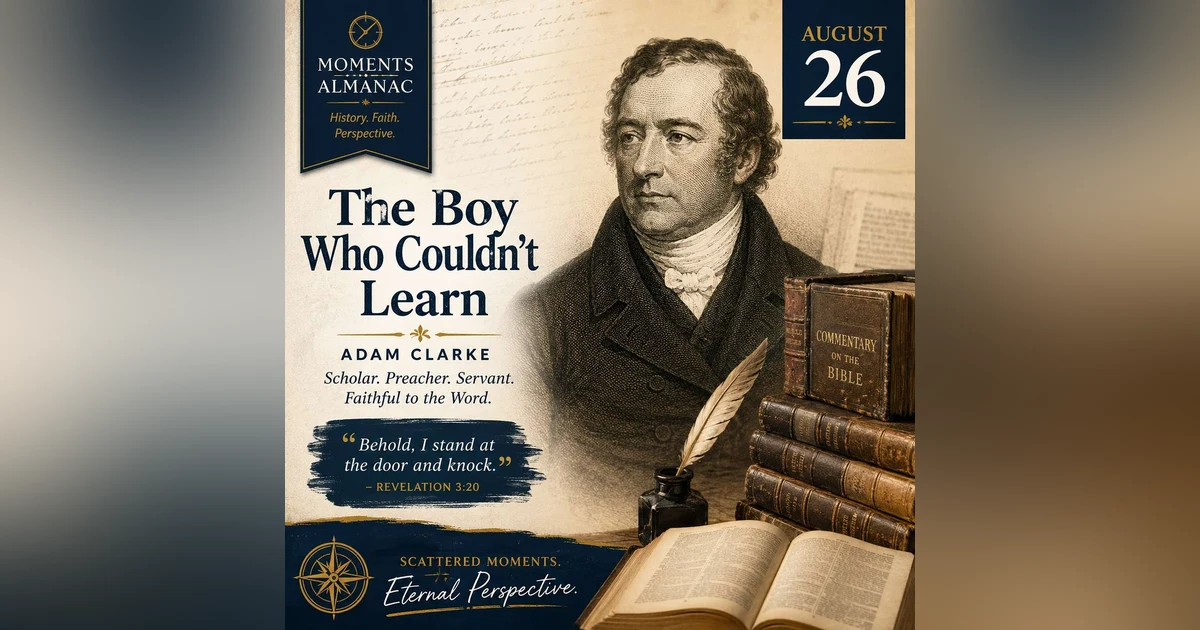


On August 26, 1832, Adam Clarke died during a cholera epidemic near London. But his story began with a boy in Ireland whom others considered slow, dull, and unlikely to amount to much academically.
They were spectacularly wrong.
Clarke became one of the great Methodist preachers and biblical scholars of his generation, mastering ancient languages and spending years producing his monumental commentary on Scripture. The boy who struggled with words devoted his life to helping others understand the Word.
His story reminds us of Paul’s words in 1 Corinthians 1:27: God has a remarkable way of choosing what the world overlooks.
Maybe we should be careful about putting periods where God has only placed a comma. Our present limitations are poor predictors of God’s future usefulness.
Take heart. Notice the scattered moments. Share the grace.
They thought the boy was dull, not merely average, not a late bloomer, dull. Adam Clark grew up in Ireland in the 18th century, the son of a school teacher, which probably made his struggles even harder to hide. Learning came slowly. The other children mocked him. There seemed to be little reason to imagine this struggling schoolboy would ever distinguish himself academically, but sometimes the people who decide what a child can become simply don't get the last word. Because the boy would eventually become one of the greatest biblical scholars of his generation. And on August 26, 1832, his remarkable life came to an end. Adam Clark was born around 1762 in County Londonderry, Ireland. According to Clark's own recollections, his early education was miserable. He struggled to learn. He was ridiculed by classmates and carried the reputation of being an intellectually slow child. And then something changed. Clark began applying himself to language with an intensity no one had expected. Latin opened one door, other languages followed, but the most important door in his life opened was his relationship with Jesus. He heard a sermon built around the words of Jesus Behold, I stand at the door and knock, and Clark became deeply convicted of his need for Christ, and eventually found his way into the young Methodist movement. There he encountered John Wesley. Wesley examined the young convert, recognized something in him, and sent him into circuit preaching before Clark believed he was ready. And so began a life divided between two loves, preaching the scripture and understanding them. Clark traveled throughout the British Isles as a Methodist preacher, studying as he went, Greek, Hebrew, and Latin, ancient languages and cultures that might help him better understand the world of the Bible. The boy who once struggled with words became consumed with them. In eighteen ten, publication began on the work that would define his scholarly life, his massive commentary on the Bible. It came out piece by piece, volume by volume, year after year. The final volume appeared in 1826, and Clark wasn't sitting quietly in the library all the time. He preached, he traveled, he served three times as president of the Methodist Conference. He supported the work of the British and the Foreign Bible Society. He made difficult journeys to strengthen Methodist work in the Shetland Islands, and he kept studying, kept writing, kept opening scriptures. Then during the cholera epidemic of eighteen thirty two, Clark became ill. On august twenty sixth, at a house near London he died. He was not yet seventy. Adam Clark was buried near John Wesley in Wesley's chapel. And there is something wonderfully fitting about that. The teacher who saw a possibility resting near the student in whom he saw it. But what I keep coming back to is that little boy in Ireland, the one who couldn't keep up, the one the other children laughed at, the one somebody might easily have dismissed. Apparently God was not finished with his education. Paul wrote, indeed, God has chosen what is foolish in the world to shame the wise, and God has chosen what is weak in the world to shame the strong. God has always had a way of seeing possibilities other people overlook. And so let's be careful about putting periods where God may have only plays a comma or a semicolon. Especially in the lives of other people, the struggling student or the awkward teenager, the new believer who doesn't seem to understand very much, the person who hasn't found the thing that awakens something inside them, and maybe even in yourself. Our present limitations are poor predictors of God's future usefulness. Adam Clark was once the boy who struggled with words. He spent the rest of his life helping generations understand the word. And maybe the sermon he has heard as a teenager still provides the best image for his life: a door, a knock, and a young man willing to open it. And that's Moment Salmanac for August 26th. I hope you'll join me tomorrow. Until then, take heart. Notice the scattered moments and share the grace.


