August 25 | Moments Almanac | Creed
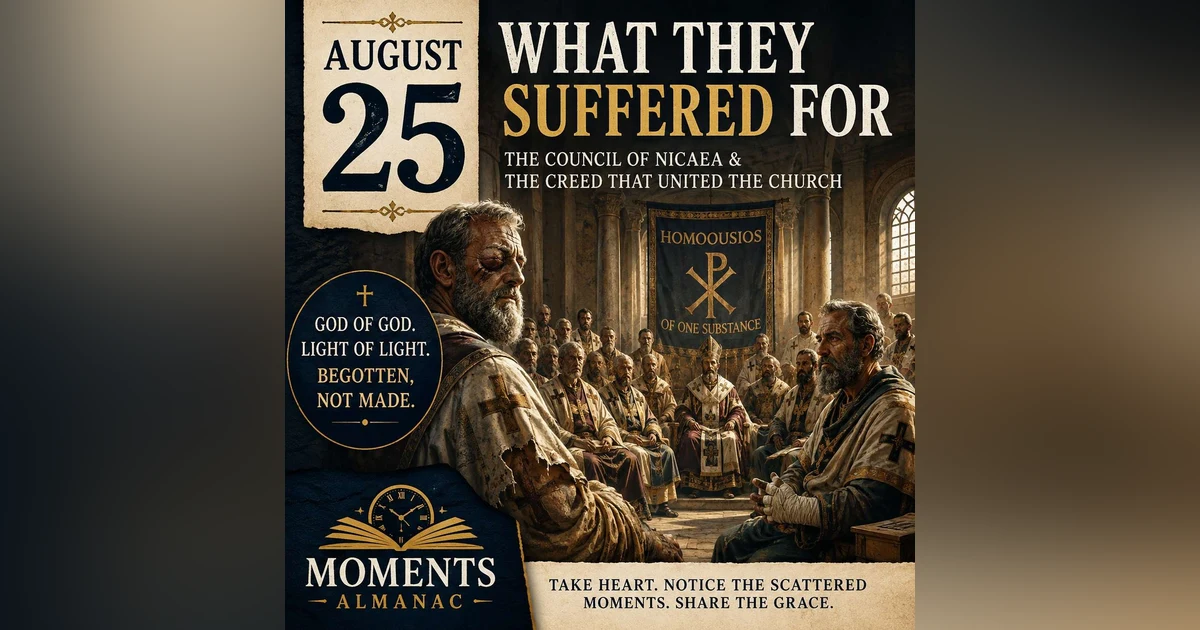


On August 25, 325, bishops gathered at Nicaea carrying more than theological arguments—some carried the scars of persecution. At the heart of their debate was a question that would shape Christianity for centuries: Who is Jesus Christ?
In this episode of Moments Almanac, we explore the story behind the Council of Nicaea, the controversy over Arius, the crucial word homoousios—“of one substance”—and the creed that declared Jesus to be “God of God, Light of Light, begotten, not made.”
We’ll also hear the Nicene Creed itself and reflect on something Christians across centuries and traditions still confess together:
Jesus Christ is Lord.
Welcome to Moments Almanac for today, August 25th. I hope you're having a great day. And this is a time for us to remember the people, places, and events that leave fingerprints on the soul. One thing that has left fingerprints on the church is an incredible creed called the Nicene Creed. And today is the day that many historians look back and remember 300 bishops who gathered in a city called Nicaea. The meeting lasted for weeks, but August 25th, according to many historians, was the culmination of this labor. These 300 bishops that gathered, some came with scars, one had lost an eye during persecutions, another carried hands damaged by torture, many represented churches that only a few years earlier had worshipped under the threat of prison and death. Now Christianity was legal, and almost immediately Christians discovered that freedom brought a different kind of problem. They had to decide what they actually believed. At the center of the argument was one question, who is Jesus? Not simply what did he teach, not simply what did he do, but who is he? And in the summer of three hundred twenty five, the church gathered in Nicaea to answer. For nearly three centuries following Jesus and the Roman Empire could cost you everything. And then Constantine came to power, and in three hundred thirteen Christianity was granted legal toleration. The church stepped out of the shadows. But while persecution had ease, controversy had not in Alexandria a presbyter named Arius was teaching that Jesus Christ, the Son of God, was not eternal in the same way the Father was eternal. His opponents summarized his teaching with a disturbing sentence. Arius believed Christ was greater than every other created being, but created nonetheless. His opponents understood what was at stake. John's gospel didn't merely say that the word was with God. It said the word was God. And then the word became flesh and dwelt among us. If Jesus was merely God's greatest creation, Christianity and its understanding of salvation changed with him. So Constantine summoned bishops from across the Christian world to Nicaea in what is now Turkey. Perhaps two hundred and fifty came, tradition remembers three hundred and eighteen, and some carried on their bodies the evidence of what confessing Christ had already cost them. These weren't men debating an interesting theological puzzle over coffee. They were trying to put words around the identity of a savior for whom some of them had already been tortured. A young deacon named Athenasius came from Alexandria with his bishop. He could not vote, but his voice would eventually become one of the most important in the controversy. The argument turned to a Greek word homousius of the same substance. Jesus was not merely like God. He wasn't God's highest ranking creature. The Son shared the very divine being of the Father, as the Creed put it, God of God, light of light, very God of very God, begotten, not made. The overwhelming majority of bishops rejected Arius' teaching. The controversy didn't disappear. In fact, it would rage for decades, and in three hundred eighty one another council in Constantinople expanded the Creed's language, particularly its confession concerning the Holy Spirit. That fuller version was what most Christians mean today when they speak of the Nicene Creed. And I thought today would be a day we could do something a little unusual, rather than merely talk about the Creed. Let's hear it. We believe in one God, the Father Almighty, maker of heaven and earth, and of all things visible and invisible, and in one Lord Jesus Christ, the only begotten Son of God, begotten of the Father before all worlds, God of God, light of lights, very God of very God, begotten, not made, being of one substance with the Father, by whom all things were made, who for us and for our salvation came down from heaven and was incarnate, and was made man. He was crucified also for us under Pontius Pilate. He suffered and was buried, and on the third day he rose again, according to Scriptures, and ascended into heaven, and sitteth on the right hand of the Father, and he shall come again with glory to judge the living and the dead, whose kingdom shall have no end. We believe in the Holy Spirit, the Lord and giver of life, who with the Father and the Son together is worshipped and glorified, who spoke by the prophets, and we believe in one holy Catholic and Apostolic Church. We acknowledge one baptism for the remission of sins, and we look for the resurrection of the dead and the life of the world to come. Amen. Now my Baptist friends may have stumbled over that word Catholic. In fact I did it in my first reading. In the Creed it doesn't mean Roman Catholic. The word means universal, the whole church. The believers at Nicaea weren't choosing between Baptists, Methodists, Presbyterians, Catholics, or Orthodox Christians. Those divisions were centuries away. They were confessing that there is one people of God across nations, languages, generations, and geography, and maybe that's where this old creed speaks most beautifully to us. Christians have plenty to disagree about since Nicaea. We've divided over denominations, worship, baptism, church government, calendars, music, liturgy, and doctrines those bishops never imagined we'd be arguing about. But underneath all the disagreement stands an ancient confession. Jesus Christ is Lord, God of God, light of light, begotten, not made, the one through whom all things were made, the one who came down to us, the one who was crucified, the one who rose, the one who will come again. And that is the moving thing about Nicaea. It isn't that three hundred bishops agreed on some carefully chosen words. It's remembering who some of these bishops were, men with damaged hands, missing eyes, scarred bodies, men who had been asked by Rome to deny Christ and had refused. And then when the persecution finally ended, they gathered together and were asked another question. Who was this Jesus for whom you suffered? Their answer was essentially this. He was worth it. Because the one who suffered for us was and is and always will be worth it. He's not merely a teacher, not merely a prophet, not even God's greatest creation. He is God with us. Sixteen centuries later, that remains the confession of the church. Jesus Christ is Lord. And that's today's moment's almanac. I hope you'll join me tomorrow. Until then, he is Lord. So we can take heart and share his grace.


