August 24 | Moments Almanac | Commentaries
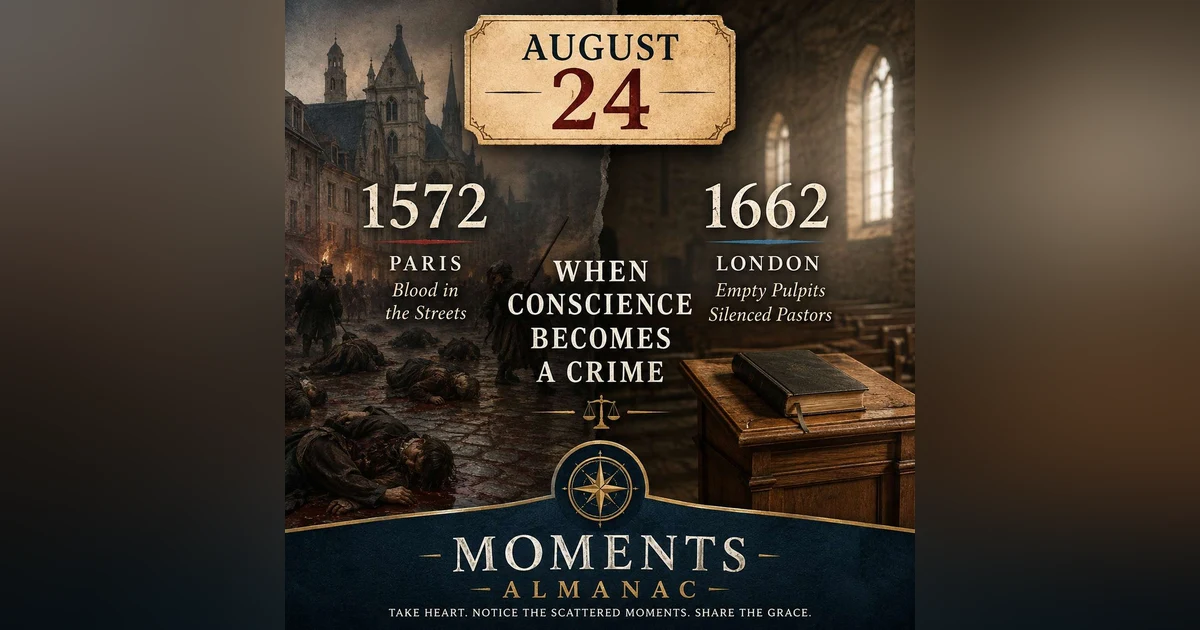


On August 24, ninety years apart, two moments of religious persecution unfolded under the same name: St. Bartholomew’s Day.
In 1572 Paris, the St. Bartholomew’s Day Massacre left thousands of French Protestants dead. In 1662 England, the Act of Uniformity forced roughly two thousand ministers from their pulpits rather than violate their consciences—including Philip Henry, father of the great Bible commentator Matthew Henry.
Two very different kinds of suffering, but one haunting question: What happens when conscience becomes a crime?
A story about courage, conviction, and the truth that while authorities may silence a voice or empty a pulpit, conscience belongs to God.
Two August mornings ninety years apart. In one, church bells rang over Paris and people began to die. In the other, church bells rang across England and the pulpits began to empty. Both happened on August 24th. Both became associated with the same name, Saint Bartholomew's Day, and both force us to consider a dangerous question. What happens when conscience becomes a crime? Before dawn, on august twenty fourth, fifteen seventy two, Paris was already tense. France had been torn for years by religious conflict between Catholics and Protestants, known as Huguenots, but for a moment peace seemed possible. Henry of Navarre, a Protestant, had married Margaret of Valois, sister of the Catholic King Charles IX. The wedding was supposed to help heal France. Instead, it brought many of the nation's most prominent Huguenots together in one city. Then someone shot Admiral Gaspard de Coligny, one of the most influential Protestant leaders in France. He survived. What happened next remains tangled in fear, politics, royal intrigue, and religious hatred. But in the early hours of august twenty fourth, armed men entered Coligny's room and murdered him. His body was thrown from a window, and then Paris exploded. The violence escaped whatever boundaries its planners may have imagined. Huguenots were dragged from the houses and killed, bodies filled streets and waterways, the massacre spread beyond Paris and other French cities, thousands died. The wedding intended to reconcile Catholics and Protestants became the prelude to one of the darkest episodes of the Reformation. And exactly ninety years later, August 24th carried another kind of sorrow. No bodies filled London streets, instead, pulpits emptied. In 1622, England's act of uniformity required ministers to conform to the restored Church of England and its prescribed worship. For hundreds of Puritan and nonconformist ministers, conscience would not allow it. So on Saint Bartholomew's day, roughly two thousand ministers lost their positions in what became known as the Great Ejection. Among the silenced was a Presbyterian minister named Philip Henry. Philip Henry had been born on august twenty fourth, sixteen thirty one. Thirty-one years later, on his birthday, the act of uniformity took effect. Henry would later describe august twenty fourth as the day on which he had been born and the day on which legally speaking he had died. His public ministry had been taken from him, but his faith hadn't. Henry continued teaching and worshiping as circumstances permitted, sometimes at considerable legal risk. His home at Broad Oak became a place where Scripture was studied, prayed, and lived, and there, in sixteen sixty two, another Henry was born, Matthew. Philip Henry could no longer stand freely in his old pulpit, so he poured the scripture into his children. Matthew Henry grew up and became a minister himself, and eventually he began writing an exposition of the Bible that Christians are still reading more than three centuries later, which makes me wonder whether the people who silenced Philip Henry really succeeded. They took away his pulpit, they could not take his conscience. They could restrict where he preached, they could not determine what he believed, and they certainly could not foresee what God might do with a little boy growing up in the home of a silenced preacher. August twenty fourth reminds us that religious persecution has many faces. Sometimes it comes violently, with mobs and blood in the streets, and sometimes it arrives politely, carrying legislation and asking for a signature. Those things are not equal in their suffering, but they can grow from the same dangerous soil. The belief that another human being can be forced into faith. Jesus never asked his followers to manufacture belief by coercion. He simply said follow me, an invitation, a choice, a matter of the heart. So perhaps courage isn't always shouting louder. Sometimes courage is simply refusing to surrender the territory no earthly power was ever meant to govern the conscience. Philip Henry lost his pulpit. The Huguenots of Paris lost far more. But August 24th remembers them both. And it whispers across the centuries, there are some things worth losing rather than pretending to believe. Because governments can close churches, crowds can silence voices, laws can empty pulpits, but conscience belongs to God. And grace has a remarkable habit of outliving the people who tried to silence it. That's Moments Almanac for August 24th. I hope you'll join me tomorrow. Until then, take heart, notice the scattered moments, and share the grace.


