August 23 | Moments Almanac | Lies
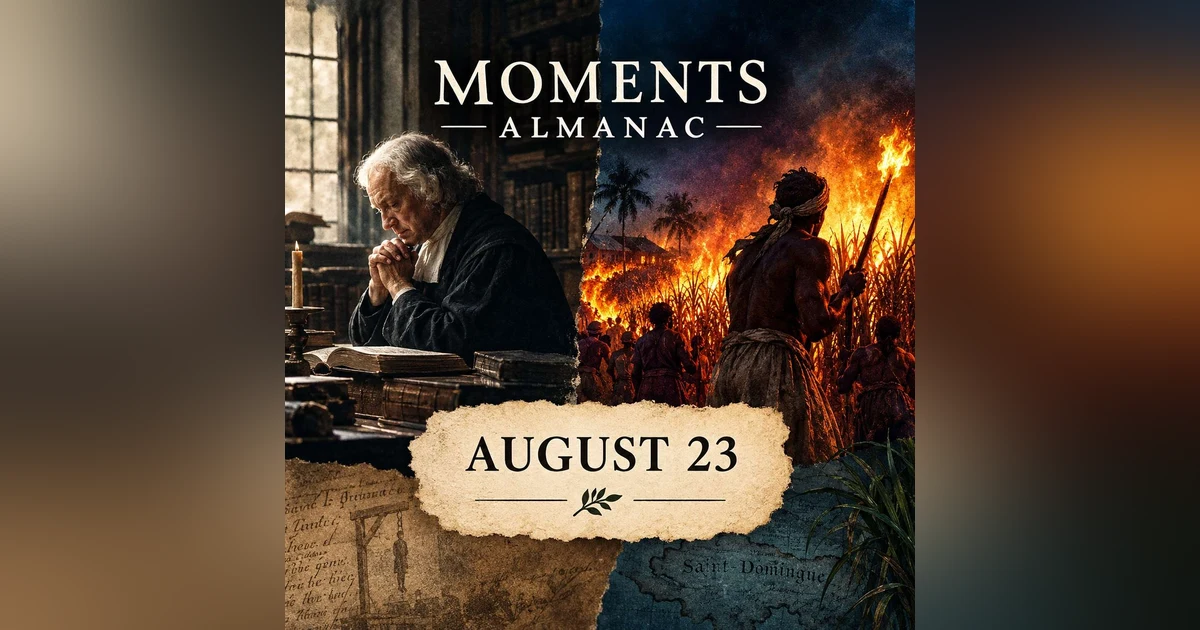


On August 23, two very different worlds confronted lies they had learned to live with. Increase Mather, a complicated voice in the aftermath of the Salem witch trials, challenged the dangerous use of spectral evidence. Decades later, the fires of rebellion spread across Saint-Domingue as enslaved people rose against a system built on the lie that one human being could own another.
In this episode of Moments Almanac, we explore Salem, the beginning of the Haitian Revolution, and a sobering question for every generation: What have we gotten so used to that we’ve stopped asking whether it’s true?
Welcome to Moments Almanac on Scattered Moments for today, August the 23rd. Two places, two fires, and two lies that had become so familiar, people had stopped recognizing them as lies. In Massachusetts, the fire was beginning to go out. Thirty-one years earlier, fear of witchcraft had consumed Salem. Neighbors accused neighbors, courts accepted testimony about invisible spirits. Innocent people went to the gallows because frightened communities became convinced that suspicion could masquerade as evidence. One of the men who finally challenged the thinking died on august twenty third, seventeen twenty three. His name was Increase Mather, and on another august twenty third, nearly seventy years later and fifteen hundred miles south, a very different fire was spreading. Sugar plantations were burning, enslaved men and women were rising, and one of history's most profitable lies the idea that one human being could own another. Now let's go to sixteen thirty nine. Let's begin with Mather. Increase Mather was born in sixteen thirty nine, the son of a Puritan minister who had crossed the Atlantic seeking freedom to worship according to conscience. By sixteen ninety two, Mather was one of the most powerful religious voices in New England, pastor, theologian, and president of Harvard College. The witch trials had begun with accusations from young girls, but fear spread quickly. Soon the courts were accepting something called spectral evidence. An accuser could claim that the spirit or spectre of another person had appeared invisibly and tormented them, and somehow that could help send the person to the gallows. nineteen people were eventually hanged. Mather was hardly a modern skeptic. He believed in witches, he believed in the devil, and his own son Cotton Mather had defended aspects of prosecutions. But Increase Mather saw something terribly dangerous happening. In October of sixteen ninety two, he presented an argument later published as cases of conscience concerning evil spirits. His point was simple. You cannot take a human life on evidence no one can see, test, or verify. Then came the sentence history remembers. It were better that ten suspected witches should escape than that one innocent person should be condemned. Mathers' record was complicated. He also defended the judges and his son from some of the criticism that followed. So this isn't a story about a flawless hero riding into Salem to save the day. It's more interesting than that. It's a story of a man inside the system beginning to recognize that the system had lost its way. Soon the special court was dissolved. The execution stopped. Increase Mather lived another thirty years, dying in Boston on august twenty third, seventeen twenty three, at the age of eighty four. And then another twenty third. Another world, another lie. By seventeen ninety one, the French colony of Saint Dominique, modern Haiti, was staggeringly profitable. Its sugar and coffee generated enormous wealth. But there was something hidden inside every spoonful of sugar shipped from the island, human suffering. Roughly half a million enslaved Africans labored under the plantation system notorious even by the brutal standards of slavery. People were bought, sold, beaten, worked to death, and all of it depended upon an enormous lie. Some people are less worth than other people. In August of seventeen ninety one, enslaved leaders began meeting secretly across the northern plain. Tradition remembers one gathering at a wooded place called Boys Cayman, associated with Vidu leader Duddy Buchman, and a priestess remembered as Cecile Fatiman. The details of that night have become difficult to separate from later retellings. But what happened next is unmistakable. On august twenty second, enslaved workers rose against the plantations, and by august twenty third the northern plain was burning. Cane fields went up in flames, plantations fell, thousands joined the revolt. The Haitian Revolution began, but Buchmann himself would not live to see its conclusion. He was killed only months later. But the uprising continued for thirteen astonishing years until in eighteen oh four Haiti declared its independence. And enslaved people had defeated armies sent to keep them enslaved, and a lie that had presented itself as economics, law, tradition, and simple common sense had been exposed by the people who refused to keep living beneath it. That may be what connects to August's story. Not that Increase Mather and Duty Bachman were alike. They weren't. Not that their struggles carried the same cost, they didn't. But both stories remind us of something uncomfortable. A lie becomes most dangerous when everybody gets used to it. Salem had become accustomed to fear. Saint Dominique had become accustomed to slavery. And once enough people accept things as normal, normal itself can become almost impossible to question. Scripture repeatedly warns us about that kind of blindness. Isaiah wrote, Woe to those people who call evil good and good evil. Because sometimes evil doesn't arrive announcing itself as evil. Sometimes it arrives as tradition, sometimes as fear, sometimes as profit, sometimes as something everybody around us simply assumes must be true. And that's why truth requires more than knowing the right answer. Sometimes truth requires the courage to question the room, to examine what everybody else has stopped examining. To say maybe we are wrong. Maybe this isn't justice. Maybe what we've accepted as normal was never right at all. August 23rd remembers two worlds confronting lies they had learned to live with. And perhaps that's a good question to carry with us today. What have I gotten so used to that I've stopped asking whether it is true? Because some lies survive not because nobody knows better, they survive because everybody has learned to live with them. And sometimes grace begins with the courage to stop.


