August 22 | Moments Almanac | Messiah
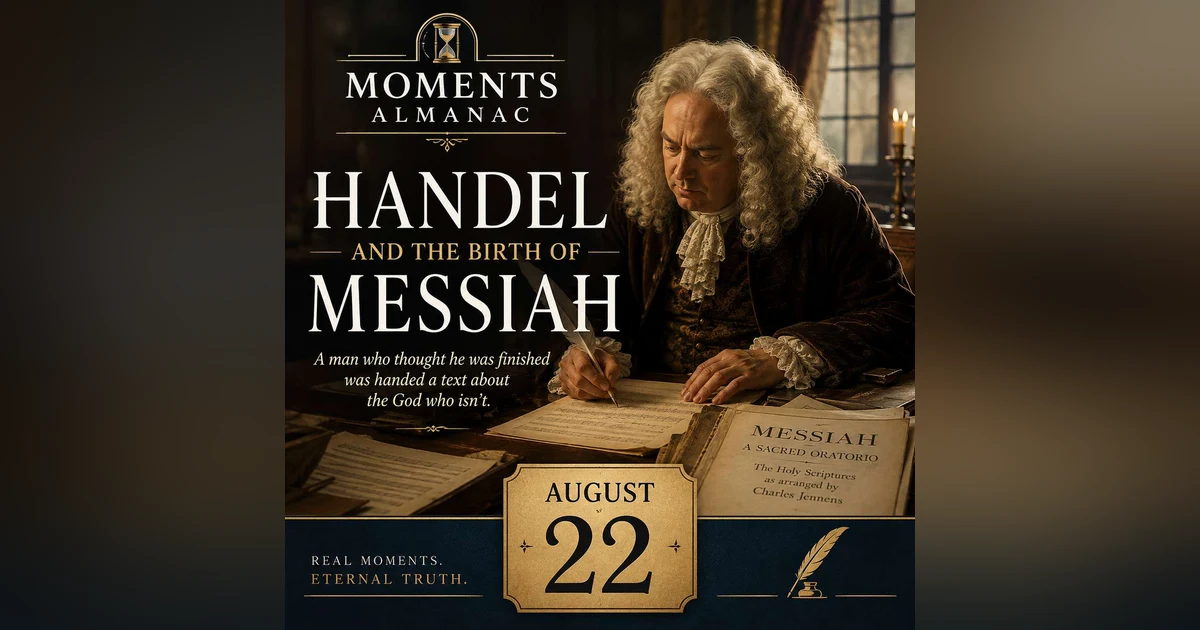


By the summer of 1741, George Frideric Handel had every reason to believe his best work was behind him. His operas were struggling, his finances were uncertain, his health had failed him before, and at fifty-six years old, the great composer seemed to be watching his celebrated career fade.
Then Charles Jennens handed him a remarkable collection of Scripture tracing the story of Christ—from prophecy and incarnation to suffering, resurrection, and eternal reign.
Handel sat down to compose.
Twenty-four days later, Messiah was finished.
In this episode of Moments Almanac, we step into those extraordinary weeks when disappointment gave way to creativity and a weary composer produced the work that would forever be associated with his name.
It is also a reminder for anyone who has wondered whether their most meaningful days are already behind them:
We are remarkably poor judges of when God is finished with something.
Your circumstances may have changed. The applause may have faded. A chapter may have closed. But you cannot see what God may still write into the pages ahead.
Sometimes what feels like the end of your usefulness is only the silence before the music begins.
🎙️ Moments Almanac — August 22
Real moments. Eternal truth.
By the summer of 1741, this man had good reason to believe his best days were behind him. He was 56 years old. London had grown tired of Italian operas that made him famous. His productions were losing money. A few years earlier, illness had temporarily crippled his right hand. The great composer was tired, bruised, and watching the world move on without him. And then someone handed him a stack of paper. There were no original lyrics on those pages, no clever poetry, just scripture, prophets and psalms, gospels and epistles arranged to tell the story of Jesus Christ. And on August 22nd, 1741, George Friedrich Hamdel sat down to write. Twenty-four days later he stood up, and the world had Messiah. This is Moments Almanac on Scattered Moments for August 22nd. The man who assembled those pages was Charles Jennens, a wealthy English landowner, patron of the arts, and deeply serious Christian. Jennens called the collection of biblical text the Messiah. He drew from the King James Bible and the Psalms as they appeared in the Book of Common Prayer, beginning not in Bethlehem, but in centuries earlier. Comfort ye, comfort ye my people, for unto us a child is born. Then came suffering. He was despised and rejected of men. Resurrection, but now is Christ risen from the dead, and finally triumph, King of Kings and Lord of Lords. Jennings believed Handel could do something extraordinary with these words. Handel apparently agreed. Once he began composing, he worked with astonishing speed. Part one was completed in about a week. Part two followed in another nine days. Part three was finished on September twelfth. By September 14th, the orchestra was complete. Roughly two and a half hours of music had been written in 24 days. The most famous claims that after completing the hallelujah chorus, Handel spoke of seeing heaven open before him. It's a beautiful story, although historians can't verify it from Handel's own writings. Perhaps the manuscript itself tells us enough. Here was a composer who had known applause and rejection, wealth and financial trouble, strength and sickness, and now in one concentrated burst of creativity, he was writing about the kingdom that would not fall. The kingdom of this world is become the kingdom of our Lord and of his Christ. Handel took Messiah to Dublin, where it premiered the following spring as a charity event, benefiting prisoners, a hospital, and an infirmary. It was an enormous success, but Handel kept returning to it. Year after year he conducted Messiah for charitable causes, particularly London's founding hospital. The work that came to him during one of the most uncertain seasons of his life became the work most inseparably connected to his name. And perhaps that's the moment worth remembering today. The habit of declaring things finished too soon, a career, a ministry, a dream, sometimes even ourselves. We look at what used to work and doesn't anymore. We count disappointments, we notice that we're older than we were when we imagined doing our greatest work. And we conclude maybe that's it. Handel was fifty-six, the applause had faded, his body had failed him, his business ventures had struggled, and Messiah was still unwritten. Think about that. The music for which millions would remember him existed nowhere except in the future. There were no Christmas performances, no Easter concerts, no packed auditoriums rising for the hallelujah chorus. There was simply a tired composer and a stack of scripture. That's one of history's beautiful reminders that we are remarkably poor judges of when God is finished with something. Moses was 80 when he saw the burning bush. Abraham was an old man when the promise seemed impossible. Peter thought his failure beside the charcoal fire had ended everything. The disciples watched a stone roll across the tomb and assume the story was over again and again. Scripture introduces us to a God who works beyond the period where we would have placed the final punctuation. And so today, maybe you're standing in one of those places. Something didn't work, something ended, something changed. Maybe the thing you thought would define your life is behind you. Don't confuse an ending with the ending. You don't know what remains unwritten. Handel certainly didn't. On August 21st, 1741, Messiah did not exist. And then came the 22nd. He started. Which, to be honest, is something we all struggle with, just starting. Within weeks, it was completed. And nearly three centuries later, the world is still singing hallelujah. And sometimes what feels like the end of your usefulness is only the silence before the music begins.


