August 20 | Moments Almanac | Send
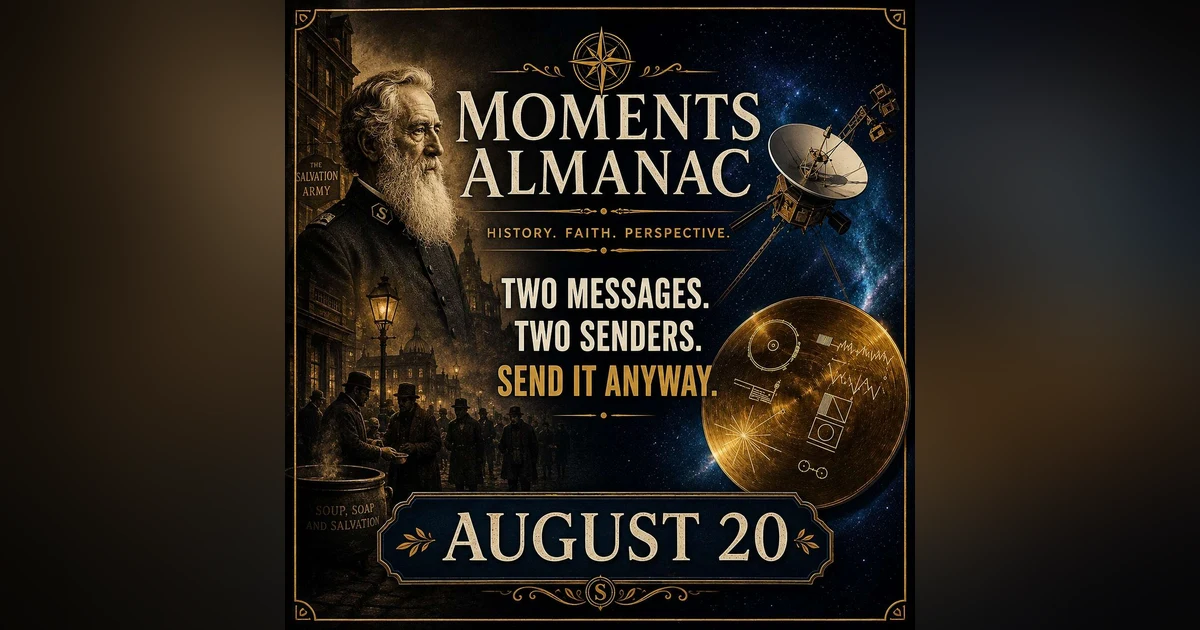


On August 20, 1912, William Booth—the nearly blind, aging founder of the Salvation Army—died after a lifetime spent carrying the gospel into places respectable society preferred to ignore. His message was simple and relentless: as long as people suffered, “I’ll fight.”
Exactly sixty-five years later, on August 20, 1977, Voyager 2 launched from Cape Canaveral carrying another kind of message: the Golden Record, filled with music, greetings, human sounds, and echoes of life on Earth. It was sent toward an unimaginably distant audience its creators might never know existed.
One message went into the streets. The other went toward the stars.
Neither sender could control who would receive it—or what would happen when it arrived.
Perhaps faithfulness is often like that. We preach the sermon, encourage the friend, teach the child, write the letter, share the gospel, and plant the seed without knowing where the message will ultimately land.
In this August 20 edition of Moments Almanac, we remember William Booth and Voyager 2—and the strange, beautiful courage of sending a message into the darkness.
Sometimes faithfulness simply says: Send it anyway.
Welcome to Moments Almanac on Scattered Moments for August the 20th. So glad you are here with me. And today let's focus on two messages that went out into darkness. One came from an old preacher who could barely see standing near the end of a life spent among people the world would prefer not to notice. And the other was bolted to the side of a spacecraft and launched toward the stars its markers would never reach. Neither sender knew where the message would finally land. They sent it anyway. And that's where we're going. By the spring of 1912, William Booth was 83 years old and nearly blind. He had spent almost half a century building the Salvation Army into something Victorian England, had never quite known what to do with, part church, part rescue mission, part marching band, and entirely unwilling to leave suffering people alone. Booth had preached in streets and tents, opened shelters, fed the hungry, fought alcoholism, and insisted that Christianity belonged wherever human misery was greatest, and now his body was giving out. But in May, only months before his death, Booth appeared before thousands at London's Royal Albert Hall. It would become his final and greatest public address. He spoke about people still trapped in poverty, addiction, exploitation, and despair again and again, came to the same promise. While people suffer, I'll fight. It sounded less like a speech and more like an old soldier refusing to surrender his post. Three months later, on august twentieth, nineteen twelve, William Booth died at his home in Hadley Wood. An estimated one hundred and fifty thousand people filed past his coffin. At his memorial service sat politicians, civic leaders, salvation army officers, and Queen Mary. But Booth had spent his life preaching to people who would never sit beside a queen. His message had always been aimed toward the edges. Now travel sixty five years forward. On august twentieth, nineteen seventy seven, Voyager II rose from Cape Canaveral aboard a Titan Centaur rocket. Its mission would eventually take it past Jupiter and Saturn and make it the only spacecraft ever to visit places like Neptune. But attached to Voyager was something unnecessary for navigation, a golden record. On it were greetings in fifty five languages, sounds from the Earth, a human heartbeat, music ranging from Bach and Chuck Berry, and of course instructions explaining how the record might be played. It was a message addressed to nobody in particular, or perhaps to everybody. The scientists who made it knew the odds of anyone finding it were almost unimaginably small. They sent it anyway. Voyager 2 crossed into interstellar space in 2018. Today it continues outward, carrying Earth's little golden introduction into the darkness almost too large to comprehend. And perhaps that is where these two August 20 stories meet. Booth couldn't know who would hear his sermons. NASA couldn't know who might someday find its record. Neither could control the receiving end. They were responsible only for sending. Faithfulness often works that way. You teach a child, you encourage a friend, you preach a sermon, you write a letter, you tell somebody about Jesus, and most of the time, you never really know how far the message travels. Kind of like this podcast. William Booth sent his into the streets. Voyager carrying ours toward the stars. And sometimes that's all faithfulness asks of us. Send it anyway. And I hope that's the message for today. Whatever you do, don't focus on the outcome. Just send it. Be faithful. That's scattered moments for today, August 20th. I hope you'll join me tomorrow. Until then, take heart. Notice the scattered moments and share the grace.


