August 19 | Moments Almanac | Calculations
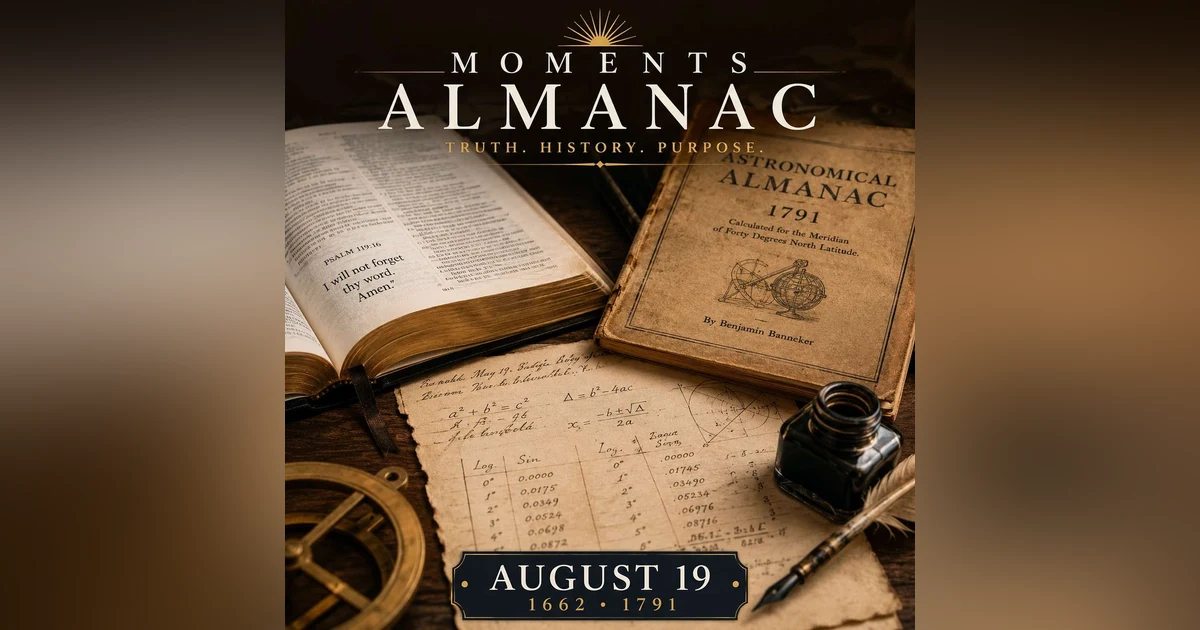
Two brilliant minds, separated by an ocean and 129 years, share the same date in history. On August 19, 1662, mathematician and inventor Blaise Pascal died at just thirty-nine years old. Hidden inside his coat was a small parchment recording the night when the great thinker encountered something reason alone could not explain: the living God. Then, on August 19, 1791, Benjamin Banneker — a free Black astronomer and mathematician — wrote Thomas Jefferson a remarkable letter. Armed with Scriptu...


Two brilliant minds, separated by an ocean and 129 years, share the same date in history.
On August 19, 1662, mathematician and inventor Blaise Pascal died at just thirty-nine years old. Hidden inside his coat was a small parchment recording the night when the great thinker encountered something reason alone could not explain: the living God.
Then, on August 19, 1791, Benjamin Banneker — a free Black astronomer and mathematician — wrote Thomas Jefferson a remarkable letter. Armed with Scripture, reason, and his own astronomical work, Banneker challenged Jefferson to confront the contradiction between America's declaration of equality and the reality of slavery.
In this episode of Moments Almanac, we meet two men who remind us that faith does not require us to abandon reason. It calls reason to keep going — past calculation, convenience, and prejudice — until the truth we know becomes the truth we are willing to live by.
Welcome to Moments Almanac on Scattered Moments. Yesterday we looked at two women, and today, August 19th, let's take a look at the lives of two men. One died in Paris at 39, his body worn down by years of illness, carrying a secret sewn inside his coat. The other sat on a farm outside Baltimore with an astronomical manuscript beside him, preparing to mail one of the boldest letters of his life. But August 19th holds them both. On this day in 1662, Blaise Pascal, mathematician, inventor, and Christian thinker, breathed his last. And 129 years later, on August 19, 1791, Benjamin Banneker, a free black astronomer, wrote to Thomas Jefferson with a simple but dangerous argument. If God made us all, then human equality isn't merely political, it's theological. Two men, two extraordinary minds, and both discovered that reason can carry you a long way. But eventually it must answer to something deeper. That's where we're going today. Blaise Pascal was born in France in 1623 and demonstrated an astonishing mathematical ability while still a teenager. But by nineteen, frustrated by watching his father perform tedious tax calculations, he began developing one of the world's earliest mechanical calculators. But the man who could calculate so much could not calculate his way to peace. Then came the night of november twenty third, sixteen fifty four. For roughly two hours, Pascal experienced something he never adequately explained. Afterward, he hurriedly wrote down what had happened. His first word was fire. Then the God of Abraham, God of Isaac, God of Jacob, not of the philosophers and scholars. He folded the paper and sewed it into the lining of his coat. He told almost no one. When he changed clothes, apparently the paper changed coats with him. It was found after his death. The brilliant mathematician had carried the memory of that night against his chest for years. Pascal spent much of his remaining life writing about Christian faith, leaving behind notes later published as the Pin C's. In them carries his famous observation, the heart has its reason which reason does not know. Pascal died on August 19, 1662. Now, across the Atlantic, we move forward 129 years. Benjamin Banneker was born free in Maryland in 1731, largely self-educated. He became an accomplished mathematician and astronomer and calculated astronomical tables for an almanac. He also assisted in surveying the boundaries of the new federal district that would become Washington, D.C. But on August 19th, 1791, Banneker turned his attention from the heavens to his country. He wrote Thomas Jefferson. Jefferson had written that all men were created equal while continuing to enslave human beings. Banneker respectfully confronted the contradiction. He reminded Jefferson of America's own struggle against tyranny and appealed to something higher than politics. There is, Banneker wrote, one universal father who created humanity, and despite differences of situation and color, we are all of the same family. Then he enclosed his almanac. In other words, here is my argument and here is my work. Jefferson replied eleven days later, acknowledging Banneker's abilities. The letter did not change Jefferson's life and in slavery, but it remained. A free black man 1791 had looked at one of America's most powerful men and insisted that the nation's theology, logic, and founding language all pointed toward a truth. It refused to practice. Pascal looked into the mysteries of mathematics and found that reason alone could not contain God. Banneker looked into the heavens and concluded that the God who ordered the stars could not have created one race to own another. And that's the moment of August 19. It's what it leaves us, that faith does not ask to abandon reason. It asks reason to keep going, past calculation, past convenience, past judgment, until what we know becomes something we are willing to live by. And sometimes the truth you carry in your heart eventually has to become the truth you put on paper. And that's Moments Almanac for today, August 19th. I hope you'll join me tomorrow. Until then, take heart. Notice the scattered moments, and share the grace.


