August 18 | Moments Almanac | Find
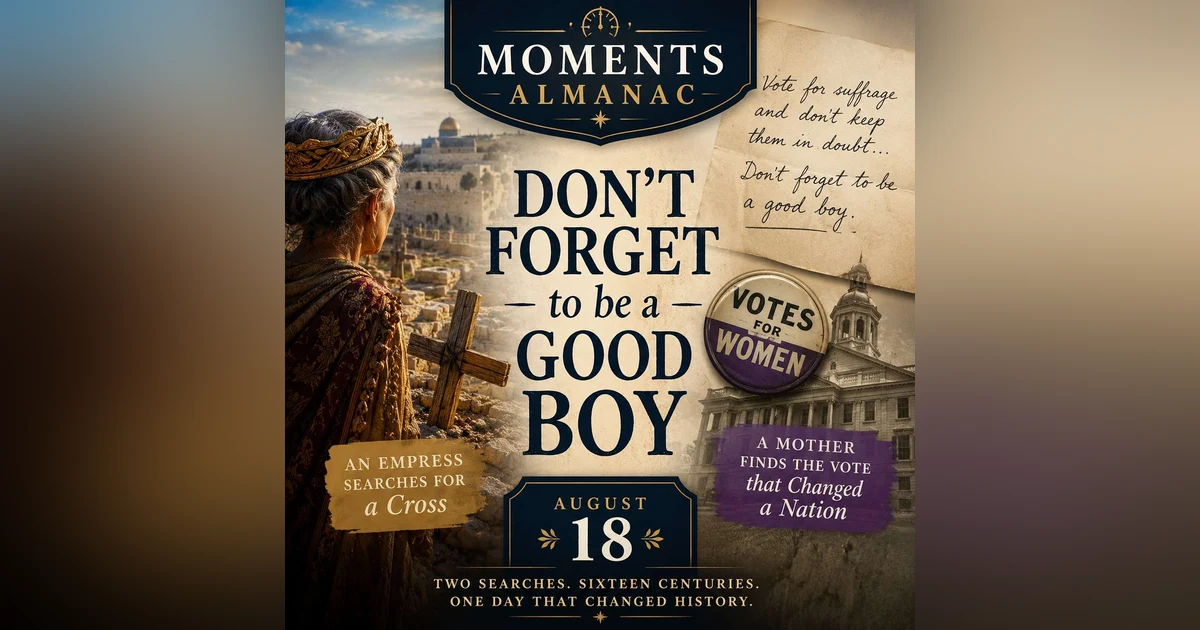
Two searches. Sixteen centuries apart. One remarkable date. On August 18, we remember two women whose influence reached far beyond what anyone might have expected. Helena of Constantinople, mother of the Roman emperor Constantine, spent her final years in the Holy Land, where Christian tradition credits her with a search that uncovered the True Cross beneath the streets of Jerusalem. Then, sixteen centuries later, Tennessee became the final state needed to secure ratification of the 19th Amen...


Two searches. Sixteen centuries apart. One remarkable date.
On August 18, we remember two women whose influence reached far beyond what anyone might have expected. Helena of Constantinople, mother of the Roman emperor Constantine, spent her final years in the Holy Land, where Christian tradition credits her with a search that uncovered the True Cross beneath the streets of Jerusalem.
Then, sixteen centuries later, Tennessee became the final state needed to secure ratification of the 19th Amendment. At the center of the drama was 24-year-old legislator Harry T. Burn—and a letter tucked inside his pocket from his mother, Febb Ensminger Burn.
Her advice was wonderfully simple: “Vote for suffrage… and don’t forget to be a good boy.”
He did.
In this episode of Moments Almanac, we travel from ancient Jerusalem to the Tennessee State Capitol and consider the things that remain buried until someone has the faith, courage, or persistence to go looking for them.
Sometimes history turns on an empress with a shovel.
Sometimes it turns on a mother with a pen.
Take heart. Notice the scattered moments. Share the grace.
Welcome to Moments Almanac for August the 18th. Two searches, sixteen centuries apart, both reached their turning point on August 18th. One was a search for a cross believed to have been buried for centuries beneath Jerusalem. The other was a search for a vote, buried beneath generations of law and custom. One involved an empress nearing eighty, the other a Tennessee mother, who never entered the state house. And both stories are about what can happen when someone decides that what has been buried long enough ought to be brought into the light. Helena was born around the year 250, probably in what is now Turkey, into a family of little wealth or standing. She eventually became the mother of Constantine, and when her son rose to become emperor of Rome, Helena rose with him. Constantine gave her the title Augusta and access to enormous imperial resources, but Helena became known for what she did with them. After becoming a Christian, she gave generously to the poor, cared for prisoners, and late in life made a pilgrimage to the Holy Land. There she funded churches at some of Christianity's most sacred sites, including Bethlehem and the Mount of Olives. And according to tradition, recorded in the decades after her death, Helena ordered excavations at the traditional site of Christ's crucifixion in Jerusalem. The story says that beneath a pagan temple, workers uncovered three crosses, and that one was identified as the cross of Christ. We should say clearly that Helena's contemporary, the historian Eusebius, never mentions this discovery. The story of the true cross appears later, so historians can't verify it. But Helena's search became a part of Christian memory, and the church Constantine built at the site, the Church of the Holy Sepulchre, still stands in Jerusalem. Helena died around the year 330. Sixteen centuries later, on August 18, 1920, something else was waiting to be uncovered. The Nineteenth Amendment had passed Congress, but 35 states had ratified it. It needed 36, and Tennessee was the battleground. Inside the Tennessee House of Representatives, the issue had reached a 48 to 48 deadlock. Then came Harry Byrne. Byrne was twenty four years old, the youngest member of the legislature, and he wore a red rose on his lapel, the symbol of the anti suffrage movement. But in his pocket was a letter. It was from his mother. Feb Insminger Byrne was a widow back home in Nota, who followed the news closely. Most of her letter was filled with ordinary things, family news, neighbors, happenings back home. And then almost casually she wrote, vote for suffrage and don't keep them in doubt. Don't forget to be a good boy. When the vote came, Harry Byrne voted aye. The chamber erupted. With that vote, Tennessee became the crucial thirty sixth state needed to secure ratification of the nineteenth Amendment, which would soon be formally certified. And one of the most consequential votes in American history had been nudged over the line by a mother sitting at home writing a letter to her boy. Two women, sixteen centuries. One went looking beneath the stones of Jerusalem, the other put a sentence inside an ordinary letter. And maybe that's what I love most about August 18th. Some of the most important things in this world are hidden. Sometimes they're hidden beneath stones, sometimes beneath centuries of custom, sometimes beneath fear, habit, silence, or the assumptions that things will always be the way they've always been. Jesus once told a story of a woman who lost a coin. She lit a lamp, she swept the house, and she searched carefully until she found it. There are things worth searching for: truth, justice, grace, the courage to do what's right when everybody expects you to do something else. And sometimes God uses the most unlikely people to bring buried things into light. An aging empress with a shovel, a Tennessee mother with a pen. And maybe even you and me. And that's Moments Almanac for August 18th. I hope you'll join me tomorrow. Until then, take heart. Notice the scattered moments, and share the grace.


