August 17 | Moments Almanac | Gold
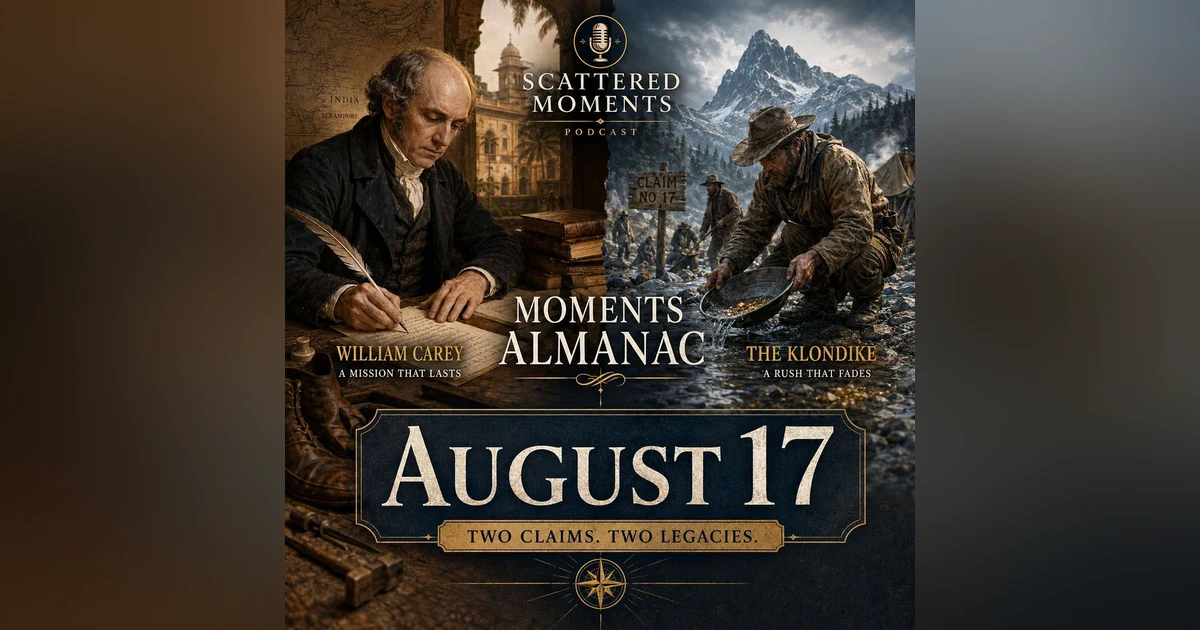
On August 17, two very different claims were staked. One was driven into the gravel of a Yukon creek, where the discovery of gold would ignite the Klondike Gold Rush and send nearly 100,000 fortune-seekers north. The other was staked decades earlier in the life of William Carey, a poor English cobbler who became one of the great pioneers of the modern missionary movement. Carey spent forty-one years in India translating Scripture, establishing schools, training leaders, and carrying the gospe...


On August 17, two very different claims were staked.
One was driven into the gravel of a Yukon creek, where the discovery of gold would ignite the Klondike Gold Rush and send nearly 100,000 fortune-seekers north. The other was staked decades earlier in the life of William Carey, a poor English cobbler who became one of the great pioneers of the modern missionary movement.
Carey spent forty-one years in India translating Scripture, establishing schools, training leaders, and carrying the gospel across barriers of language, culture, and distance. His conviction was simple and costly: “Expect great things from God; attempt great things for God.”
One claim promised treasure. The other demanded a life.
In this episode of Moments Almanac, we remember William Carey, the Klondike Gold Rush, and the difference between the things we chase and the things that keep paying dividends long after we are gone.
Welcome to Moments Almanac on Scattered Moments for today, August 17th. And on August 17th, two very different claims were staked. One was driven into the gravel of a Yukon Creek in 1896, where four prospectors had found gold glinting beneath the water. Within a year, the discovery would send nearly a hundred thousand people rushing north in search of fortunes. Most of them would never find. The other claim had been staked 135 years earlier, in 1761, when a poor weaver's son was born in a little English village called Pollisbury. His name was William Carey. One claim took a morning to stake, the other took forty-one years, and only one of them is still paying dividends. Carey grew up with no money, few prospects. At sixteen he was apprenticed to a shoemaker, and while working at a cobbler's bench, he taught himself Latin, Greek, Hebrew, Dutch, and French from borrowed books. He became a Baptist preacher, but even then he kept repairing shoes to support his family. In 1792, Carey published a small pamphlet arguing something many Christians of his day had almost forgotten. The Great Commission still belonged to the church. Jesus said go, and Carey believed he meant it. That same year, preaching from Isaiah's command to enlarge the tent and strengthen the stakes, Carey issued a challenge that would become the motto of his life. Expect great things from God, attempt great things for God. Within months, a handful of Baptist ministers gathered in Kettering and formed what became the Baptist Missionary Society. The following year Carey sailed from India. He would never return home. For nearly forty-one years Carey and his fellow missionaries worked from Sarimpur. He helped translate scripture into numerous languages, established schools, founded Sarumpur College, and fought the practice of Sati, in which widows were burned on their husbands' funeral pyres. Much of his work was slow, some of it failed. A fire destroyed years of manuscripts. The converts came far more slowly than supporters in England had imagined. Carey simply kept going. He died in India in eighteen thirty four, having spent more than half his life there. Now back to August seventeenth, eighteen ninety six, where we meet a man named George Carmick, and his wife, known as Kate and her brother Kish, and Dawson Charlie staked claims along the Yukon Stream that would soon be renamed Bonanza Creek. There was gold in the gravel. When news finally reached the outside world, Waklondike fever exploded. Nearly 100,000 people headed north. Only about a third of them made it. And most of them who arrived discovered the richest ground had already been claimed. The gold rush burned hot and faded quickly. He had staked his life on the conviction that Christ's command was still true, that no people were too distant, no language too difficult, and no place too forgotten for the gospel. The Klondike prospectors, well, they went looking for treasure, and William Carey went looking for people. And more than two centuries later, the claim he staked is still paying out. And that's Moments Almanac for August 17th. I hope you'll join me tomorrow. Until then, take heart. Notice the scattered moments today, and share the grace.


