August 16 | Moments Almanac | Gallery
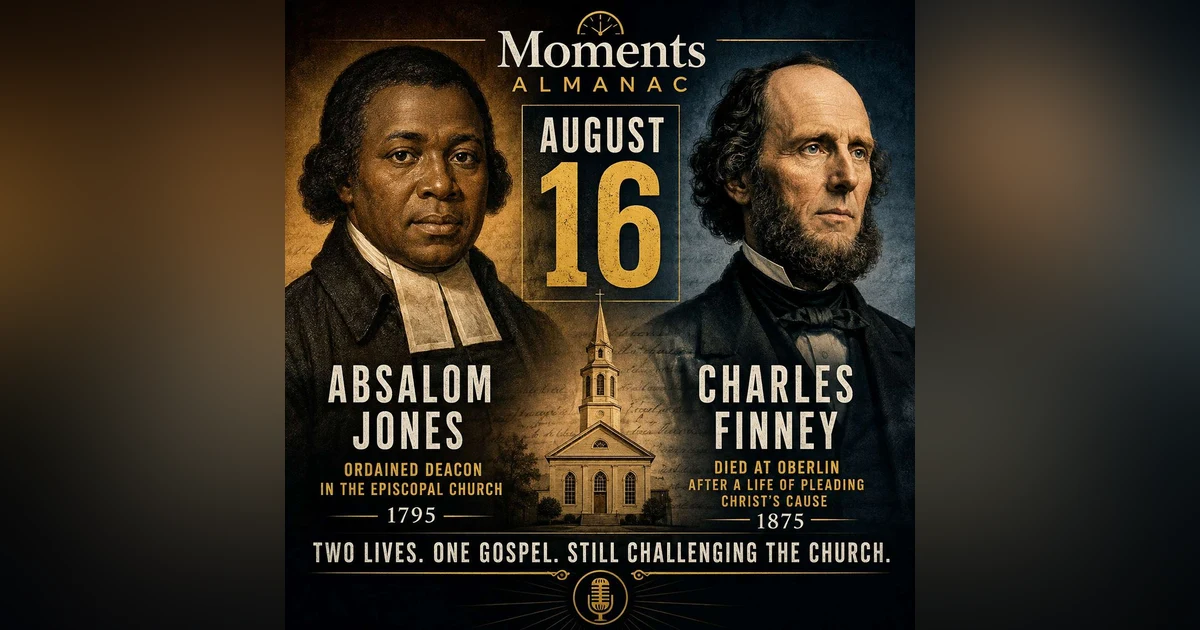


On August 16, two lives separated by eighty years tell a larger story about what happens when the gospel refuses to stay safely inside the walls of a church.
In 1795, Absalom Jones was ordained a deacon in Philadelphia after once being forced from his knees and told where a Black worshipper was permitted to pray. Eighty years later, on August 16, 1875, revivalist Charles Grandison Finney died at Oberlin after a lifetime of preaching conversion and condemning slavery as a national sin.
Two preachers. Two very different journeys. And one enduring question: If the gospel truly changes the human heart, what happens when that changed heart stands up and looks at the person beside it?
Welcome to Moments Almanac on Scattered Moments for August 16th. And on this day in 1795, Absalom Jones knelt before Bishop William White in Philadelphia and became a deacon in the Episcopal Church. Getting there had required him to walk out of another church. Jones had been born enslaved in Delaware. He taught himself to read, purchased his wife's freedom, and eventually gained his own. He and his friend Richard Allen became leaders at St. George's Methodist Episcopal Church in Philadelphia where their preaching helped attract growing numbers of black worshipers. But one Sunday, church leaders decided those worshipers belonged somewhere else. As Jones and the others kneeled in prayer, a church officer tried to pull them from their knees and force them into the gallery upstairs. Jones asked only that they be allowed to finish praying. They did. Then they stood up and walked out. What looked like an ending became a beginning. Jones helped establish the African Church in Philadelphia, later St. Thomas African Episcopal Church, the first black Episcopalian congregation in the country, and on august sixteenth, Bishop White laid hands on a man another congregation tried to move out of the way. Seven years later, Jones became the first black priest ordained in the Episcopal Church in America. Eighty years later, on that same date, another preacher reached the end of a very different ministry. Charles Grandison Finney had begun his adult life as a lawyer in upstate New York, and then after a dramatic conversion in 1821, a client arrived expecting Finney to argue his case in court. Finney told him, I have a retainer from the Lord Jesus Christ to plead his case. He never practiced law again. Instead, Finney became one of the most influential revivalists of the 19th century, preaching across the Northeast and eventually joining Oberlin College in Ohio. His methods, they were controversial. His opposition to slavery was not subtle. Finney called slavery a national sin and argued that Christianity demanded more than private belief. Faith had consequences for the way human beings treated one another. And on August 16th, 1875, Finney died at Oberlin at the age of 82. So to August 16ths, one man knelt to receive the laying on of hands after being told there was a place in church where people like him were supposed to stay. Another died, spending much of his ministry insisting that the gospel could not comfortably coexist with enslavement of human beings. Absalom Jones and Charles Finney were separated by generation, a denomination, a very different experience of America. But both lives ask the church a question it still has to answer. Will we cling to cultural norms or will we stand by biblical Christianity? And that's Moments almanac for August the 16th. Hope you have a great day in worship. Hope you'll join me tomorrow. Until then, take heart. Notice the scattered moments and share the grace.


