August 14 | Moments Almanac | Exchanged
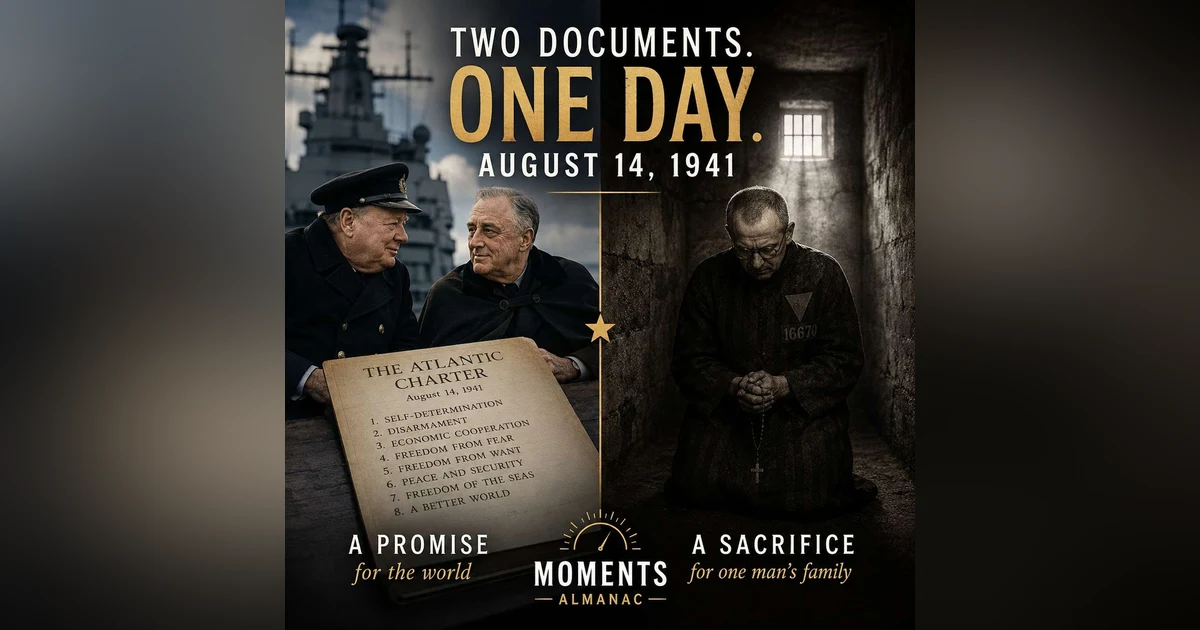
On August 14, 1941, two very different promises were written into history. Off the coast of Newfoundland, Winston Churchill and Franklin Roosevelt issued the Atlantic Charter—eight principles describing their hopes for a freer, more peaceful world after the war. That same day, inside Auschwitz, Polish priest Maximilian Kolbe was dying after volunteering to take the place of a condemned husband and father. One declaration was announced to the world. The other was written quietly in flesh and b...


On August 14, 1941, two very different promises were written into history.
Off the coast of Newfoundland, Winston Churchill and Franklin Roosevelt issued the Atlantic Charter—eight principles describing their hopes for a freer, more peaceful world after the war.
That same day, inside Auschwitz, Polish priest Maximilian Kolbe was dying after volunteering to take the place of a condemned husband and father.
One declaration was announced to the world. The other was written quietly in flesh and blood.
In this episode of Moments Almanac, we remember two moments from the same day in the same broken world—and consider the words of Jesus: “No one has greater love than this: to lay down his life for his friends.” — John 15:13
Grace is often scattered in places no one is watching.
Take heart. Notice the scattered moments. Share the grace.
Keywords: August 14, Maximilian Kolbe, Atlantic Charter, Winston Churchill, Franklin Roosevelt, Auschwitz, World War II, John 15:13, sacrificial love, Christian history, faith, grace, Moments Almanac, Scattered Moments
Welcome to Moments Almanac for August 14th. On August 14th, 1941, two documents were written into history, though only one was ever put on paper. In Placentia Bay, off the coast of Newfoundland, Winston Churchill and Franklin Roosevelt stood aboard warships anchored side by side and issued the Atlantic Charter. It contained eight short principles: self-determination for nations, disarmament for aggressors, and a shared hope for a better world once the guns had finally fell silent. Reporters carried it around the globe. Presidents would cite it for decades. It became one of the seeds of the United Nations itself. And yet the Atlantic Charter wasn't even a treaty. It was never signed. It bound no one by force of law. Its power was in the fact that two of these, the most watched men on earth, said these things out loud where the world could hear. That same day, in a concrete cell beneath Block 11 at Auschwitz, a Polish priest named Maximilian Kolby was dying. Two weeks earlier, guards had selected ten prisoners to starve in reprisal for another man's escape. One of the condemned men cried out for his wife and children. Colby stepped out of a line. He asked if he could take the man's place. Survivor accounts remember him identifying himself simply as a Catholic priest. The commandant strangely agreed, and for two weeks Colby suffered along with the other condemned men, leading them in prayer. On August 14th, with Colby still faintly alive, an injection ended his life. No cameras recorded, no newspaper carried the story around the world. Among those who carried the story forward was the man Colby saved. He survived the war and returned to his family that he feared he would never see again. Same date, same year, same collapsing world, one declaration written for the nations, one life quietly given for a single family. The Atlantic Charter described the kind of world men hoped might come after the world. Colby showed what love looks like when the world has disappeared. Jesus said no one has greater love than this to lay down his life for his friends. One document was written in eight principles, the other was written in flesh and blood. Most of us will never issue a charter or shape the future of nations, but we will face similar, smaller moments when love costs us something, our comfort, our reputation, our plans, the hours we wanted for ourselves. Colby's answer was never written down for the world to read. He lived it one hour at a time, in the dark, until there were no hours left to give. And that's where grace is most often scattered, not in the Declaration of Nations announced in daylight, but in the cells no one else is willing to enter. And that's Moments Almanac for August the 14th. I hope you'll join me tomorrow. Until then, take heart. Notice the scattered moments and share the grace.


