August 13 | Moments Almanac | Conquest
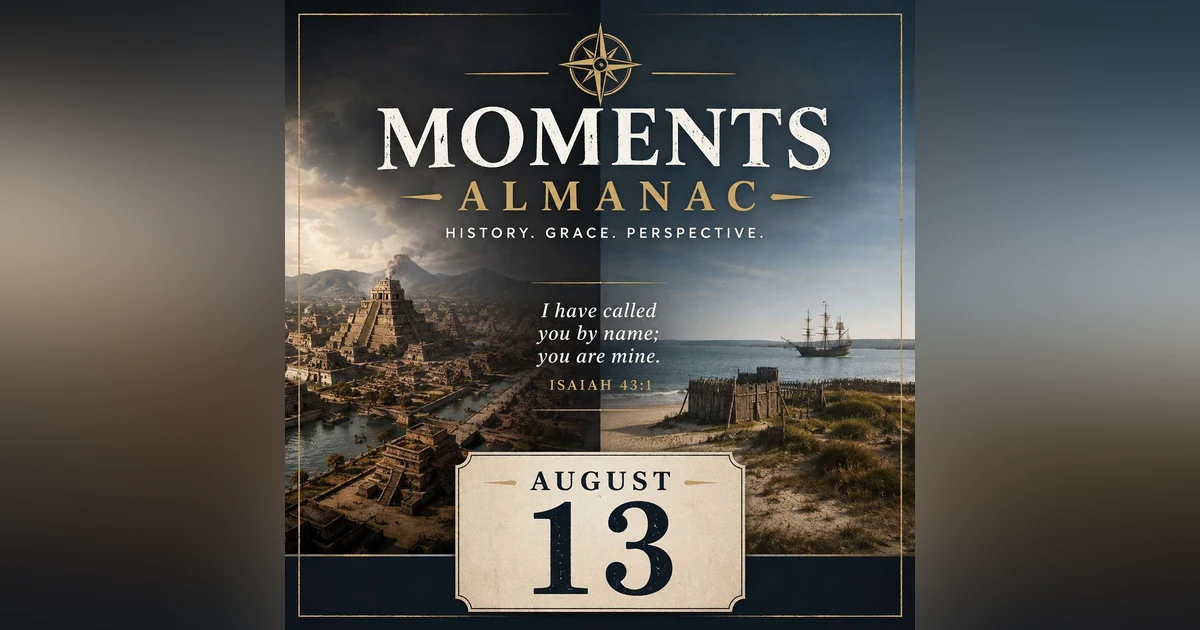


On August 13, 1521, an empire fell. On August 13, 1587 — sixty-six years later — one man was named. Today's Moments Almanac holds the fall of Tenochtitlán alongside the baptism of Manteo at Roanoke: two colonial-era encounters, two very different outcomes, and a question about what it means to be seen. Take heart. Notice the scattered moments. Share the grace.
Prayer: Lord, in a world that so easily reduces people to numbers, casualties, or footnotes, thank You that You call each of us by name. Today, help me see the person in front of me the way You see them — known, named, and loved. Amen.
Welcome to Moments Almanac on Scattered Moments. This is a time for us to remember the people, places, and events that leave fingerprints on the soul. And today is August 13th, and on this day in 1521, after a three-month siege, Spanish forces under Hernan Cortes broke the last resistance of the Aztec capital and captured its emperor as he tried to flee across Lake Texcoco. The city he ruled, Tenochtitlan, had stood on its island for nearly two centuries, a marvel of canals and causeways that stunned the conquistadors who first laid eyes on it. By the time the siege ended, hunger, smallpox, and months of house to house fighting had reduced much of it to rubble, and its people to a fraction of their number. An empire fell that day, and it fell the way empires often do, not gently, but wholesale. Its multitude of names swallowed into a single verb conquered. Sixty six years later, on that same date, a far smaller scene played out in Roanoke Island off the coast of what is now North Carolina. An English colony struggling and unsure of its own survival gathered to baptized a Croatoan man named Manteo into the Church of England. Manteo had crossed the Atlantic twice already. He learned English. He had watched two attempts at English colonization rise around him, and he had chosen again to stand with the strangers who called this land theirs. The colonists gave him a title that day Lord of Roanoke and Desmonuponki, words tangled up if we're honest with English politics as much as with any pure motive. We shouldn't pretend the moment was uncomplicated. Manteo's baptism sat inside the same current of empire and self interest that had carried Europeans across the Atlantic in the first place. The English were not innocent observers of conquest, but buried inside the compromised moment was another vocabulary altogether. Conquest has a way of turning people into categories. It still does. Enemies, subjects, casualties, converts, territory won or territory lost. But baptism, when it tells the truth about the gospel, moves in the opposite direction. It stops over one person, it speaks a name, it says this one belongs. Scripture tells us that God does not deal in nameless masses either. Not with Israel, not with the nations pulled into her story, not with us. I have called you by name. The prophet Isaiah wrote to the people facing the terror of losing everything. You are mine. Isaiah wasn't writing about Monteo or Tenochtitlan or the Outer Banks. He was writing to Israel, reminding God's people who they were, and more importantly, whose they were. But the truth underneath his words reaches further than one nation's grief. This is a God who does not conquer people in anonymity. He calls them by name into belonging. Sixty six years apart, on the same August day, Empire left its fingerprints on two very different shores. But buried inside one of those compromised moments was another vocabulary altogether not territory, but a name, not possession, but belonging. Yes, we're all sinners telling the story, not the heroes of it. The English who baptized Manteo were still men of empire, capable of using him for their own purposes, and within three years the colony itself would disappear into the mystery and fog of the outer banks. Grace doesn't require clean history to still be grace. It shows up in compromised moments through compromised people, and it still means what it means. Because empire counts people, grace calls them by name. No matter how difficult their names are to pronounce. So take heart, whatever wreckage surrounds you, whatever empire, literal or personal, has swallowed something you loved, you're not a nameless casualty in someone else's conquest. You have a name, and it has been spoken. So notice the scattered moments, even the ones tangled up in things you can't fully justify. Share the grace, because somebody somewhere is still waiting to hear their name.


