August 11 | Moments Almanac | Unprecedented
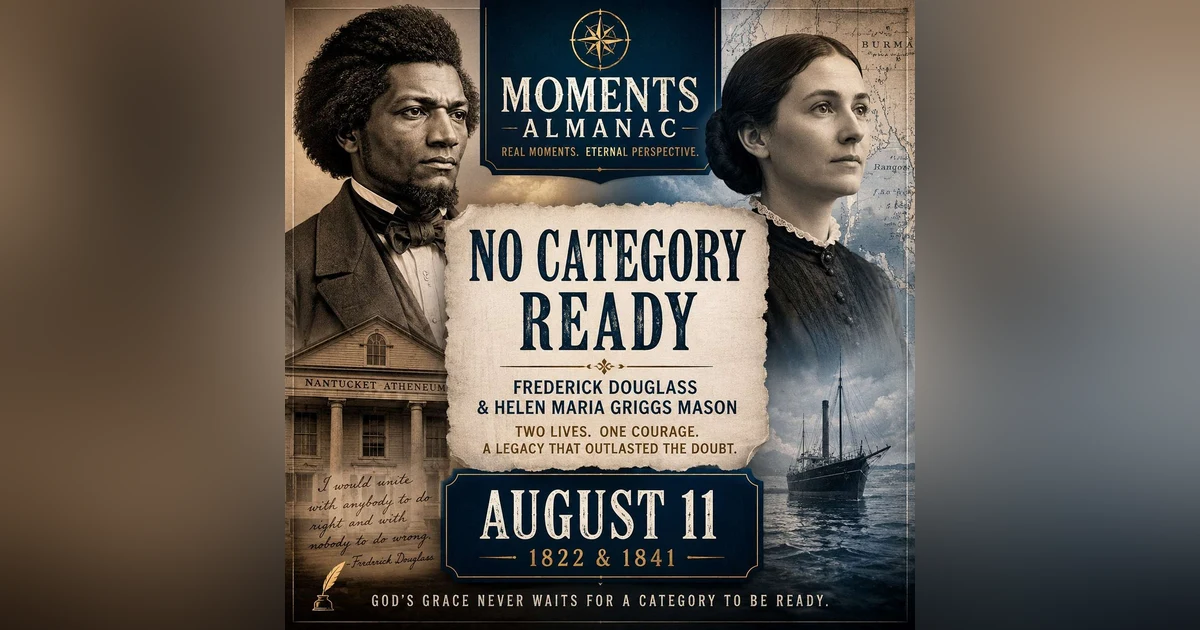


August 11, 1841: a fugitive slave named Frederick Douglass, just twenty-three and three years out of bondage, gave the first full speech of his life to a room of strangers on Nantucket — and walked out of it a full-time abolitionist lecturer. Nineteen years earlier to the day, in 1822, a young woman named Helen Maria Griggs was baptized in Brookline, Massachusetts, and asked her mission board for something they'd never granted anyone: to go to Burma alone. Neither had a precedent to stand on. Both were trembling when they said yes anyway — and both paid for it in ways that had nothing to do with whether the choice was right. Take heart. Notice the scattered moments. Share the grace.
Prayer: Lord, I don't have a category for what You're asking of me, and neither does anyone around me.
Steady the trembling. Give me courage for the parts of this that have no precedent, and peace for the cost I can already feel coming.
Whatever this costs me, be worth it. Amen.
Welcome to Moments Almanac for today, August 11th. And on this day in 1841, a fugitive slave named Frederick Douglass stood in the Nantucket Anthonyum and gave for the first time in his life a full speech to a room of strangers. He was twenty three and only three years removed from bondage in Maryland. A Nantucket man named William Coffin was the one who gave the invitation to speak at the convention, and Douglas later called the invitation a severe cross, one he took up reluctantly. He trembled as he rose, hardly able to stand erect or get two words out without stammering. Most of the room was white, and Douglas had spent his whole life being told exactly what a man like him was not permitted to do. He spoke anyway, describing what slavery had done to him in his own voice, to people who might actually change something. By the time he sat down, William Lloyd Garrison was on his feet, and within days the Massachusetts Anti-Slavery Society had hired Douglas as a full-time lecturer. No one in that hall had a category ready for what he was about to become. And on that same date in 1822, a young woman in Brookline, Massachusetts was baptized into a Baptist church, and something quite similar began. Her name was Helen Maria Griggs, and she wanted something the mission board had never granted anyone to go to Burma alone, unmarried, with no husband to send in her place. The board didn't have a category ready for that kind of request either. It took seven years and a formal examination before they finally appointed her in 1829. Before she sailed, she married Frances Mason, a fellow student preparing for the same field, and together they made the hundred and twenty two day voyage to Calcutta and then on to Burma. There Helen learned Burmese and Sagou Karen well enough to teach and write in both. Work that outlasted her own lifetime. Years later on furlough in the States, she made a decision that cost her more than her board's old hesitation ever had. She left her own children in the care of family and sailed back to the work. Christian periodicals did not spare her for it. She was criticized publicly and felt it as sharply as any mother would. We have heard of the tortures of the Inquisition, she wrote, but I do not know that they could exceed this self sacrifice. Editors eventually rose to her defense and opinion shifted, but the ache of that choice never fully left her. The stories of Douglas and Mason echo back to a familiar hymn written by Francis Ridley Havergall in 1874. Take my voice and let me sing always only for my king. Take my lips and let them be filled with messages from thee. Neither Douglas nor Mason had a precedent to stand on. No escaped man had addressed that room before, and no unmarried woman had ever been sent to the field alone. Both were examined by people who were not entirely sure they should be trusted with what they were being asked to carry. Both were trembling when they said yes anyway, and both went on, paying for that yes, in ways that had nothing to do with whether the decision was right or not. Douglas carried physical danger and years of hostile crowds. Mason carried a particular grief that only a mother can carry, who put an ocean between herself and her own children for the sake of people she had come to love. History does not remember either of them because the room was comfortable with the choice. It remembers them because they were willing to be doubted first and faithful anyway. So today, if you reach a point where you don't feel like you fit in any category, I hope you'll remember Mason and Douglas. And that you'll take heart and notice the scattered moments and share the grace.


