September 9 | Moments Almanac | Authority
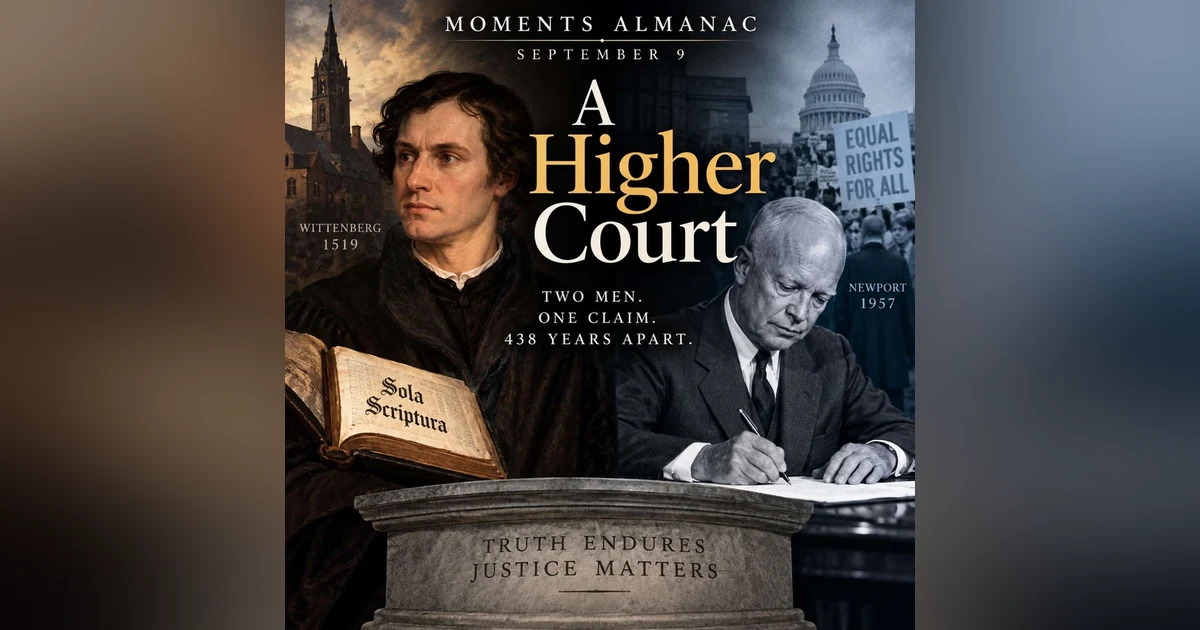


Four hundred and thirty-eight years apart, Philipp Melanchthon and President Dwight D. Eisenhower faced very different questions of authority. One helped articulate a Reformation conviction that Scripture stands above human institutions. The other signed the first federal civil rights legislation since Reconstruction, as America wrestled with whether justice could be left to the will of individual states.
Two moments. Two very different struggles. And one enduring question: Who gets the final word?
In today’s Moments Almanac, we travel from Reformation-era Wittenberg to the struggle for civil rights in 1957 America—and consider what happens when conscience, justice, and truth appeal to a higher court.
Welcome to Moments Almanac on Scattered Moments for September 9th, 438 years apart. On the same date, two very different men stake something on the claim that there is a higher authority than the one currently holding power. One was a twenty-two-year-old professor in Wittenberg, Germany, brilliant, young, and not yet a theologian by degree, publicly defending claims that Scripture rather than popes councils and accumulated tradition was the final authority for Christian doctrine. The other was an American president signing the first civil rights legislation Congress had passed since Reconstruction, asserting that voting rights of black Americans could no longer simply be left to the states. Different cultures, different questions, but underneath both was an ancient question. Who gets the final word? Philip Melanchthon was born in fourteen ninety seven in Breton, Germany, and he was a genuine prodigy. He earned his bachelor's degree at fourteen, his master's at seventeen, and by twenty one became professor of Greek at the University of Wittenberg. There he met Martin Luther. Melanchthon had come to teach the classics, and Luther helped turn his attention towards Scripture, particularly the letters of Paul. In 1519, Melanchthon accompanied Luther to Leipzig for the famous debate with Catholic theologian Johann Eck. He was officially a spectator, but his comments from the sidelines irritated Eck. Enough that Eck dismissed the young scholar as essentially a grammarian meddling in theology. Melanchthon answered with his pen. His defensio contra Johannum Eckiem argued for the authority of Scripture over competing authorities within the church. Then, on September 9, 1519, the 22-year-old Melanchthon defended 24 theological theses. In Wittenberg as a part of his examination for Bachelor of the Bible, ten days later he received the degree. It was the beginning of an extraordinary theological career. In 1521 he published the Lochi Communes, an early systematic presentation of Reformation theology, and nine years later he became the principal author of the Augburg Confession. Europe would eventually call him the Preceptor Germanae, the teacher of Germany. Now move forward 438 years. On September 9, 1957, President Dwight D. Eisenhower sat in his office at the naval base in Newport, Rhode Island, and signed the Civil Rights Act of 1957. It was the first federal civil rights legislation enacted since 1875. The measure had been weakened considerably during the journey through Congress, including fierce Southern opposition and Senator Strom Thurman's marathon filibuster. But the law created a federal civil rights division within the Justice Department and established a Commission on Civil Rights with voting rights as the central concern. And almost immediately the larger question of federal authority moving from paper to pavement. In Little Rock, Arkansas, the governor had used the Arkansas National Guard to prevent nine black students from entering Central High School. By September 23rd, an angry crowd surrounded the school. On September 24th, Eisenhower federalized the Arkansas National Guard and ordered troops from the 101st Airborne Division into Little Rock to enforce the federal court's desegregation order. The law had been written. Now someone had to stand behind it, and that's really where these two September ninths meet. Malecton believed the church itself must stand beneath the authority of God's word. America was wrestling with whether governments and majorities themselves must stand beneath principles of justice that protect people whose rights have been denied. Human institutions matter, governments matter, churches matter, courts and councils matter, but none of them are God. Paul told Timothy, All scripture is breathed out by God. And Amos heard the Lord's demand. Let justice roll down like waters and righteousness like an ever-flowing stream. And sometimes faithfulness begins when we remember that the loudest voice in the room is not necessarily the highest one, and the authority currently holding power is never the final court of appeal. That's today's scattered moments for September 9th. I hope you'll join me tomorrow. Until then, take care. Notice the scattered moments and share the grace.


