September 7 | Moments Almanac | Boxer
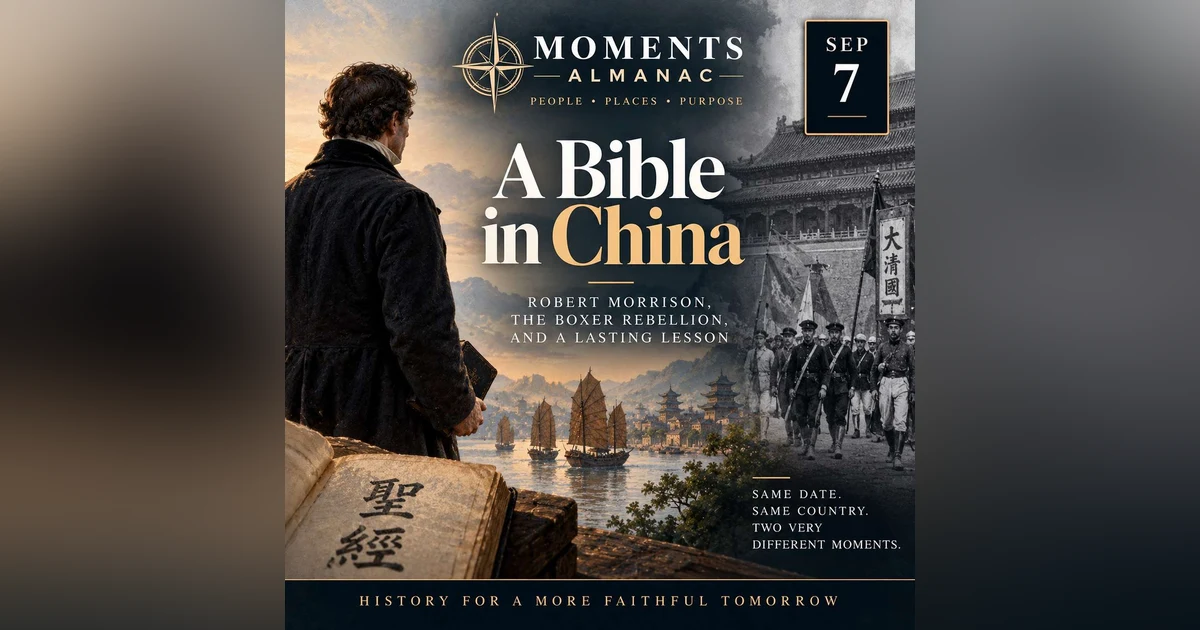


On September 7, 1807, Robert Morrison arrived in China with a Bible and a calling, beginning decades of quiet missionary work that would help bring Scripture to the Chinese people. Ninety-four years later, the Boxer Protocol marked the bitter aftermath of an uprising fueled partly by resentment toward foreign influence.
Two moments on the same date offer both a calling and a warning: carry the gospel faithfully—but be careful what else you carry with it.
Welcome to Moments Almanac on Scattered Moments for September 7th. And on this day in 1807, a 25-year-old Englishman stepped ashore at a cramped foreign trading post outside Canton, China. He was unwelcome, largely alone, and carrying no weapon but a Bible and an astonishing will to stay. His name was Robert Morrison, and he would become the first Protestant missionary to China. And then 94 years later, on that very same date, Chinese officials signed the Boxer Protocol, a humiliating settlement imposed after a violent uprising aimed in part at driving foreign missionaries and Chinese Christians out of the country. Same day, same country, two very different moments. One was a door quietly opening, and the other was a terrible aftermath of a nation trying to force that door shut. Orson was born in Northumberland, England, in 1782. China missionary work was forbidden. Foreigners were tightly restricted. Even teaching the Chinese language to outsiders could bring severe punishment. But worse than went anyway. He reached on September 7, 1807, and began studying Chinese in secret. Eventually he became so skilled that the British East India Company hired him as a translator, giving him the practical means to remain in the country. And for 27 years he labored there. He helped translate the entire Bible into Chinese, produced a massive Chinese English dictionary, and helped establish a college in Lacka to prepare others for ministry in Asia. But if you measured his life only by immediate results, the numbers would be unimpressive. Morrison personally baptized only a handful of converts. He died in Canton in 1834 without seeing a great Christian expansion in China. That would come much later. And then came the darker side of his story. By 1900, resentment toward foreign powers had exploded into the Boxer Rebellion. Missionaries and Chinese Christians were attacked and killed. Foreign armies intervened, crushed the uprising, and imposed harsh terms on China. On September 7th, 1901, the Boxer Protocol forced the Xing government to pay enormous reparations, punish officials, and accept an expanded foreign military presence. It became one of those symbols of what China remembers as its era of national humiliation. And that leaves us with an uncomfortable truth. The Gospel enters China during an age when Western nations were also arriving in gumboats, trade demands, unequal treaties, and imperial ambition. Missionaries did not approve of that whole system, and men like Morrison were often far more interested in translation and domination. But to many Chinese people, the Bible and the Empire arrived wearing the same foreign face. And that is worth noting. The gospel does not need the sword. It does not need political privilege. And we all know it's most powerful when it comes the way Christ came. Not to conquer, but to serve. Robert Morrison spent decades planting seeds he could barely see. The Boxer Protocol reminds us how easily the message of Christ can be confused with the ambitions of those who carry it. So today, September 7th, gives us both a calling and a warning. Carry the gospel faithfully and be very careful what else you carry with it. That's today's Moments Almanac. Thank you so much for listening. I hope you'll be back tomorrow. Until then, take care.


