September 4 | Moments Almanac | Surrender
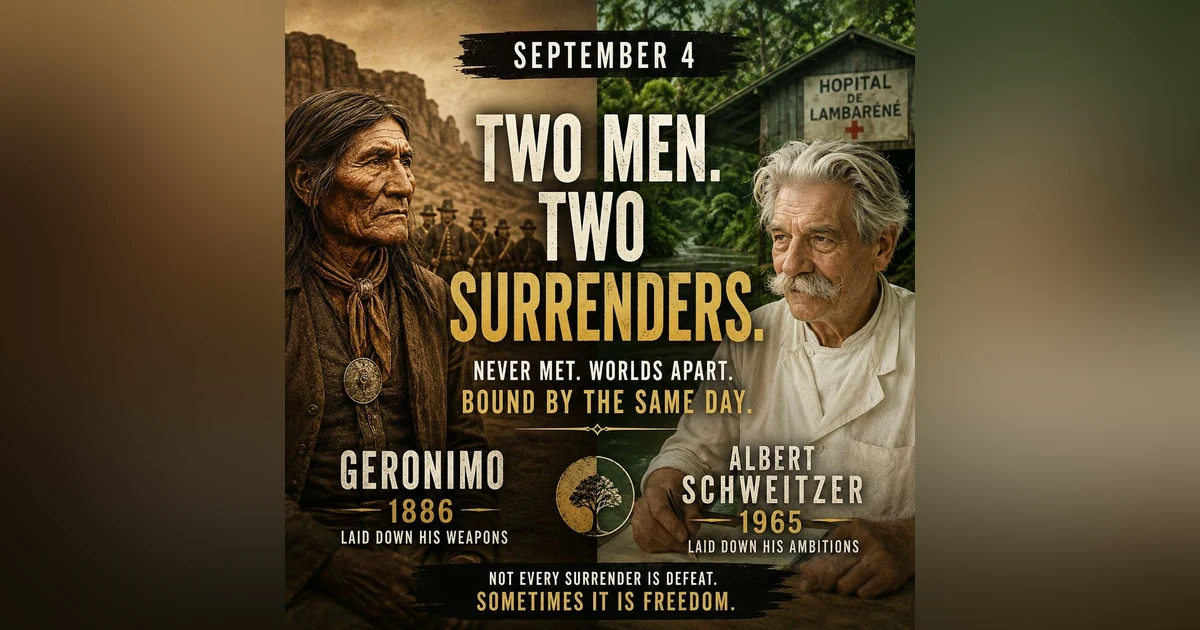

September 4 — Two Men, Two Surrenders On September 4, 1886, Apache leader Geronimo laid down his weapons for the final time, ending years of resistance against the United States government. Seventy-nine years later, on the same date, physician, theologian, and Nobel Peace Prize winner Albert Schweitzer died at the hospital he had built in Lambaréné, Gabon. Geronimo surrendered because the fight had reached its end. Schweitzer surrendered a life of prestige and accomplishment because he believ...


September 4 — Two Men, Two Surrenders
On September 4, 1886, Apache leader Geronimo laid down his weapons for the final time, ending years of resistance against the United States government. Seventy-nine years later, on the same date, physician, theologian, and Nobel Peace Prize winner Albert Schweitzer died at the hospital he had built in Lambaréné, Gabon.
Geronimo surrendered because the fight had reached its end. Schweitzer surrendered a life of prestige and accomplishment because he believed he had found something worth more.
Two men. Two very different lives. Two very different kinds of surrender.
In this episode of Moments Almanac, we travel from the deserts of the American Southwest to the banks of an African river and consider a surprising truth: not every surrender is defeat. Sometimes laying something down is how we finally become free.
Welcome to Scattered Moments. Seventy-nine years and half a world stood between them. One was an Apache warrior who spent decades fighting to keep his people free. The other was a European scholar, musician, and theologian who walked away from nearly everything the world called success. But September 4th holds them both. On this day in 1886, Geronimo laid down his weapons for the last time and he surrendered to the United States Army. And on the same date in 1965, Albert Schweitzer died in an African hospital where he had spent most of his life, fifty years after laying down fame, comfort, and a brilliant European career. Both Schweitzer and Geronimo experienced two different kinds of surrender. Geronimo was born in 1829 in what is now New Mexico. His Apache name was often translated the one who yawns. But there was very little in his life that would be labeled as sleepy. In 1858, Mexican soldiers killed his mother, wife, and three children while the men in his band were away trading. Geronimo's grief hardened into decades of warfare. As American settlement expanded across the Southwest, he repeatedly fled the reservation life and fought Mexican and American forces. In 1885, Geronimo escaped once more with a small group of followers. Thousands of American troops pursued them through Arizona and Mexico. By the summer of 1886, his people were exhausted. On September 4th, at Skeleton Canyon in Arizona, Geronimo surrendered to General Nelson Miles. He would never again live freely in his homeland. Geronimo spent the rest of his life as a prisoner of war, eventually settling at Fort Sill, Oklahoma. He died there in 1909, still longing to return home. Seventy-nine years later, on the same date, September 4th, well that marked the end of another life shaped by laying something down. Albert Schweitzer was born in 1875, and by 30 he was already celebrated as an organist, a Bach scholar, a philosopher, a controversial theologian. Then he heard about the desperate need for physicians in Africa, so Schweitzer did something extraordinary. He went back to school. At thirty years old, he began studying medicine. In 1913, he and his wife Helene traveled to what is now Gabon, where they established a hospital. His theology had made some missionaries suspicious of him, but his calling was simple. Heal the sick, and he stayed. Schweitzer returned periodically to Europe, giving concerts and lectures to help fund the hospital, but Africa became his life's work. In 1952, he received the Nobel Peace Prize, becoming internationally known for his philosophy of reverence for life. On September 4th, 1965, Albert Schweitzer died. He was 90. Geronimo laid down his weapons because he had reached the end of his fight. Schweitzer laid down his ambitions because he believed he had found something worth more. And maybe September 4th leaves us with this question: what are you still carrying that God may be asking you to lay down? Not every surrender is defeat. Sometimes surrender is the moment we finally lose. And sometimes it is the moment we finally become free.


