September 3 | Moments Almanac | Disappear
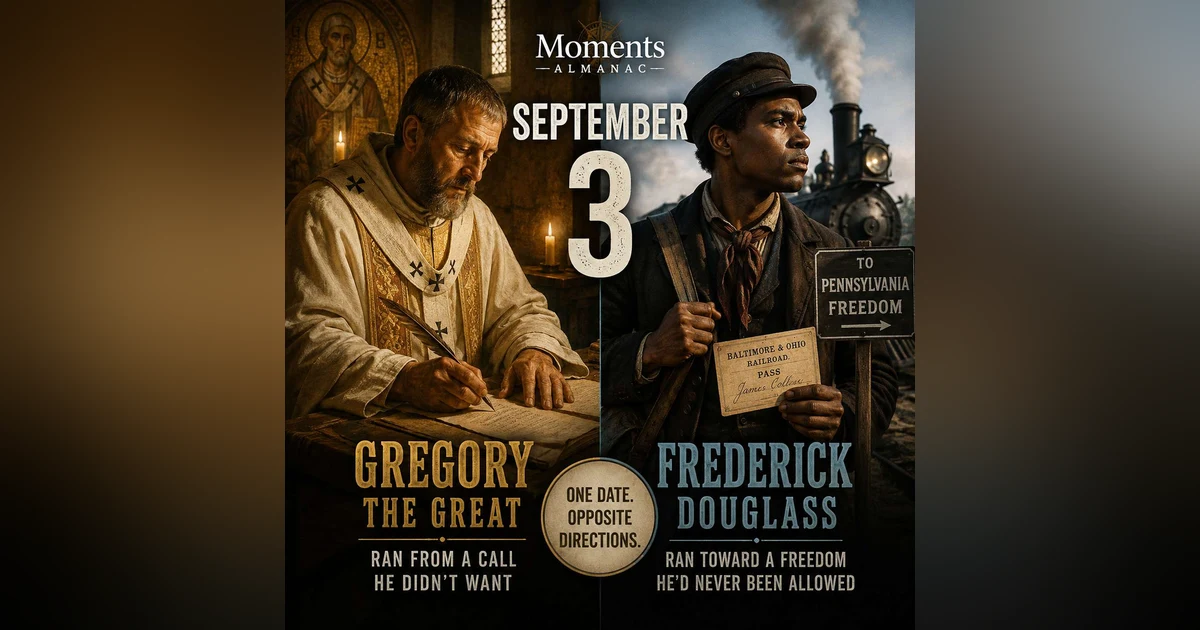

On September 3, two men tried to disappear — for very different reasons. In 590, Gregory the Great tried to escape the responsibility of becoming bishop of Rome. More than twelve centuries later, Frederick Douglass escaped slavery, risking everything for freedom. One ran from a calling he didn’t want. The other ran toward a freedom he’d never been allowed. Their stories raise a powerful question: What are you running from — and what are you running toward? In this episode of Moments Almanac, ...


On September 3, two men tried to disappear — for very different reasons.
In 590, Gregory the Great tried to escape the responsibility of becoming bishop of Rome. More than twelve centuries later, Frederick Douglass escaped slavery, risking everything for freedom.
One ran from a calling he didn’t want. The other ran toward a freedom he’d never been allowed.
Their stories raise a powerful question: What are you running from — and what are you running toward?
In this episode of Moments Almanac, we travel from sixth-century Rome to nineteenth-century America and discover that sometimes faithfulness means staying when you’d rather run — and sometimes it means having the courage to leave.
September 3: Gregory the Great and Frederick Douglass — one date, opposite directions.
Welcome to Moments Almanac for September 3rd. Glad you're with me today. And on September 3rd, two men tried to disappear. One was hiding because people wanted to make him Pope. The other was hiding because people claimed they owned him. Gregory ran from a calling he didn't want. Frederick Douglass ran toward freedom he had never been allowed to have. Same date, two opposite directions. And somewhere between them is a question about when faithfulness means staying and when it means running for your life. In the year 590, Roman needed a bishop. Gregory wanted no part of it. Gregory had served as a diplomat in Constantinople, but he also had tasted the quiet life of a monk, and that was the life he preferred. When Gregory was overwhelmingly chosen to become bishop of Rome, he protested that he wasn't fit for the job. According to an old tradition, he even fled Rome and hid in a cave, hoping they would eventually give up looking for him. They didn't. Gregory was found, brought back, and on September 3rd, 590, consecrated bishop of Rome. He would become known to history as Gregory the Great, but Gregory preferred another title. He called himself the servant of servants of God. And he lived like he meant it. During fourteen years as Pope, Gregory cared for the Roman people, battered by famine, disease, political instability, and invasion. Church resources were used to feed the poor. He negotiated with invading Lombards when imperial officials proved unable to protect the city. He also sent missionaries north to evangelize the Anglo-Saxons in England. His influence on Roman worship became so significant that centuries later a whole tradition of music would carry his name, Gregorian Chants. The man who ran from responsibility became one of the most influential church leaders of the Middle Ages. Now let's move forward more than twelve centuries. September 3rd, 1838. A twenty-year-old enslaved man named Frederick Bailey boarded a train in Maryland. He was also trying to disappear, but Frederick wasn't running from responsibility. He was running from slavery. Disguised as a free black sailor and carrying borrowed identification papers, he boarded a northbound train and prayed no one would examine him too carefully. The conductor barely did. Frederick crossed Maryland, then Delaware, and finally entered Pennsylvania, free soil. In less than twenty four hours he reached New York City. He was free, but not safe. Under American law, he was still considered a fugitive, vulnerable to capture and return to slavery. Soon he married Anna Murray, the free black woman who had helped finance his escape and adopted the surname by which history remembers him. Douglas. Frederick Douglass. He became an abolitionist, writer, speaker, newspaper publisher, and one of the most photographed Americans of the nineteenth century. And the man who once escaped alone spent the rest of his life fighting for the freedom of others. Two men, one date, opposite directions. Gregory ran because he feared he wasn't worthy of the calling placed before him, and Douglas ran because another human being had no right to determine his calling at all. And I kind of think that's worth remembering. Not every escape is cowardice, and not every surrender is faithfulness. Sometimes obedience means staying when you rather run. Sometimes it means running when someone else demands that you stay. Hebrews 12 1 says, Let us run with endurance the race that lies before us. Maybe the question isn't simply, Am I running? Maybe the better question is, what am I running from? And what am I running toward? Because sometimes God calls us out of hiding and sometimes he calls us out of bondage. Either way, freedom is found when we finally run the race that is ours to run. And that's your Moments Almanac. I hope you'll join me tomorrow. Until then, take heart. Notice the scattered moments and share the grace.


