September 15 | Moments Almanac | Four
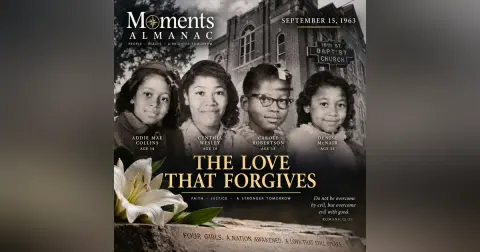


On September 15, 1963, a bomb exploded at Birmingham’s 16th Street Baptist Church, killing four young girls: Addie Mae Collins, Cynthia Wesley, Carole Robertson, and Denise McNair.
The tragedy came on a Sunday when the church’s Youth Day carried an almost unbearable theme: “A Love That Forgives.”
In this installment of Moments Almanac, we remember four lives, a nation confronted by the horror of racial hatred, and a difficult question that still reaches across the decades: What does forgiveness mean when the wound is this deep?
“Do not be overcome by evil, but overcome evil with good.” — Romans 12:21
Welcome to Moments Almanac for September 15th. And on this day in 1963, it was Sunday morning in Birmingham, Alabama. At the 16th Street Baptist Church, children were gathering for Sunday school. Young people were preparing for Youth Day. Girls were straightening dresses, talking with friends, getting ready for worship. And hanging over that Sunday was a theme almost unbearable to read sixty three years later. A love that forgives. At ten twenty two that morning, a bomb exploded beneath the church. Dynamite had been planted by white supremacists near a stairwell. The blast ripped through the gate, windows shattered, walls collapsed, people ran through the smoke, the debris looking for children and friends, and four girls were killed. Addie May Collins, Cynthia Wesley, Carol Robertson, and Denise McNair. Denise was eleven. The other three were fourteen. Four names worth saying slowly. Four children who went to church on Sunday morning and never came home. The bombing of the 16th Street Baptist Church became one of the defining atrocities of the civil rights movement. Birmingham was already notorious for racial violence. The church itself had become an important gathering place for civil rights meetings and demonstrations, but this was different. These were children. And across America, people who had managed to look away from segregation and racial terrorism suddenly found it much harder to turn their eyes. The bombing helped awaken the conscience of a nation and added momentum to the struggle that would lead to the Civil Rights Act of 1964. But I keep coming back to those words associated with that Sunday, their fame. A love that forgives. What does forgiveness even mean when the evil is this great? Surely it can't mean pretending it didn't happen. Forgiveness doesn't require us to rename hatred as misunderstanding. It doesn't ask us to call injustice acceptable, and it certainly doesn't mean those who commit evil should escape justice. And maybe forgiveness means something much more difficult. It means refusing to let hatred that wounded you take up residence inside you. It reminds me of those legendary words that Paul wrote to the Romans don't be overcome by evil, but overcome evil with good. Notice what Paul admits. Evil can overcome us. Not only by what it does to us, but what it creates within us. Hatred can reproduce itself. Violence can make another generation violent. Bitterness can convince wounded people that the only way forward is to become like those who wounded them. But the gospel offers another way. There is an old spiritual that grew from the suffering of generations. There is a bomb in Gilead to make the wounded whole. Not to pretend there was never a wound, to make the wounded whole. On September 15th, 1963, a bomb tore through a church in Birmingham and it took four lives. It left families grieving. It scarred a city and shocked a nation. But it could not have the final word because there is a love stronger than hatred. Not a love that forgets, not a love that excuses, not a love that looks away, but a love that can stare evil directly in the face and call it what it is, demand what is right, and still refuse to become evil in return. That is a love that forgives. And on the September 15th, that is the question that history leaves us. When hatred has done its worst, what will we allow it to make of us?


