September 14 | Moments Almanac | Words
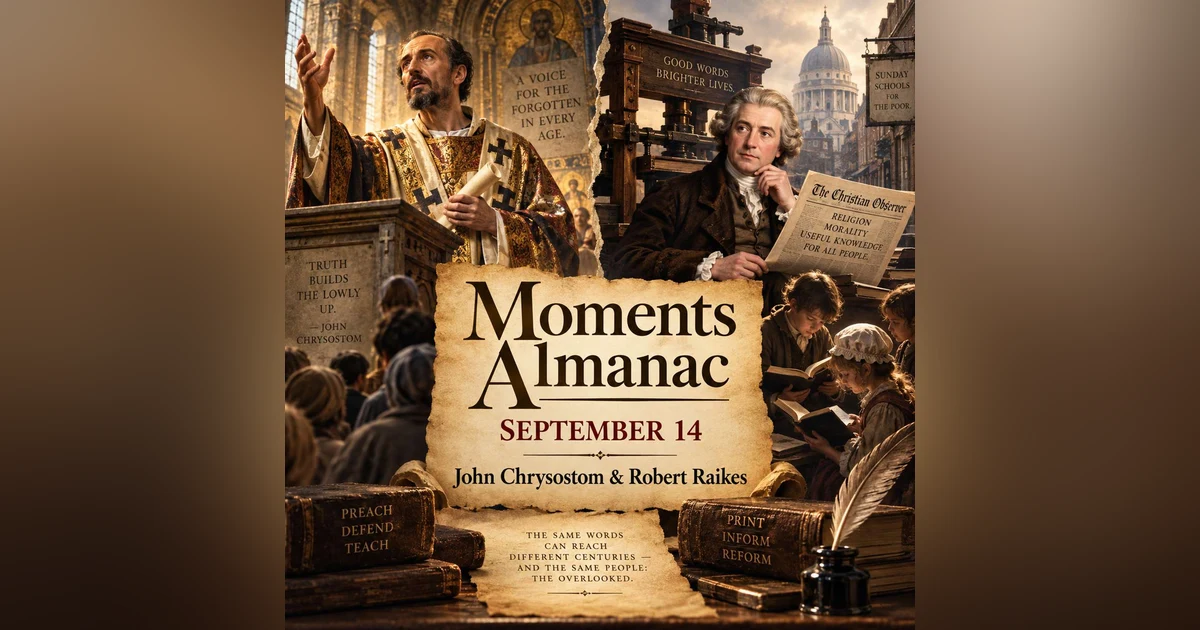
On September 14, two remarkable lives meet across more than thirteen centuries. John Chrysostom — the famed “Golden Mouth” of the early church — died in forced exile in 407 after years of preaching with unusual courage against corruption, luxury, and indifference toward the poor. His words could fill a cathedral, but they also unsettled powerful people because he refused to let the comfortable forget the suffering around them. On that same date in 1736, Robert Raikes was born in Gloucester, E...


On September 14, two remarkable lives meet across more than thirteen centuries.
John Chrysostom — the famed “Golden Mouth” of the early church — died in forced exile in 407 after years of preaching with unusual courage against corruption, luxury, and indifference toward the poor. His words could fill a cathedral, but they also unsettled powerful people because he refused to let the comfortable forget the suffering around them.
On that same date in 1736, Robert Raikes was born in Gloucester, England. A newspaper publisher with a growing concern for prisoners, poverty, and neglected children, Raikes came to believe that education and the gospel could help change the course of a child’s life before poverty and crime claimed it. His efforts helped ignite the Sunday school movement.
One man had a pulpit. The other had a printing press.
Both discovered that words are not merely something we speak — they are something we spend.
In this September 14 edition of Moments Almanac, we meet John Chrysostom and Robert Raikes, two fascinating men who chose to spend their voices on behalf of people others had overlooked.
Welcome to Moments Almanac for September 14th. And on this day in the year 407, an exhausted preacher died beside a road in what is now Turkey. He had once preached before packed churches in Constantinople. People called him Chrysostom, the golden mouth, because few people in the ancient church could use words like John Chrysostom. But beautiful words were not what got him into trouble. It was what he chose to say with them. More than thirteen centuries later, on another september fourteenth, a boy named Robert Rakes was born in Gloucester, England. He would grow up with a very different kind of platform. Chrysostom had a pulpit and rakes, well he had a printing press, and both men eventually decided that words ought to be spent on people everyone else had learned to ignore. John Chrysostom became bishop of Constantinople near the end of the fourth century. He preached to the wealthy and powerful of the empire, but he repeatedly turned their attention toward the poor. When people treated poverty as though it made a person less valuable, Chrysostom, well he answered sharply. He insisted that the wealth itself was not evil. The danger came when wealth made a person blind to the suffering lying just outside the door. That kind of preaching didn't always make him popular. Christostom criticized luxury, corruption, and abuses of power. His conflicts with church leaders and imperial courts eventually led to exile. In four hundred seven, already weakened by illness, he was ordered farther into the remote reaches of the empire and forced to travel under brutal conditions. His body finally gave out at Comena. On september fourteenth, John Christostom died in exile. Ancient accounts preserved his final words Glory be to God for all things. Now let's move forward more than thirteen hundred years, and Robert Rakes, well he inherited his father's newspaper, the Gloucester Journal, and before Sunday school ever entered the picture, Rakes was already using his newspaper to draw attention to people society preferred not to think about, the prisoners. He visited Gloucester's jail, saw the terrible conditions there, and publicly appealed for reform, eventually became convinced that simply dealing with crime after it happened was not enough. What if you reached the children before they ever reached the prison? Rakes began helping establish schools on Sunday for poor children who had little opportunity for education during the week. Many of them worked the other six days. They were taught to read and the Bible became central to their instruction. Then Rakes did something only a newspaper publisher could do. He printed the story, and the idea spread. Sunday school. Two September 14 lives. One man with a pulpit and the other with a printing press. One preached until his words cost him his home, and the other printed until his words helped give forgotten children a future. So I think within September 14th we get a question. What are your words for? Are they to impress, to win, to protect your place? Or could the words God has given you become, well, a voice for someone whose voice nobody seems to hear? You see, sometimes words are more than something we simply say. Sometimes they are something we spend. And that's the question for me and for you these days. The lives of John Christostom and Robert Rakes remind us that we must spend them well. And that's Moments Almanac for September 14th. I hope you'll join me tomorrow. Until then, take heart. Notice the scattered moments and share the grace.


