Psalm 19 | Psalms Reflections
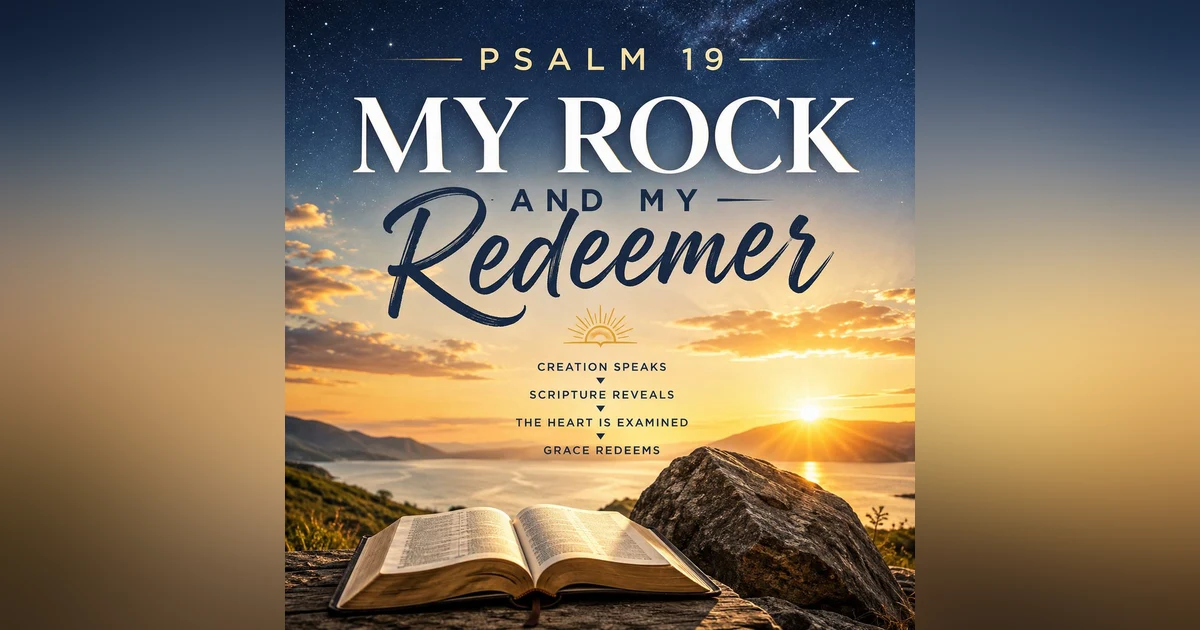

Psalm 19 — My Rock and My Redeemer Psalm 19 is one of those passages that feels like an old neighborhood. Nearly every turn reveals a familiar verse: “The heavens declare the glory of God.” “The law of the LORD is perfect.” “More to be desired are they than gold.” And finally, “Let the words of my mouth and the meditation of my heart be acceptable in your sight.” But when we put these familiar verses back together, we discover that Psalm 19 is not merely a collection of memorable sayings. It ...


Psalm 19 — My Rock and My Redeemer
Psalm 19 is one of those passages that feels like an old neighborhood. Nearly every turn reveals a familiar verse: “The heavens declare the glory of God.” “The law of the LORD is perfect.” “More to be desired are they than gold.” And finally, “Let the words of my mouth and the meditation of my heart be acceptable in your sight.”
But when we put these familiar verses back together, we discover that Psalm 19 is not merely a collection of memorable sayings. It is a journey:
Creation. Revelation. Examination. Redemption.
David begins by looking upward. The heavens are declaring the glory of their Creator without uttering a single audible word. Day and night testify that the universe is not self-explanatory; creation points beyond itself to the One who made it. As Paul later writes in Romans 1, God's invisible attributes are perceived through what He has made. Creation gives us what theologians often call general revelation—a witness available to all humanity that God exists, possesses power, and is worthy of glory.
But creation cannot tell us everything we need to know.
So David moves from the skies to the Scriptures. The God whose handiwork is revealed in creation has spoken more specifically through His Word. His instruction restores the soul, makes the simple wise, rejoices the heart, and enlightens the eyes. This is special revelation: God graciously making Himself, His character, His will, and His truth known.
Then something remarkable happens.
The light that illuminated the heavens and the light that shines through God's Word begins illuminating David himself.
“Who can discern his errors? Declare me innocent from hidden faults.”
David realizes that some sins are hidden not only from others but even from himself. God's Word does more than inform us; it exposes us. It reveals motives, desires, pride, fear, selfishness, and sins we have learned to excuse or rename. David therefore asks God not only for forgiveness but also for protection from deliberate sin gaining dominion over his life.
And that brings the psalm to its beautiful conclusion:
“O LORD, my rock and my redeemer.”
David does not finish his self-examination by promising to try harder. He finishes by looking toward his Redeemer.
That is where Psalm 19 ultimately points us. Revelation without redemption would leave sinful people exposed before a holy God. But the God who reveals our need is also the God who provides our rescue. For Christians, that hope finds its fullness in Jesus Christ—the Word made flesh, the Light of the world, and the Redeemer who brings us out of darkness and into His marvelous light.
In this episode of Scattered Moments: Psalms Reflections, we walk through Psalm 19 and follow David's gaze from the heavens, to the Scriptures, to the hidden places of the heart, and finally to the grace of God.
Creation speaks.
Scripture reveals.
The heart is examined.
Grace redeems.
And perhaps David's closing prayer can become ours:
May the words of our mouths and the meditations of our hearts be acceptable in His sight—
our Rock and our Redeemer.
Welcome to Psalms Reflections on Scattered Moments. You know, there are some passages of scripture that feel like old neighborhoods. You may not have visited them in a while, but when you return, everything seems familiar. You recognize a phrase here, a verse there, something you memorized as a child, something a Sunday school teacher taught you, something underlined in the Bible years ago. Something you've quoted so many times that you've almost forgotten where it came from. Psalm 19 feels that way to me. The heavens declare the glory of God. I know that one. The law of the Lord is perfect, refreshing the soul. I know that one too. More precious than gold, sweeter than honey. There it is. And then perhaps the most familiar of all, may the words of my mouth and the meditation of my heart be pleasing in your sight. Lord, my rock and my redeemer. But perhaps we've become so familiar with the individual lines that we missed what David was doing when he put them all together. Because Psalm 19 isn't a collection of beautiful memory verses. It's a journey. David walks by looking up, then he looks at the world, and then he looks within. Creation, revelation, examination, redemption. And so let us meditate on Psalm 19. The heavens declare the glory of God. The skies proclaim the work of his hands. Before there were pulpits, there were stars. Before there were hymnals, there were birds singing at sunrise. Before there were stained glass windows, there was a moon hanging over the darkness. Before anyone carved into stone or put ink onto parchment, creation was already preaching. It hasn't stopped. David says, day after day, creation pours forth speech. Night after night, it reveals knowledge. And then he says something that almost sounds contradictory. They have no speech. They use no words. No sound is heard from them. And yet, their voice goes out into all the earth. A sermon without words. Every sunrise says something. Every thunderstorm says something. Every mountain, every ocean, every constellation, every tiny flower pushing its way through a crack in the pavement. Bears witness to a creator. The heavens aren't God, but they point to God. Creation cannot tell us everything we need to know about him, but it can certainly tell us to look for him. David looks. And maybe that's why David's next move makes so much sense. Because the God who gives light to the world also gives light to the soul. The instruction of the Lord is perfect, renewing one's life. David moves from the heavens to scripture. Creation tells us what God is. His word tells us who God is. The heavens declare the glory of the Lord. Scriptures reveal his heart. And listen to the words David uses to describe what the word does. It renews the soul. It makes the inexperienced wise. God's word doesn't merely give us information. God's word does something to us. It awakens us. It illuminates us. David had been talking about the sun and now he talks about Scripture giving light to the eyes. There is light above him. Now there is light before him. No wonder David says God's words are more desirable than gold, even in abundance of pure gold and sweeter than honey dripping from the honeycomb. Gold can make you wealthy. Honey can satisfy your appetite, but neither one can tell you who you are. Neither one can tell you why you are here. Neither one can show you the way home. For that we need the word of God. But there's something about light. Once you turn it on, you begin to see things you didn't see before. And that's exactly what happens to David. The heavens have shown him the glory of God. The scriptures have shown him the wisdom of God, and now in that light, David begins to see himself. We move from illumination to examination. Who perceives his unintentional sins? That's quite a question. David doesn't ask God to merely forgive the sins everyone knows about. He asks, cleanse me from my hidden faults. There are things about me that everybody can see. There are things about me that only I can see. And there are things about me that even I can't see. That's unsettling because we are remarkably skilled at renaming our own sins. We call pride conviction, we call resentment, discernment, we call selfishness wisdom. We call control leadership. We call fear caution. We call jealousy concern. And sometimes we can live with something for so long that we no longer recognize what it is. So David prays, in essence, God, show me what I can't see. Take a moment and pray that prayer to him and wait. God, show me what I can't see. That's a dangerous prayer. But it's also a liberating one. Because the God who reveals our sin isn't standing over us waiting for an opportunity to condemn us. He is bringing things into the light so that they can be healed. And David continues. Do not let them rule me. Notice that phrase, rule me. Sin always wants more than a visit. It wants a throne. David knows that what begins as a tolerated thought can become a practiced behavior. And what becomes a practiced behavior can eventually become a master. So he asks God to keep him free. And then David arrives at one of the most familiar passages in all scripture. May the words of my mouth and the meditation of my heart be acceptable to you. Not just my words, my meditation, not merely what comes out of me. What happens inside me, my thoughts, my motives, my imagination, my secret conversations with myself. David wants God, who fills the heavens with his light, to shine that light all the way down into the deepest room of his heart. And that's where this psalm finally takes us. Redemption. What a beautiful word to find at the end of Psalm 19. Because after looking into the light, David doesn't conclude, I need to try harder. He doesn't say, I'll clean myself up. He doesn't promise I'll do better tomorrow. He says, my Redeemer. David needs more than revelation. He needs redemption. And so do I. Scriptures can tell me that God is holy. Examination can tell me that I am sinful. But redemption tells me that I am not without hope. God doesn't reveal our darkness merely to expose us. He brings us into the light to redeem us. And maybe that's the journey of Psalm 19. Look up. Creation is speaking. Look into the Word. God is speaking. Look within. The Spirit is revealing. And then look to your Redeemer. Because ultimately the answer to the darkness within us isn't found in trying to manufacture light. It's found in coming to the one who is light. The heavens declare his glory. The scriptures reveal his wisdom. The heart confesses its need. And through it all, our rock and redeemer is still speaking. So today, maybe David's ancient prayer can become ours. May the words of my mouth and the things that I say when everyone is listening, the things that I mutter when no one is around, and the meditation of my heart, the thoughts, motives, fears, desires, and dreams no one else can see. May they be pleasing in your sight, O Lord, my rock, and my redeemer.
unknownAmen.


