November 27 | Moments Almanac | Will
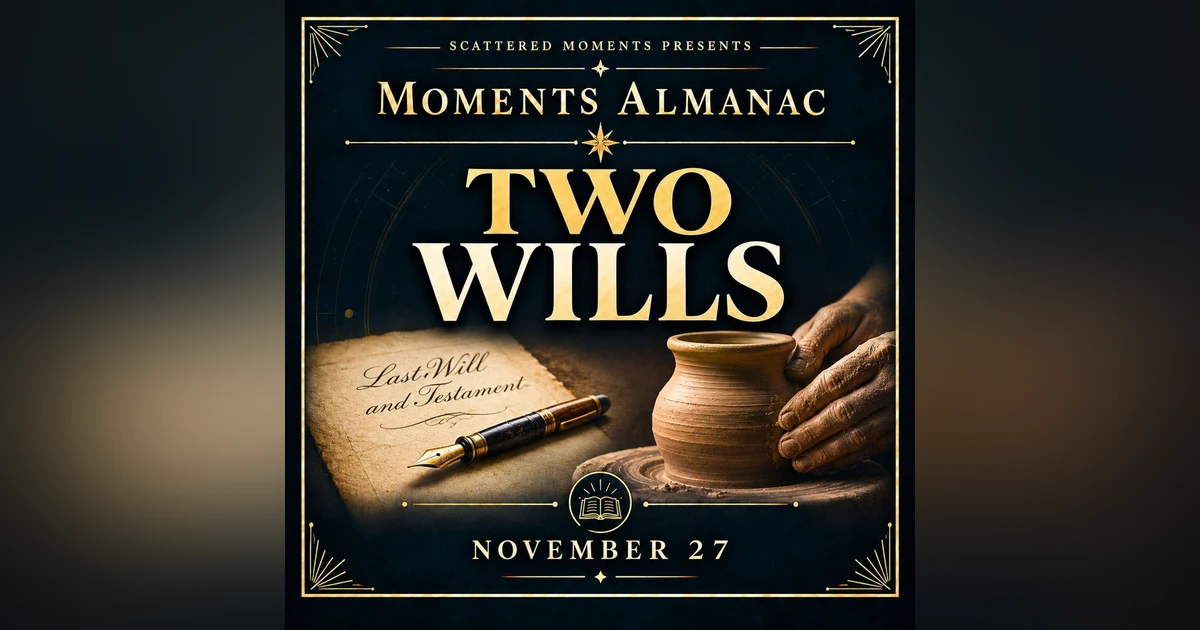

Two Wills | Moments Almanac – November 27 On November 27, 1895, Alfred Nobel signed his final will, establishing a legacy that would shape generations. Thirty-three years earlier, on that same date, Adelaide Pollard was born—a woman who would write one of the church’s most enduring hymns of surrender, “Have Thine Own Way, Lord.” One man determined the future of his fortune. One woman surrendered the future of her life. Through these two historical moments and Jeremiah’s visit to the potter’s ...


Two Wills | Moments Almanac – November 27
On November 27, 1895, Alfred Nobel signed his final will, establishing a legacy that would shape generations. Thirty-three years earlier, on that same date, Adelaide Pollard was born—a woman who would write one of the church’s most enduring hymns of surrender, “Have Thine Own Way, Lord.”
One man determined the future of his fortune. One woman surrendered the future of her life.
Through these two historical moments and Jeremiah’s visit to the potter’s house, we explore the sacred tension between our plans and God’s purposes. Sometimes the hardest thing to surrender to God is something we wanted to do for God.
For anyone whose life has taken an unexpected shape, this episode offers a gentle reminder: the Potter has not abandoned the clay. You are still in His hands.
Take heart. Notice the scattered moments. Share the grace.
Welcome to Moment's Almanac for November the 27th. There are two kinds of wills. One is a document you sign, and the other is something you surrender. On November 27, 1895, Alfred Nobel sat down at the Swedish Norwegian Club in Paris and signed his third and final will. Nobel had accumulated an enormous fortune through his inventions, including dynamite. He held hundreds of patents. He had spent much of his life discovering what could be done with the forces of nature, but now, at the age of sixty-two, he was deciding what would be done with the fruits of his life's work. He directed most of his fortune toward the establishment of prizes that would recognize those who had conferred the greatest benefit to humankind science, literature, medicine, and peace. With a stroke of the pen, he established a legacy that continues to this day. But thirty three years earlier, on that very same day, november twenty seventh, eighteen sixty two, a little girl was born in Bloomfield, Iowa. Her name was Adelaide Pollard, and she would become known for writing about an entirely different kind of will. Adelaide had a deep sense to become a missionary to Africa. She wanted to spend her life sharing the gospel, but in nineteen oh two she found herself discouraged because she was unable to raise enough money necessary to go. It was a good dream, a noble ambition, a holy desire, and yet the door remained closed. According to an account behind her song, Adelaide attended a prayer meeting where she heard an elderly woman pray a simple prayer expressing her willingness to accept whatever God wanted for her life. Something about that prayer stayed with Adelaide. She turned to the eighteenth chapter of Jeremiah where God had instructed the prophet to go down to the potter's house. Jeremiah watched as the potter worked his wheel. The vessel he was making became marred in his hands. So the potter formed it into another vessel, as seemed good to him. And then God asked a question, Can I not do with you as this potter? That evening Adelaide put her own prayer into words have thine own way, Lord, have thine own way. Thou art the potter, I am the clay. Mold me and make me after thy will. While I am waiting, yielded and still. I wonder how many times Adelaide had prayed for God to open the door to Africa before she wrote those words. And I wonder how many of us have shared a similar experience. Sometimes the hardest thing to surrender to God is something we wanted to do for God. The ministry we dreamed about, the family we imagined, the opportunity we prepared for. The prayer we thought would be answered differently. We had envisioned the shape of the vessel. We could almost see it sitting on the shelf. We knew what we wanted it to become and how we wanted it to be used, but the clay cannot see what the potter sees. And there is something tender about the scene in Jeremiah when the vessel becomes marred, the potter doesn't throw the clay away, it remains in his hands. And perhaps that's the assurance someone needs today. Your life may have taken a shape you never anticipated. The years may have brought interruptions, disappointments, and detours that you never would have written into your own story. But you are still in his hands. Alfred Nobel wrote a will that determined what would happen to his possessions after his death. Adelaide Pollard wrote a hymn about what she wanted to happen to her life when she was still living. Both left extraordinary legacies. And today, more than a century later, Nobel's name is spoken in great halls in Stockholm and Oslo. Adelaide's words, well, they're sung in country churches, whispered beside hospital beds, and prayed in the quiet places where people wrestle with the difference between what they wanted and what God has allowed. Two wills. One written with a pen and the other surrendered in prayer. And maybe, just maybe, there is something you have been holding tightly that you couldn't place in the hands of the potter today. You don't have to understand the shape he is making. You don't have to see the finished vessel. You need only to remember whose hands you are in. Have thine own way, Lord. Have thine own way. That's Moments Almanac for November the 27th. I hope you'll join me tomorrow. Until then, take heart. Notice the scattered moments and share the grace.


