July 30 | Moments Almanac | Rags
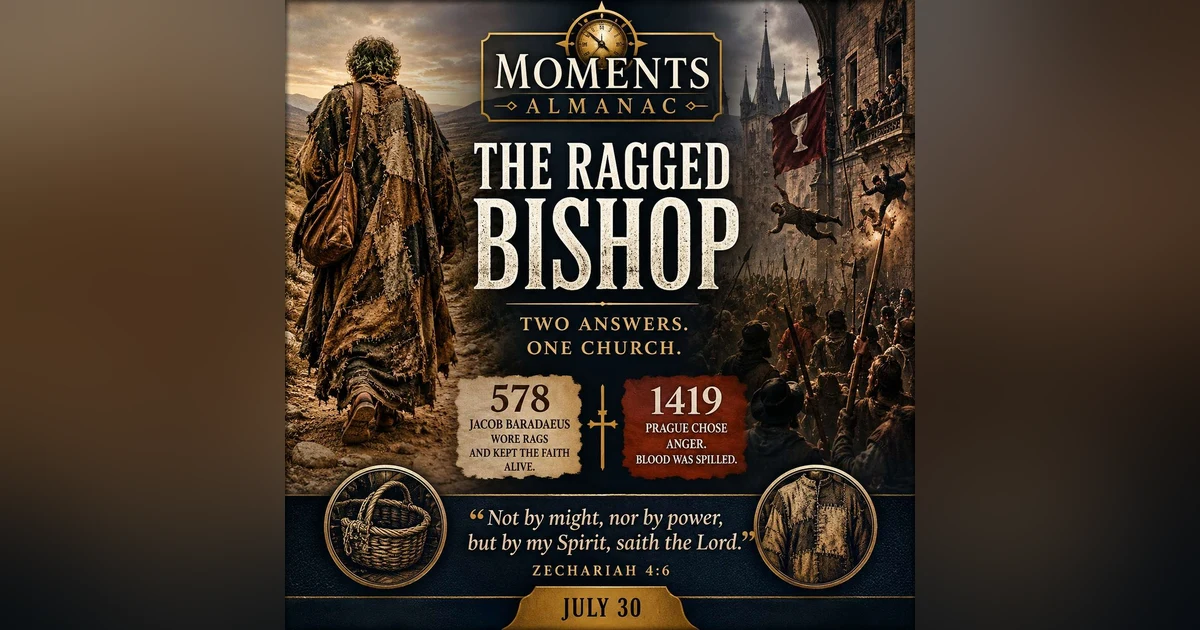
How does Christ preserve His Church when it seems determined to tear itself apart? On this July 30 edition of Moments Almanac, we journey from the dusty roads of sixth-century Syria to the turbulent streets of medieval Prague, tracing two dramatically different responses to conflict within the Christian faith. Meet Jacob Baradaeus, the "Ragged Bishop," who spent thirty-five years disguised in a patchwork robe, quietly ordaining pastors and encouraging scattered believers while an empire tried...


How does Christ preserve His Church when it seems determined to tear itself apart?
On this July 30 edition of Moments Almanac, we journey from the dusty roads of sixth-century Syria to the turbulent streets of medieval Prague, tracing two dramatically different responses to conflict within the Christian faith.
Meet Jacob Baradaeus, the "Ragged Bishop," who spent thirty-five years disguised in a patchwork robe, quietly ordaining pastors and encouraging scattered believers while an empire tried to erase his church. Then witness the tragic events of July 30, 1419, when the First Defenestration of Prague ignited decades of religious warfare following the martyrdom of Jan Hus.
Woven throughout these stories is the example of the Apostle Paul—escaping through a city wall in a basket, planting churches one faithful step at a time, and reminding Timothy that "the servant of the Lord must not quarrel, but be gentle unto all..."
This episode is a meditation on endurance, conviction, and the quiet ways God preserves His people—not by might, nor by power, but by His Spirit.
Take heart. Notice the scattered moments. Share the grace.
Welcome to Moments Almanac, a time for us to remember the people, places, and events that leave fingerprints on the soul. And today is July 30th. And on July 30th, we see two very different answers to the same enduring question. How does God preserve his church when it seems determined to tear itself apart? In the year 578, in a monastery near Gaza, a weary old bishop named Jacob died wearing the clothes of a becker. He had dressed that way for thirty-five years. Not because he had taken a vow of poverty, but because an empire wanted him dead. The Byzantine authorities had decided that the Myaphysite Christians of Syria and the East should simply disappear. Their bishops were exiled or executed, ordinations outlawed, churches emptied one by one, so Jacob did something no emperor expected. He stitched together a robe from worn out saddle blankets, the patchwork garment that earned him the nickname Baratius, which meant the ragged one, and began to walk. If his life sounds strangely familiar, it should. Christianity has seen this pattern before. The apostle Paul escaped Damascus by being lowered through a city wall in a basket. He crossed the Roman world on tired feet instead of the head of an army, appointing elders city by city, congregation by congregation. The gospel spread not by force, but by faithful people quietly carrying it to the next town. For thirty five years he slipped across Mesopotamia, Syria, Anatolia, Egypt, often disguised, ordaining priests in secret, and encouraging scattered believers whenever he found them. Ancient writers claim he ordained thousands. Modern historians debate the numbers, but no one disputes the results. One exhausted man in a patchwork robe kept an ancient church alive. Eight hundred and forty one years later, on that same calendar date, july thirtieth, another divided church reached a very different crossroad. Four years earlier, the reformer John Huss had been burned at the stake after pleading to the church to return to biblical faithfulness. His death left deep wounds across Bohemia. Hus himself never carried a sword. He preached, he wrote, and he finally died praying. But on July 30th, 1419, a procession led by the fiery priest Jan Zlivsky marched through the streets of Prague demanding justice. A stone flew from the window. In an instant, protests became a riot. The crowd stormed into New Town Hall, seized the counselors, and hurled them from the windows onto the weapons below. The violence of that afternoon became the spark that ignited the Hussite war. Both stories begin with a church wounded by conflict. Both grew from genuine convictions about truth, but they ended in remarkably different ways. One trusted endurance and the other reached for force. None of this excuses the corruption that John Hus confronted or the grief of watching a faithful preacher burned alive. Those wounds were real. Righteous anger has its place, but Scripture reminds us that even righteous anger can become something else when it outruns the Spirit. Paul, who knew imprisonment, beatings, betrayal, constant opposition, gave Timothy this remarkable counsel. The servant of the Lord must not quarrel, but must be gentle unto all men, patient, correcting his opponents with gentleness, in the hope that God may grant them repentance leading to the knowledge of the truth. Keep in mind that's not the advice of a man who never suffered. It's the testimony of someone who escaped in baskets, stood before governors, slept in prisons, and still believe that Christ builds his church one faithful life at a time. Perhaps that is the lesson Jacob Bardius leaves behind. The church has survived emperors, prisons, fires, councils, and controversies, not because Christians have always chosen wisely, but because in nearly every generation, someone quietly kept walking. Someone kept praying, someone kept teaching, kept ordaining, kept believing. The kingdom of God is rarely advanced by those who shout the loudest. More often it is carried forward by ordinary servants willing to endure a little longer, walk a little farther, and trust that Christ Himself is able to preserve his church. Sometimes the most faithful thing a believer can wear is not a crown, but a patchwork robe. And that's Moments Almanac for July the 30th. Hope you have a great day today. Hope you'll join me tomorrow. Until then, take heart. Notice the scattered moments, and share the grace.


